Apple CEO Tim Cook’s visit highlights confidence in China
Overseas investors eye nation’s stable growth, supply chains, talent: expert
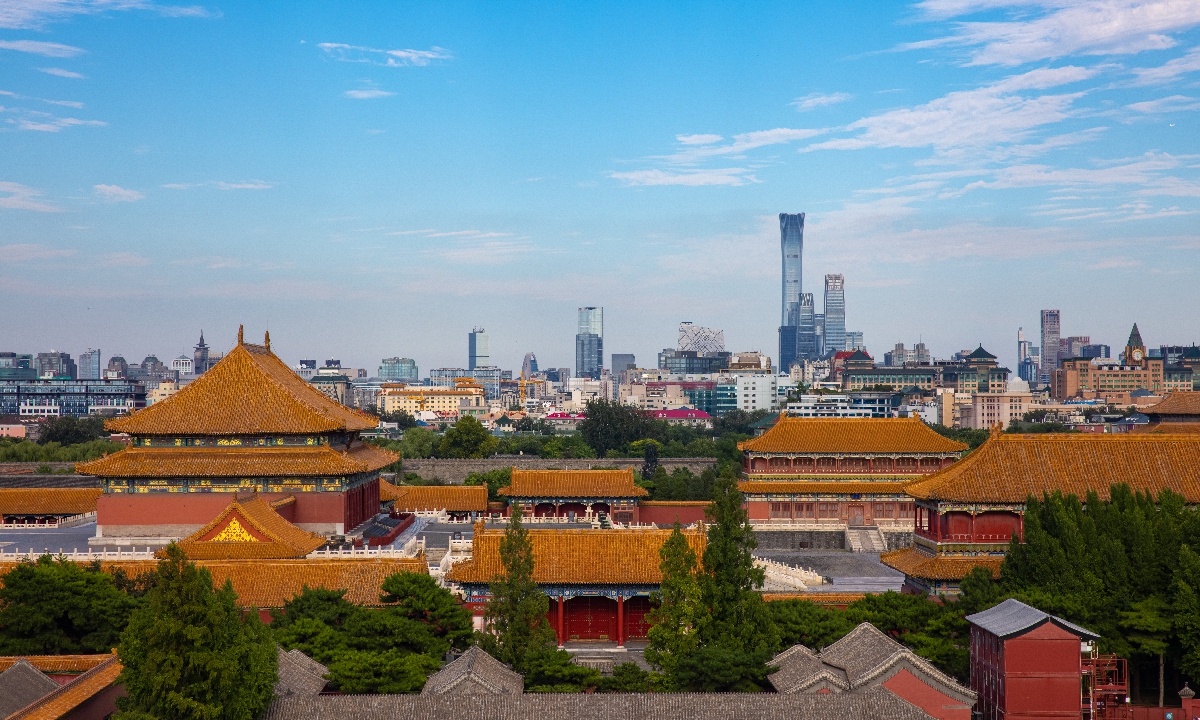
A view of the Forbidden City and the CBD area in Beijing. Photo: VCG
Chinese Minister of Commerce Wang Wentao met with Apple CEO Tim Cook in Beijing on Friday, according to a video clip released on the official WeChat account of China's Ministry of Commerce (MOFCOM).
In the meeting, Wang said he recalled that each previous discussion with Cook had been highly pragmatic, with both sides engaging in candid exchanges that proved mutually enlightening. Wang has mentioned that he enjoys his conversations with Cook.
Cook emphasized the importance of the Chinese market and local supply chains to Apple. He said Apple focuses not only on supply chains and manufacturing, but also on automating and putting as much artificial intelligence (AI) into the factories as possible.
Apple on Friday announced a new donation to the China Development Research Foundation to support youth employment and skills training in less-developed regions, according to the company's official website.
The program will collaborate with vocational institutions, industry leaders, researchers and policymakers to equip students with skills for evolving job markets.
Cook's visit came as several foreign firms have recently announced plans to expand their presence in China, as senior executives traveled to the country and held meetings with Chinese officials and business leaders, underscoring continued confidence in the market. A Chinese expert said these moves reflect the enduring appeal of China's stable business environment, vast market potential and increasingly complete industrial ecosystem, even amid global economic uncertainties.
On the same day, Wang met in Beijing with David Ricks, CEO of US pharmaceutical giant Eli Lilly. Wang said that he meets with senior executives of multinational companies during the China Development Forum each year to hear their views on the current situation, understand the problems they encounter in China and hear their suggestions.
Ricks said it was always a pleasure to return to China, to meet various friends and expand the company's business. "We had a strong year last year going a bit above the market and we have high expectations for this year … driven by our breakthrough innovations, which have been thanks to your agency's help along with many others in the government," he said to Wang.
Eli Lilly announced on March 11 that it plans to invest $3 billion over the next decade to expand its supply chain capacity in China and establish a localized production and supply system for oral solid dosage forms. This marks its second major investment in China in the past two years.
He said they now expect drug approvals in China to be completed within four weeks, noting that regulatory processes have been significantly accelerated and are increasingly aligned with global standards. He said these changes are producing "two very positive effects," including stronger foreign direct investment from companies such as Eli Lilly.
Similar moves are being seen across other foreign companies seeking to deepen their presence in China.
Li Xingqian, vice chairman of CCPIT, met with executives from The Cohen Group in Beijing on March 20 to exchange views on supporting foreign firms in China, outbound investment, supply chain cooperation and APEC-related business engagement.
In another case, Michelin (China) Investment Co recently increased its registered capital from $224 million to $319 million, a rise of about 42 percent, according to corporate registry data.
China will deepen reform of the institutional framework for promoting foreign investment this year, according to a government work report submitted on March 5 to the country's top legislature for deliberation. Greater efforts will be made to attract and utilize foreign investment in the 2026-30 period, according to a draft outline of the 15th Five-Year Plan (2026-30), the Xinhua News Agency reported.
The country will continuously optimize the foreign investment environment, improve services and support for foreign investors, and foster new strengths in attracting foreign investment, said the draft outline. It also pledged to guide foreign investment to flow more to areas such as advanced manufacturing, modern services, new and high technology, as well as energy conservation and environment protection, Xinhua reported.
Bian Yongzu, an executive deputy editor-in-chief of Modernization of Management magazine, told the Global Times that the fundamental reason foreign firms continue to scale up investment in China is that the market remains profitable and offers predictable returns, especially amid rising global uncertainties and geopolitical tensions. China's relatively stable business environment has also become a key anchor for multinational companies.
He noted that China's sustained medium-to-high economic growth and clear long-term development outlook translate into rising incomes and an expanding market, offering companies a rare window of stable demand and growth potential that is difficult to find elsewhere.
Bian added that China's comprehensive industrial ecosystem and well-established supply chains enable firms to maintain stable production and reduce costs, while the country's growing scientific research strength and deep talent pool further support innovation and long-term competitiveness.
He said that as China moves toward a more central role in global industrial chains, it is increasingly becoming an indispensable strategic base for multinational companies, with its advantages in market size and development stability remaining difficult to replace.
RELATED ARTICLES