Foreign diplomats hail Xinjiang’s role as gateway in Central Asia
Participants share on-site visit experiences of region’s prosperity and stability at event
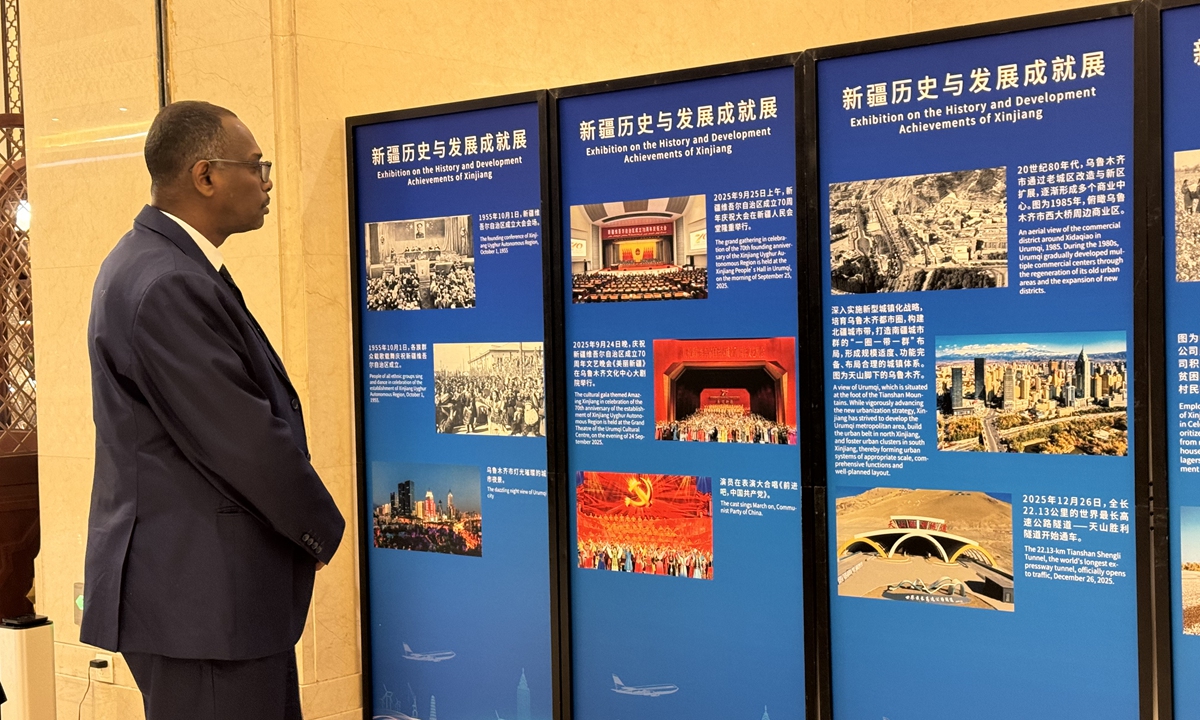
A foreign diplomat visits the "Exhibition on the history and development achievements of Xinjiang" on the sidelines of an exchange event held by Xinjiang authorities in Beijing on March 20, 2026. Photo: Li Yawei/GT
Authorities from Northwest China's Xinjiang Uygur Autonomous Region held an event in Beijing on Friday, presenting the region's economic and social progress as well as achievements in human rights protection. Over 70 diplomats, including multiple ambassadors and envoys, along with representatives from three international organizations, exchanged their views on Xinjiang's pivotal role as a gate way in Central Asia at the event.
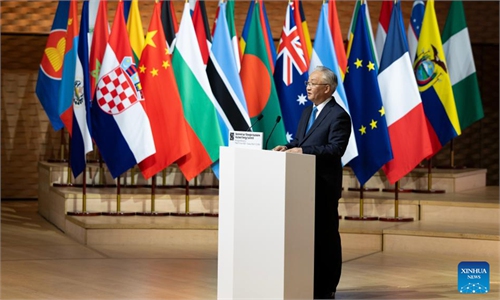
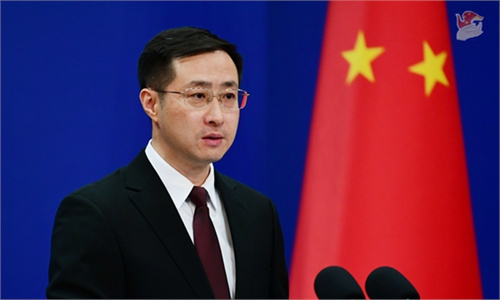
Chinese Assistant Minister of Foreign Affairs Hong Lei and secretary of the Xinjiang Uygur Autonomous Regional Committee of the Communist Party of China, Chen Xiaojiang, attended the event and delivered speeches.
During his speech, Hong said the Chinese government remains committed to taking social stability and long-term peace and security as the overarching goal of Xinjiang's work, and has brought about a historic transition in Xinjiang's overall social situation from turmoil to stability, and from stability to effective governance.
Hong said through law-based counter-terrorism and de-radicalization efforts, Xinjiang region has not seen a single violent or terrorist case for more than nine consecutive years. The sense of security and satisfaction among people of all ethnic groups have stayed above 99 percent for years running.
In terms of the region's achievements in economic development, livelihood improvement, and human rights developments, Chen said in 2025, Xinjiang's regional gross domestic product (GDP) reached 2.15 trillion yuan ($312 billion), with a growth rate of 5.5 percent, and its major economic indicators ranked among the top in China.
He also elaborated on the development of a modern industrial system with distinctive local strengths in the speech.
Cotton output hit 6.165 million tons, accounting for 92.8 percent of the national total, Chen said, adding that the entire textile and apparel industry chain has created more than one million jobs.
Chen's introduction to the employment boost driven by the development of Xinjiang's cotton industry has drawn the attention of foreign media reporters at the event.
The Xinjiang cotton industry has long been used by some Western media as one of the excuses to fabricate claims of so-called "forced labor." Yet in the eyes of Bruno Falci, correspondent of Latin American news outlet teleSUR, such allegations collapse in the face of concrete facts and figures.
Bruno told the Global Times at the event that certain foreign media have used the cotton industry as a tool for defamation against the region, often turning a blind eye to its tangible role in generating employment.
Some Western media have attempted to distort China's exemplary achievements in social development and misrepresent the nature of genuine democracy through such disinformation campaigns, Bruno added.
Sohail Khan, deputy secretary general of the Shanghai Cooperation Organization (SCO), praised Xinjiang's achievements in maintaining social stability. Khan noted Xinjiang's experience in safeguarding social stability and taking economic development as the foundation for security serves as a valuable key reference for the SCO in implementing the SCO Development Strategy 2035.
Some ambassadors from Central Asian countries also lauded the economic benefits of Xinjiang's role as a gateway at the event.
Nuryshev Shakhrat, ambassador of Kazakhstan to China, said during his speech that for Kazakhstan, Xinjiang is not only a neighboring region but also their primary economic partner in China, serving as a vital transit hub connecting Asian and European markets.
He said in 2025, trade between Kazakhstan and China reached $48.7 billion—an 11 percent increase.
Belarusian Ambassador to China Charviakou Aliaksandr highly appreciated the significance of the direct Urumqi-Minsk flight route, describing it as a crucial step in fostering business, tourism, and people-to-people exchanges, thereby creating more conditions for expanding direct ties between regions and enterprises.
Turkish Ambassador to China, Selcuk Unal, shared his observations and impressions from his trip to Xinjiang. "During my visits to Urumqi and Kashi, I witnessed firsthand the solid measures taken by the local government to advance development across various fields in Xinjiang," he said in his speech.
"Today marks the Spring Equinox in China, and tomorrow coincides with Eid al-Fitr, a moment of renew, unity and gratitude, and this is what Xinjiang looks like under the leadership of the Chinese government," Martin MPANA, Cameroon Ambassador to China, said during the event.
RELATED ARTICLES