China contributes around 30 percent to global economic growth, and that share is likely to rise: scholar Zheng Yongnian tells GT
By and Tao Mingyang Published: Mar 22, 2026 01:55 PM

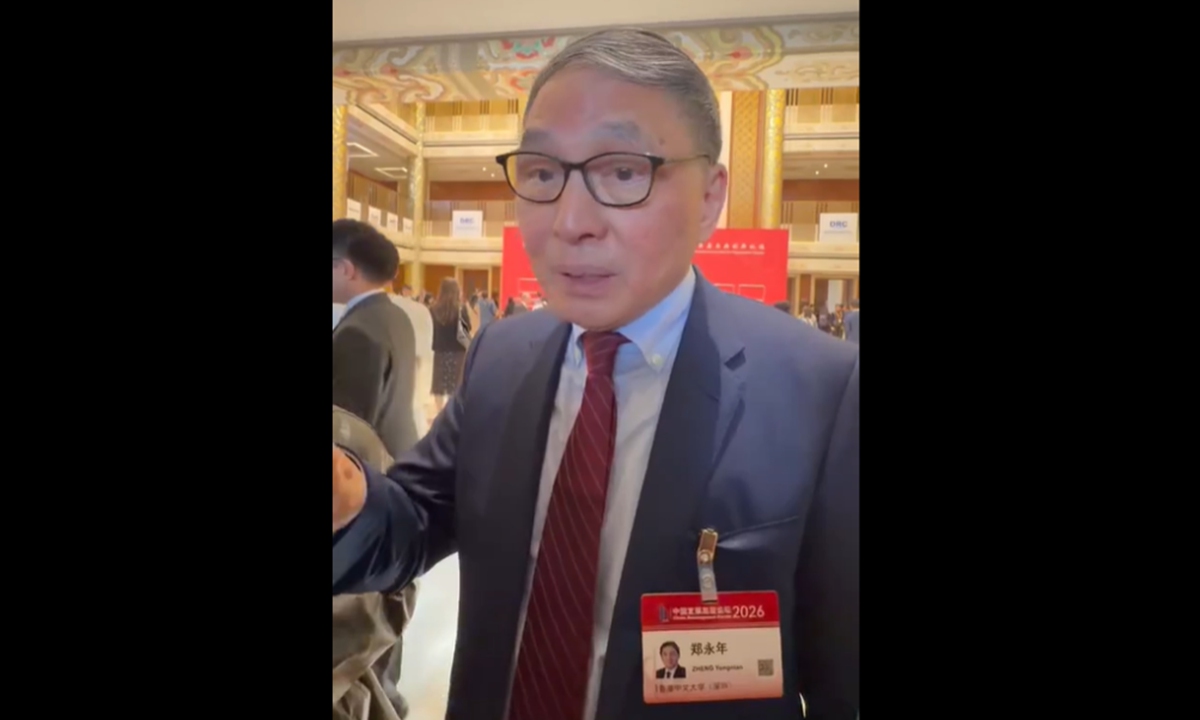
Chinese scholar Zheng Yongnian speaks with the Global Times on the sidelines of 2026 China Development Forum which takes place from March 22 to 23, 2026, in Beijing. Photo: Chen Qingqing/GT
China has contributed about 30 percent to global economic growth on average so far, and that share is likely to rise, Zheng Yongnian, dean of the School of Public Policy at the Chinese University of Hong Kong, told the Global Times on Sunday on the sidelines of the China Development Forum 2026 (CDF), held in Beijing on Sunday and Monday.
Asked what key message the forum sends to the world, Zheng offered a succinct assessment: while the world is marked by uncertainty, China is becoming increasingly certain.
"We use China's certainty to cope with global uncertainty. That is why people - not only entrepreneurs - are coming to China," Zheng said. He noted that recent visits to China by leaders from Europe and Canada reflect the same logic, as development requires a stable and predictable environment.
Speaking on China's 15th Five-Year Plan (2026-30), Zheng said that the plan itself represents a source of certainty, not only for China's domestic development, but also for the global economy. While some have pointed out that the GDP growth target under the plan ranges between 4.5 percent and 5 percent, he emphasized that after China joined the World Trade Organization, the country contributed more than 50 percent to global economic growth for several years. Even now, China has contributed about 30 percent to global economic growth on average so far, and that the share is likely to rise, even if calculated based on a relatively modest GDP growth target of 4.5 percent.
"Look around the world - there are few places that can be described as truly stable. People struggle to identify where stability comes from," Zheng said.
Zheng added that five-year plans are inherently long-term and strategic in nature. They serve not only as directional guidance but also outline concrete policy tools and measures. "Many large companies look at what China prioritizes and align themselves with the country's five-year plans," he said.
He also stressed the importance of aligning international capital with national development strategies. As China advances initiatives such as the Belt and Road Initiative and promotes the globalization of its enterprises, Chinese capital going abroad should work in coordination with the development plans and priorities of host countries.
The annual CDF is held under the theme "China in its 15th Five-Year Plan Period: Advancing High-Quality Development and Creating New Opportunities Together."
More than 100 representatives from major international organizations, global multinational corporations, and leading research institutions, along with internationally renowned scholars, will gather at the forum, according to the forum's organizer.
RELATED ARTICLES