Iran says it hit an F-35; Chinese expert analyzes how Iran could have struck it using infrared detection, breaking US stealth myth
By Liang Rui and Published: Mar 22, 2026 04:31 PM

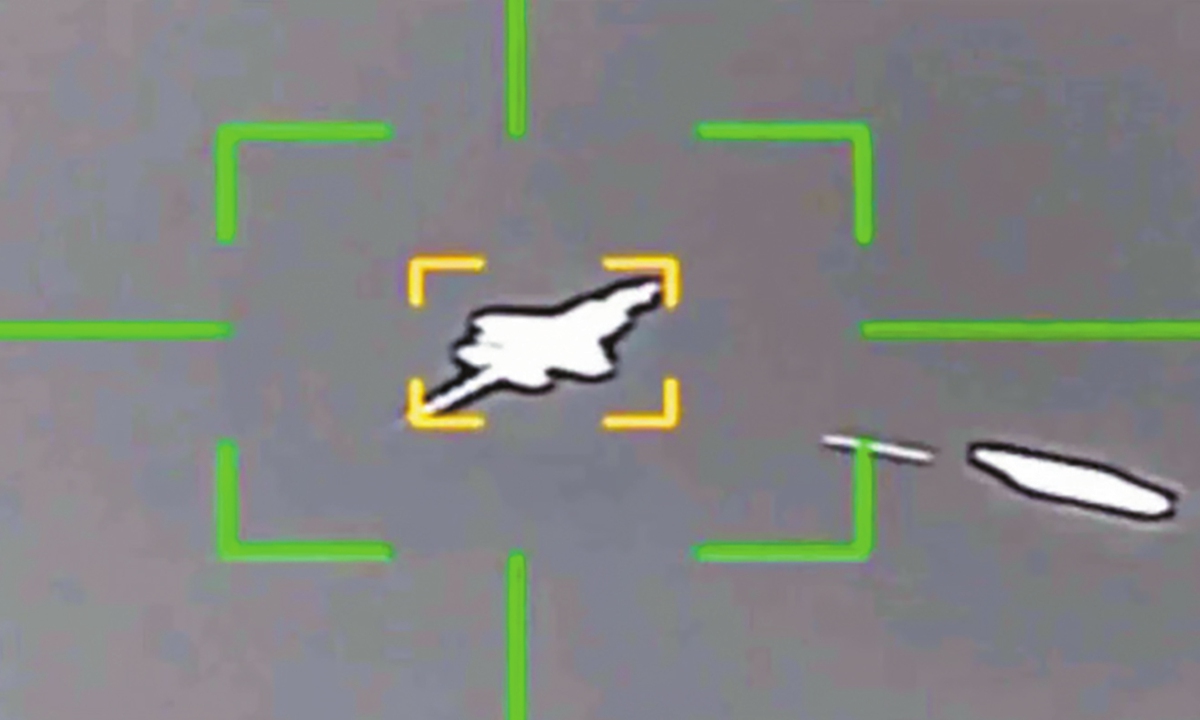
Photo: Screenshot from a video released by Iran's Islamic Republic News Agency on X purporting to show an F-35 being targeted and struck by an Iranian air defense system.
A reported Iranian strike that damaged a US F-35 fighter jet continues to draw widespread online attention. The Iran side said it caused the damage, but the US side has not confirmed whether the jet was hit, claiming that the aircraft was on a combat mission against Iran when it made an emergency landing. A Chinese military affairs expert told the Global Times that if confirmed, the incident could be significant in the evolution of stealth warfare. Since the 1999 downing of a US F-117 by Yugoslav forces, it would mark another case in which a highly regarded stealth aircraft was struck in a setting where US forces were believed to have air superiority — a challenge to the notion of "invulnerability."
A US F-35 fighter jet made an emergency landing at US air base in the Middle East after it was struck by what is believed to be Iranian fire, two sources familiar with the matter claimed, according to a CNN report on Friday.
Tim Hawkins, a spokesperson for US Central Command, said that the fifth-generation stealth jet was "flying a combat mission over Iran" when it was forced to make an emergency landing. Hawkins claimed the aircraft landed safely and the incident is under investigation, according to the CNN.
Both the US and Israel are flying F-35s in the US-Israel-Iran conflict; the aircraft costs upwards of $100 million, the CNN said.
Iran's Islamic Republic News Agency posted a video on the social media platform X on the same day purporting to show an F-35 being targeted and struck by an Iranian air defense system.
The footage showed that the F-35 was detected within the field of view of an infrared sensor on the Iranian side.
Wang Yanan, editor-in-chief of Beijing-based Aerospace Knowledge magazine, told the Global Times on Sunday that under sustained airstrikes, Iran could have difficulty deploying large early-warning radars, which are bulky, less mobile, and highly vulnerable to detection and suppression. He noted that stealth aircraft such as the F-35 are designed to avoid radar detection, so Iran may instead have relied more on dispersed and mobile non-radar detection methods, particularly infrared search capabilities, possibly forming a low- to medium-altitude infrared surveillance network.
Infrared detection is relatively effective at lower altitudes, Wang said. Although its range is limited and insufficient for long-distance detection, it can be paired with short-range air defense systems, such as man-portable or vehicle-mounted infrared-guided missiles. These systems are characterized by high mobility and concealment, typically employing a "detect, fire, and relocate" tactic.
The Chinese expert noted that while the F-35 has clear advantages in radar stealth, its infrared signature can be reduced, but not eliminated. In cooler ambient conditions, the heat from its engine remains detectable. In such cases, if Iran has even a basic infrared detection capability, it could still identify and engage the aircraft.
Before the incident, US Defense Secretary Pete Hegseth claimed that Iran's air defenses had been "flattened" in a Pentagon briefing Thursday morning and promised that the day would be "the largest strike package yet," reported the The Jerusalem Post on Thursday.
Wang said that if US forces assessed they had achieved air superiority, aircraft might have operated at lower altitudes during strike missions to improve effectiveness. However, that would also place them within the engagement envelope of short-range air defense systems. Based on publicly available footage, if authentic, the engagement likely occurred at relatively close range — possibly within several to roughly a dozen kilometers. At such distances, once an infrared-guided missile had locked on, the aircraft would have had limited room for evasion.
The expert added that if multiple missiles had been fired in salvo, the probability of a successful hit would have increased significantly, potentially preventing the aircraft from escaping.
Wang further noted that the incident is significant in the evolution of stealth warfare.
Since the 1999 downing of a US F-117 by Yugoslav forces, it marks another case in which a stealth aircraft, widely regarded as technologically superior, was struck in an environment where the opponent was believed to pose little air threat, thereby challenging the notion of "stealth invulnerability," he said.
The incident may have stemmed in part from US overconfidence, while also potentially producing the opposite effect in subsequent operations, Wang said.
Infrared-guided missiles are typically associated with short-range air defense systems and lack wide-area coverage, so their impact on overall air superiority and the broader battlefield over Iran is limited. However, they can raise operational costs for US forces and prompt more cautious use of stealth aircraft, for example, stricter constraints on flight altitude, sortie timing, and operational airspace, increasing the burden on US and Israeli operations, the expert added.
RELATED ARTICLES