ARTS / CULTURE & LEISURE
Bittersweet, salty life: Liu Zhenyun, China’s first Nord-Sud Prize winner, unpacks life’s poignant jokes in his new novel
Bittersweet, salty life
By Published: Mar 22, 2026 11:16 PM


Liu Zhenyun speaks at a book-sharing session for his new book Salty Jokes in Beijing on December 27, 2025. Photos: VCG
Before winning Italy's prestigious Premio Internazionale Nord-Sud prize, Chinese author Liu Zhenyun had just returned to the spotlight with his long-awaited new novel Salty Jokes, a darkly humorous tale full of ordinary life's bittersweet twists.As his new book finds readers across the globe, the award-winning Chinese novelist talks about humor, hardship and the "salty jokes" that make life worth living.
"The copyrights for overseas editions have been confirmed for multiple languages, but all are still being translated," Xu Zitong, an editor from the People's Literature Publishing House told the Global Times.
"On different streets across the world, everyone walking those streets carries scars within them. You've all been through so much," Liu wrote in the book. The upturned curve of a smile on the cover seems to offer a warm embrace to weary, wandering souls.
Liu, one of China's most celebrated contemporary novelists, has spent four years away from the long-form genre.
On February 20, he became the first Chinese novelist to receive Italy's Premio Internazionale Nord-Sud, an influential Italian literary award known for its international perspective and its emphasis on both literary merit and social significance, joining a roster that includes Nobel laureates Elias Canetti, Peter Handke and Maryse Conde. The jury praised the "unique philosophical insight and humor" in his work, qualities on full display in his new book, Salty Jokes.
New kind of storyteller
Liu presents Salty Jokes, a satirical yet touching depiction of ordinary people's struggles and resilience, continuing his lifelong focus on "writing about all living beings."
The protagonist, Du Taibai, whose name playfully combines the two great Tang Dynasty (618-907) poets Li Bai and Du Fu, is a failed intellectual who cycles through jobs, including middle school teacher, master of ceremonies for weddings and funerals and a street vendor.
Du was once a middle school teacher, but was fired after getting drunk and fighting with the principal. He has become, in his own words, "a Kong Yiji who has taken off his long gown," a reference to a scholar reduced to poverty from a work by Chinese writer Lu Xun.
His family life crumbles too. His wife constantly quarrels with him, his son elopes with a married teacher, and his daughter enters a same-sex relationship. Through it all, Du stumbles through relationships and careers, from hosting weddings to selling radishes, only to face more betrayal and slander.
"Many jokes in the world are destined to be finished with tears," Liu wrote, a line that encapsulates the novel's core.
"There are plenty of jokes in life… But a joke is different from a laugh. A laugh is individual. A joke is the relationship between the individual and the public. Laugh too much, and it turns salty," Liu said.
The book has strongly resonated with many Chinese readers. One reader wrote that many things in life are not to be solved, but to be endured; if you can't bear them, you go through them slowly, and getting through them is a lifetime. Life is salty with sweat and tears, and the world is also salty, filled with gossip that can be intimidating.
Unlike formulaic stories with clear beginnings and endings, the novel takes a playful, unexpected turn. It unfolds in sections labeled "Main Text" and "Side Note." It is through these digressions where the real story lives.
"What seems like a side note is actually the main text... That's how life works," Liu said.
He noted that a writer's greatest fear is repeating themselves.
"Repeat a few times, and your creativity is gone." Salty Jokes is a departure, a novel that finds new directions in old soil. "It asks what happens when the jokes life plays on us stop being funny, and whether, in the salt of our own tears, we might taste something worth holding onto."
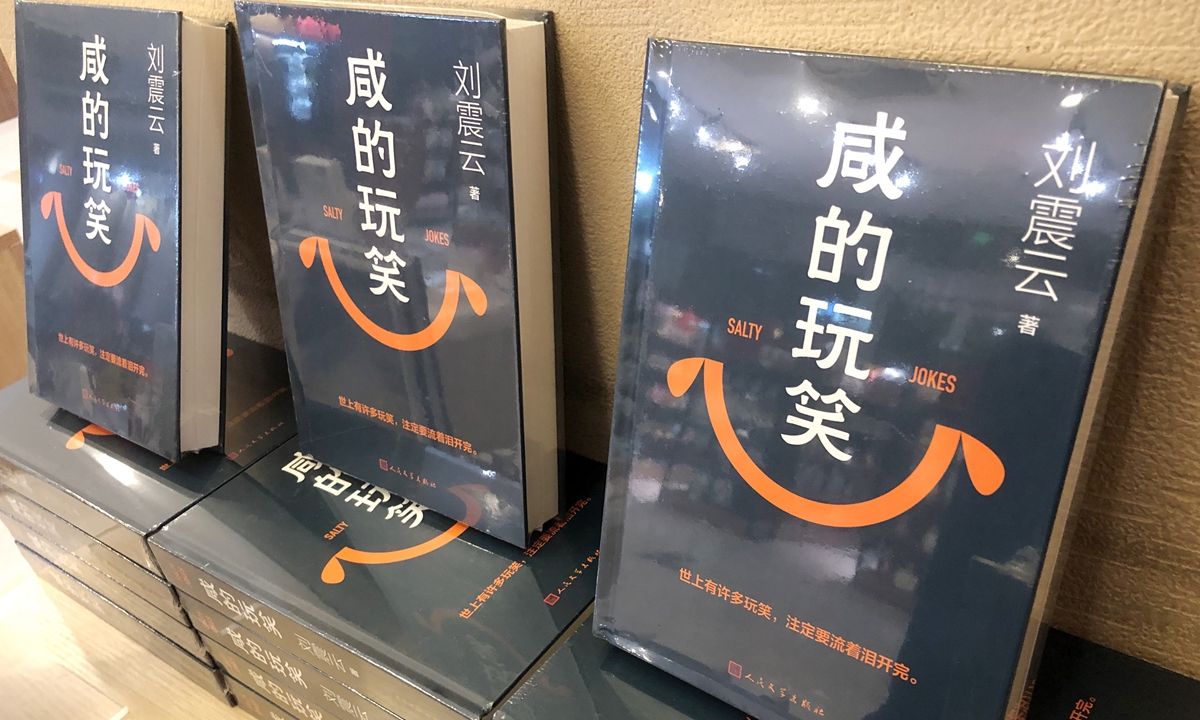
Salty Jokes on display at a bookstore in Changzhou, East China's Jiangsu Province, on January 5, 2026
Microcosm of the Chinese spiritOver two decades, Liu has built what critics call his "Yanjin universe" with novels such as One Sentence Worth Ten Thousand and One Day Three Autumns. Yanjin, a small county in Central China's Henan Province, is his real hometown and his fictional anchor, a place where ghosts speak, animals possess wisdom, and ordinary people carry the weight of existence in quiet, desperate dignity.
In Salty Jokes, Yanjin is home to a cast of colorful characters, including a barber, an opera singer, a masseuse, a steamed bun shop owner, each with their own small joys and sorrows. They are the unnoticed millions who populate China's small towns.
Liu's greatest achievement is uncovering what he calls "sparkles" in life, small, overlooked details that give meaning to existence.
For instance, Du names children after cities he might never visit - his son Ba Li (Paris), his daughter Niu Yue (New York), and his nephew Lun Dun (London) - in an attempt to bring these cites to his doorstep through the sheer audacity of naming.
A tailor in the book becomes obsessed with the Terracotta Warriors, not out of historical curiosity, but because he wants to understand how the Emperor Qinshihuang, China's first emperor, lived and how he died.
These obsessions are Liu's so-called "sparkles," small, seemingly irrational fixations that, in the author's words, "become the support for a way of life."
"Without that spark, the tailor is just a tailor," Liu said.
"But with it, the meaning of his life immediately emerges."
As overseas translations progress, global readers will soon get to taste the "salt" of life through Du's story, which is not just about one man, but about all of us, struggling, laughing, crying, and finding the courage to keep going.
After all, as Liu reminds us, the only way to untangle life's knots is to "turn complexity back to simplicity."
RELATED ARTICLES