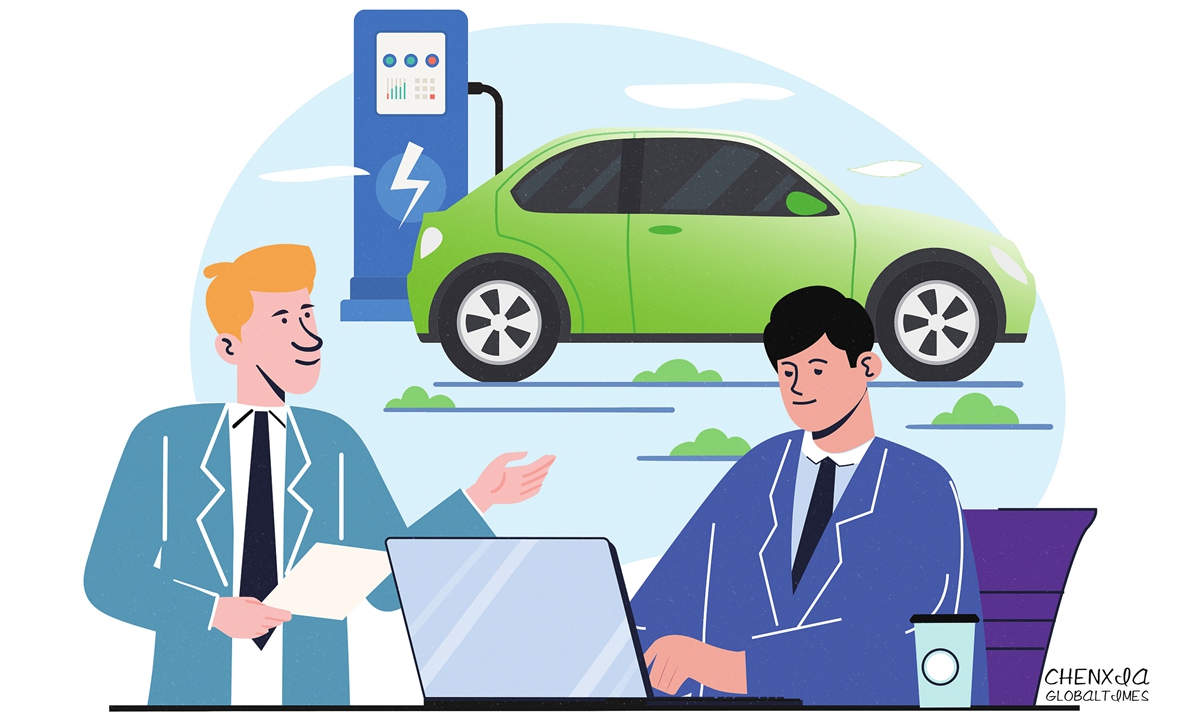
Illustration: Chen Xia/GT
In a remarkably candid admission, Oliver Blume, the chief executive of Volkswagen, recently suggested that Germany's storied automotive industry could learn a great deal from China's disciplined industrial planning as Volkswagen undergoes deep restructuring to stay competitive, according to Reuters.
This pragmatic observation is anchored in unassailable data about China's electric vehicle (EV) industry. For instance, as of February 2026, China's network of EV charging stations has surpassed a staggering 21 million units, a nearly 48 percent increase from the previous year.
Simultaneously, a historic watershed has emerged in China-EU auto trade. Over the past year, EU automotive exports to China plummeted by 34 percent to 16 billion euros ($18.5 billion), while EU imports of comparable Chinese products rose by 8 percent to 22 billion euros, according to Yahoo Finance.
This unprecedented reversal in the automotive trade balance signifies more than just shifting industrial cycles; it indicates that the China-Europe relationship is quietly entering a new phase that demands profound strategic wisdom - an era of mutual learning.
For years, the EU has wavered, struggling to define its posture toward China while awkwardly juggling the labels of "partner, economic competitor and systemic rival." Amid escalating trade frictions, proposing a framework of "mutual learning" demonstrates piercing foresight. It strips away the fog of emotional antagonism and returns to the objective realities of economic development.
Europe, whose automotive industry was once the ultimate sanctuary of its technical supremacy and brand premium, is now watching China overtake it on the curve, propelled by new energy and smart technologies. This paradigm shift proves that the era of one-way technology transfer and industrial condescension is over.
In its place, a new dynamic of two-way scrutiny and borrowing, grounded in genuine parity, is taking hold.
China's success stems from four decades of learning from developed economies like Europe. Absorbing technology, governance and management practices fueled growth. Even now, business leaders like Huawei's Ren Zhengfei stress the need for continued learning from Western science and management. An open, inquisitive approach ensures long-term prosperity.
China's growth, driven by innovation and strong supply chains, has made it a leader in battery tech, smart vehicles, autonomous driving and infrastructure, beyond just being a huge market.
Blume's remarks show Europe's industry leaders recognize the shift. China's efficient supply chains and policies have become key examples. Many EU industry voices see adapting to China's success, not isolation, as vital for renewed competitiveness.
To be sure, industrial and technological competition between China and Europe is an inescapable reality. As China transitions from a fast-following manufacturer of low-end goods to a formidable challenger with comprehensive capabilities in core industrial sectors, it inevitably comes into competition with the vital economic interests of developed nations. The ensuing industrial anxiety and defensive posture in the West - manifested in recent anti-subsidy probes and steep tariff walls - are understandable reactions to this new reality.
Yet, we must clarify the true nature of this competition. The goal must be to catalyze mutual advancement, not to force an opponent into a corner or compel them to retreat to the starting line. Sustainable economic progress requires competing while evolving, and learning while competing.
Achieving this constructive dynamic will require a profound psychological reckoning within the EU. For the better part of a century, Europe has comfortably played the pedagogical role in global industry and technology, accustomed to unilaterally dictating standards. Now, faced with formidable competition, swallowing one's pride to learn from the emerging competitor is undeniably difficult.
However, true confidence is not found in an insistence on perpetual supremacy, but in the capacity to embrace advanced productive forces wherever they emerge. Acknowledging the strengths of others and assimilating their expertise has always been the fundamental code of progress for European - and indeed, human - industrial civilization.
Conversely, reaching new heights brings new perils. Having scaled the summit of the global automotive industry, China now faces a landscape characterized by stronger headwinds and thinner air.
As it enters a new phase of exporting manufacturing capacity, technology and localized brands, China still has much to learn from Europe. It must master the art of navigating geopolitical fault lines, constructing complex frameworks for global compliance, deeply integrating into foreign markets and shouldering broader social responsibilities.
Old balances are broken; a new one is needed fast. As industry shifts globally, China-Europe ties shouldn't be defined by clashes but by equal dialogue, learning and mutual gain.
RELATED ARTICLES