Images and videos of Japanese PM at White House spark criticism; Takaichi’s gestures reflect entrenched pro-US dependency mindset: experts
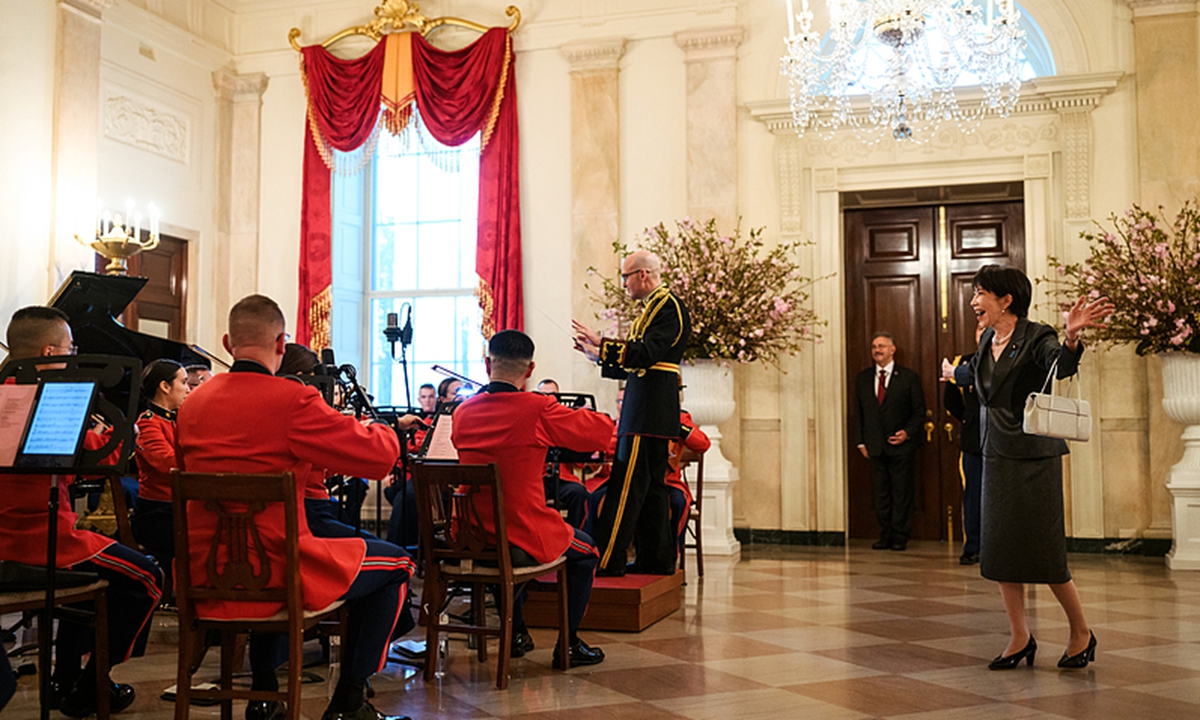
Japanese Prime Minister Sanae Takaichi sings and dances before dinner with President Donald J. Trump in the State Dining Room of the White House, Thursday, March 19, 2026. Photo: VCG
After Japanese Prime Minister Sanae Takaichi concluded her three-day visit to the US, videos and images released by both Japan and the White House showing her gestures and expressions during the visit have sparked some domestic criticisms. Chinese experts said the gestures reflect an entrenched dependency mindset of Japan toward the US, aimed at seeking Washington's support amid mounting pressure over security issues, including US calls for escort operations in the Strait of Hormuz.
The official X account of Japan's Prime Minister's Office on Friday posted a video titled "Scenes from the Japan-US leaders' dinner," showing Takaichi moving along with a live band in a relatively casual manner. Photos released by the White House also captured her gestures, including raising both hands. A Japanese media outlet portrayed Takaichi as relying on "charm," but her behavior drew criticism from some Japanese netizens.
Japanese media reported that netizens' reactions on X questioned Takaichi's behavior. Some described the sudden embrace as "embarrassing" and questioned whether she was "overly deferential" or "curry favor" toward US President, according to ABEMA Prime.
Sayo Saruta, head of the New Diplomacy Initiative and a lawyer, said that while hugging itself is not unusual in the US, she questioned the way it was presented. She said that Takaichi's posture, distance and overall demeanor, including what she described as an overly lively manner at the event, could be perceived by some as "curry favor," adding that as the leader of a country, she should present herself in a more composed and dignified manner, in a discussion on ABEMA Prime.
Japanese media appeared to have paid more attention on external reactions to Takaichi's visit. According to The Asahi Shimbun, global responses to the Japan-US summit were mixed.
The New York Times, cited by The Asahi Shimbun, commented that Takaichi relied on "charm" in her dealings with Trump, referring to her remark that "I firmly believe it is only you, Donald, who can achieve peace across the world."
Meanwhile, France's Le Monde, also cited by The Asahi Shimbun, described her approach as "flattery," noting that she skillfully used such tactics to express support for US actions.
British media, according to The Asahi Shimbun, also focused on Trump's reference to the Pearl Harbor attack. The Telegraph said she looked "visibly uncomfortable."
Under the video footage posted by the Prime Minister's Office of Japan's X account, one netizen commented: "Have the voices of worldwide strong disapproval and ridicule not reached the PM's Office? I wonder if they are wearing earplugs. As a Japanese person, I feel ashamed."
Another netizen @Its_ereko said: "This is how they present Japan's leader. This is how they want the world to see her," citing criticism from another commenter who said that "as a Japanese person, it is 'truly upsetting'" when referring to the White House's decision to place the image at the top of its website gallery.
Lü Chao, a professor at the Liaoning Academy of Social Sciences, told the Global Times on Sunday that Takaichi's behavior was most likely deliberate, aimed at signaling strong alignment with the US by exaggerating her personal relationship with Trump and acting more casually and informally in a diplomatic setting, while seeking Washington's support for Japan's security agenda, including further loosening military constraints and advancing constitutional revision.
Takaichi's approach was also driven by a desire to ensure the success of her US visit by trying to align closely with US President and appealing to his preferences, particularly as Japan faces pressure after being directly named by Trump over escort operations in the Strait of Hormuz, Xiang Haoyu, a distinguished research fellow at the China Institute of International Studies, told the Global Times on Sunday.
It was aimed at securing tangible diplomatic outcomes that could be used domestically to bolster her political standing. At a deeper level, Xiang said that such behavior reflects a deep-rooted mindset in Japan of reliance on the US, particularly among conservative forces, even as this approach appears increasingly out of step with broader international views.
According to the Prime Minister's Office of Japan's X account, Takaichi also visited Arlington National Cemetery near Washington on Friday morning and laid flowers. However, the cemetery also honors US service members who fought against Japan during World War II.
Ironically, the cemetery is also the resting place of William S. Parsons, previously a weaponeer on the Enola Gay, the aircraft that dropped the atomic bomb "Little Boy" on Hiroshima, Japan, in 1945, according to the Arlington National Cemetery's website.
Another netizen, @ax3t0, said, "Did Takaichi talk to Trump about the victims of the atomic bombings in Hiroshima and Nagasaki? Surely she didn't?"
Her visit to the Arlington National Cemetery came just a day after her reaction was described by some media as uneasy and embarrassing, when US President Donald Trump, sitting beside her in the Oval Office on Thursday local time, referred to Japan's 1941 Pearl Harbor attack in reply to a question from a Japanese reporter about why Washington did not notify allies such as Japan before striking Iran.
Takaichi's visit to Arlington was not an act of reflection on the war, but rather a gesture still aimed at signaling loyalty to the US, Lü said, adding that this reflects a selective historical perception in Japan, where wartime memory is handled differently depending on the counterpart, and that such behavior ultimately serves to seek US recognition and support by aligning with its preferences.
RELATED ARTICLES