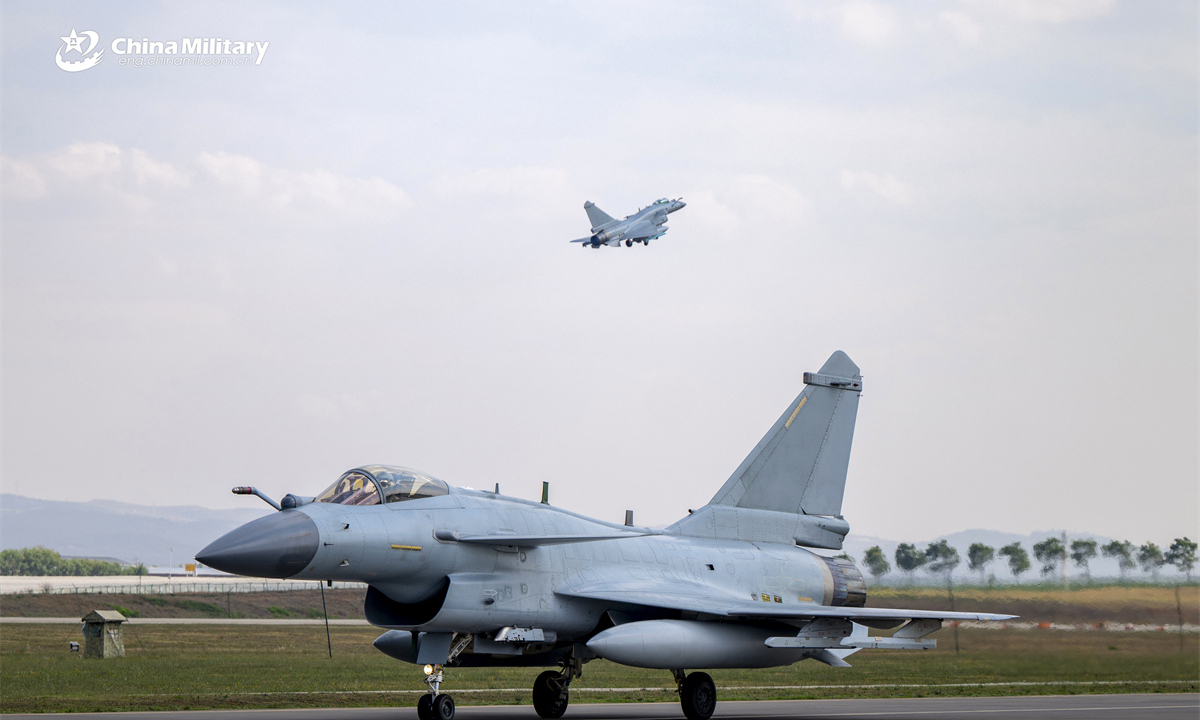
J-10 fighter jets attached to an aviation brigade of the air force under the Chinese PLA Southern Theater Command take off in succession during a day-and-night flight training exercise. (eng.chinamil.com.cn/Photo by Shang Jieyan)
As Monday marked the 28th anniversary of the maiden flight of Chinese People's Liberation Army (PLA) Air Force's J-10 fighter jet, CCTV News reported on Monday that multiple units have in recent days conducted high-intensity drills with J-10C fighter jets under complex electromagnetic conditions, including confrontational combat, close-range dogfights, and penetration strike training.
A Chinese military affairs expert told the Global Times that the J-10C's evolution from a standalone platform to an integrated part in routine joint operations reflects a broader shift toward system-of-systems warfare, strengthening advanced combat capabilities and the defense of airspace and territorial integrity.
From its debut 28 years ago to today's multi-type, multi-element operations, the J-10 has mirrored the PLA Air Force's rapid modernization, reported CCTV News.
A CCTV footage showed several J-10Cs taking off in sequence and flying to a designated area, where an air combat exercise supported by an early-warning network unfolded in a contested electromagnetic environment.
During the engagement, both teams transitioned from tracking and lock-on to high-G maneuvering, from beyond-visual-range exchanges to mid-range engagements and close-range dogfights, continuously shifting between offense and defense with systematic support, said the report.
As new equipment is fielded at a faster pace with greater technological sophistication, integration among platforms has deepened and system-based operations have become more prominent. Regular joint training now includes J-10C coordination with airborne early warning (AEW)systems as well as ground-based air defense, radar, and electronic warfare units, CCTV Military reported on Monday.
Zhang Junshe, a Chinese military affairs expert, told the Global Times on Monday that the evolution from early-generation fighters to the regular joint training of the J-10C with AEW systems and ground-based air defense units reflects a broader shift toward system-of-systems warfare. This approach is more aligned with real combat conditions and makes integrated training increasingly essential.
In operations, coordination between the J-10C and an AEW platform such as the KJ-500 early warning aircraft can significantly enhance combat effectiveness. Operating at high altitude, the early warning aircraft can detect aerial targets, including enemy aircraft and missiles, hundreds of kilometers away, and relay their position, speed, and altitude to the fighter via data links, Zhang said.
With this information, the J-10C can conduct intercept maneuvers while keeping its radar off or in a low-emission state. Only when approaching the target would it activate its radar to confirm and engage. This model combines the wide-area sensing capability of the early warning aircraft with the fighter's maneuverability, said Zhang.
Meanwhile, Zhang explained that within coordinated operations between the J-10C and ground-based air defense systems, ground-based radars can detect low-altitude targets and guide fighters for interception. Conversely, once the J-10C identifies aerial threats, it can share targeting data with ground-based air defense units, enabling them to prepare for engagement.
Such two-way information sharing creates a coordinated mechanism between air and ground forces, forming a comprehensive defense system capable of both offense and defense. This integration enhances battlefield survivability, improves coordinated operations, and strengthens overall homeland air defense, contributing to the protection of national territorial airspace and territorial integrity, Zhang added.
The development of China's advanced fighter jets, represented by the J-10 series, serves as a vivid microcosm of the country's continuous self-reliant progress in national defense and technological capabilities. It once again demonstrates China's determination, resilience, and confidence in achieving technological self-sufficiency and strength, Chinese military affairs expert Zhang Xuefeng told the Global Times.