ARTS / CULTURE & LEISURE
China Open format gives Chinese swimming new fast lane to the world
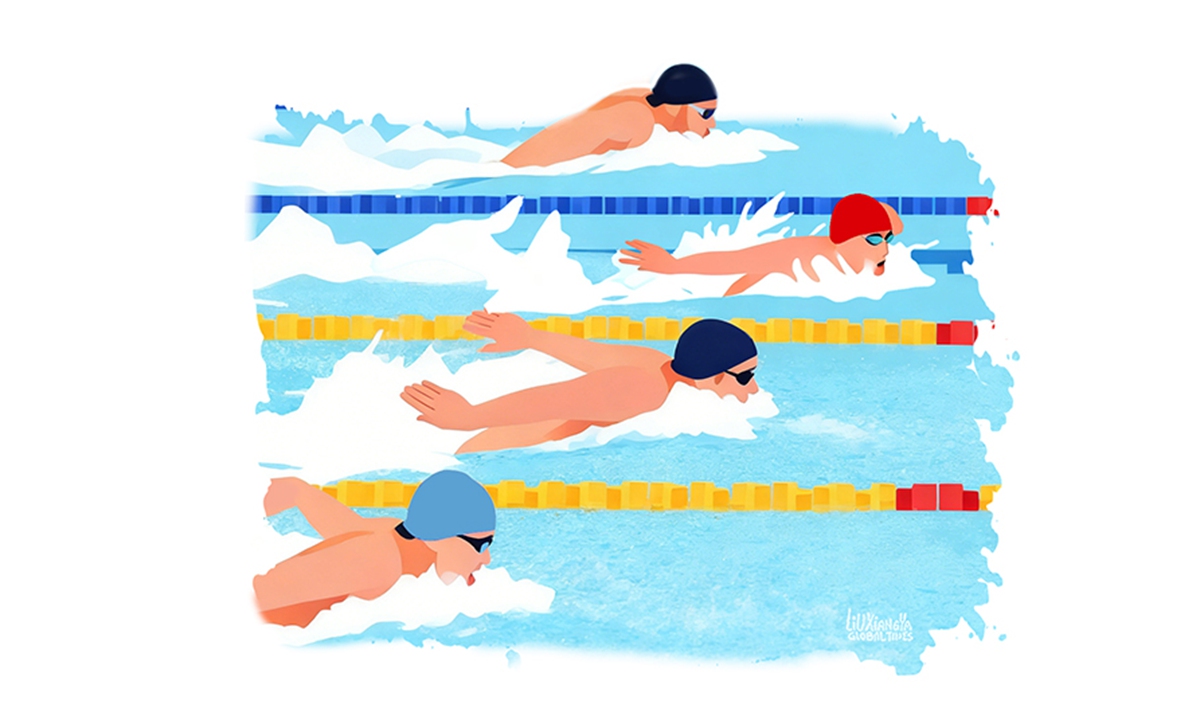
Illustration: Liu Xiangya/GT
The China Open Swimming Championships, which concluded on Sunday at the Shenzhen Universiade Sports Centre Aquatic Stadium, marked a new chapter in Chinese swimming not just for the results it produced, but for its bold new format that is already reshaping how Chinese swimmers develop. For the first time, China hosted a domestic-focused event in an open-competition model, blending the national spring championships with an international invitation format.By inviting 17 of the world's top swimmers from powerhouses like the US and Australia, organizers created a rare competition where Chinese athletes, young and established alike, could measure themselves against global standards without traveling overseas. The result is a powerful accelerator for talent growth that traditional training camps and domestic meets cannot replicate.
This event delivered what the Chinese swimming community has long needed: high-stakes exposure to world-class intensity and race rhythm. The initial argument for the new format was spot-on, home-soil benchmarking against the world's top-level swimmers offers young Chinese swimmers invaluable development opportunities. Instead of waiting for major international meets where pressure could sometimes be overwhelming, China's rising stars faced elite swimmers in a domestic competition. They competed in the same pool against the same swimmers who will line up beside them at the Los Angeles 2028 Olympics or at future world championships.
Take the performances of the next generation as proof. In the women's 200m butterfly, 13-year-old sensation Yu Zidi stunned multi-time Olympic medalist Regan Smith and drew international headlines. The following day, Yu reset her personal best in the 400m individual medley with 4:33.33. Though Yu remained distant from the 4:32 she had targeted, it is a clear step forward after becoming the youngest world championships medalist in 2025.
A wave of young Chinese talent is on the verge of breaking through, as 15-year-old Liu Xinting, Lu Xingchen and 13-year-old Wu Yunhan have been catching international attention. In a conventional national championship, these juniors might have dominated age-group fields without ever feeling the sting of world-class pressure. But at the China Open, they raced side-by-side with Olympic medalists, which offered them fresh racing experience at world level.
The format also dismantled the old hierarchical walls that once separated national-team stars from provincial prospects. Veterans like Olympic champions Pan Zhanle, Zhang Yufei, Li Bingjie, Tang Qianting, Wang Shun, and Yu Yiting shared the blocks with teenagers and provincial newcomers. Zhang Zhanshuo, who exploded onto the scene at the 2025 National Games with five gold medals, collected three golds in the 200m, 400m, and 1500m freestyle at the China Open while shaving time off his personal best in the longest event. He credited a winter of smart changes, including completely adjusted training philosophy, for the improvement. That kind of rapid maturation happens fastest when athletes are forced to apply new physical tools amid real competition rather than against the clock alone. The open format turned the pool into a testing ground where training hypotheses were trialed under competition stress.
Even the prize money reinforced the seriousness of the race. Gold medalists received $10,000, silver $6,000, and bronze $4,000, the highest payout structure ever seen in a Chinese swimming event. According to swimming news website SwimSwam, it even exceeded the average World Cup stop if appearance fees are excluded. At the China Open, Australian Olympic champion Cameron McEvoy shattered the 17-year-old men's 50m freestyle world record with 20.88, showcasing that the event was truly competitive instead of some token invitation meet.
By opening elite lanes to Chinese athletes born after 2010, organizers created a ladder from youth competition to senior international racing. Young swimmers absorbed the atmosphere of a major meet without the discomfort of competing overseas. They learned race-day routines and the subtle psychological adjustments required when facing multiple Olympic champions or world champions. The long-term payoff is obvious: fewer debut nerves at future major competitions, the ability to adapt quicker, and a deeper reservoir of competition-tested athletes ready for 2028 and beyond.
With no major world championships on the 2026 calendar, the China Open became the premier head-to-head arena. As an international swimming tournament, it allowed global audiences to see the depth of Chinese youth talent. By keeping the competition at home yet raising it to world level, the young Chinese swimmers are no longer waiting their turn, they are racing for it against the best swimmers in the world.
In the end, the China Open was never just about who won the most medals but about who improved the most. Chinese swimmers gained priceless confidence in real combat. They saw the gaps, felt the rhythm, and tasted the pace required to stand on future podiums. They returned to their clubs and provincial teams not with abstract goals but with concrete targets. That may ultimately become the China Open's most lasting legacy.
The author is a reporter with the Global Times. life@globaltimes.com.cn
RELATED ARTICLES