ARTS / CULTURE & LEISURE
1st ICH academy on publishing, printing launched in Shanghai
Refined teaching method helps clarify career paths
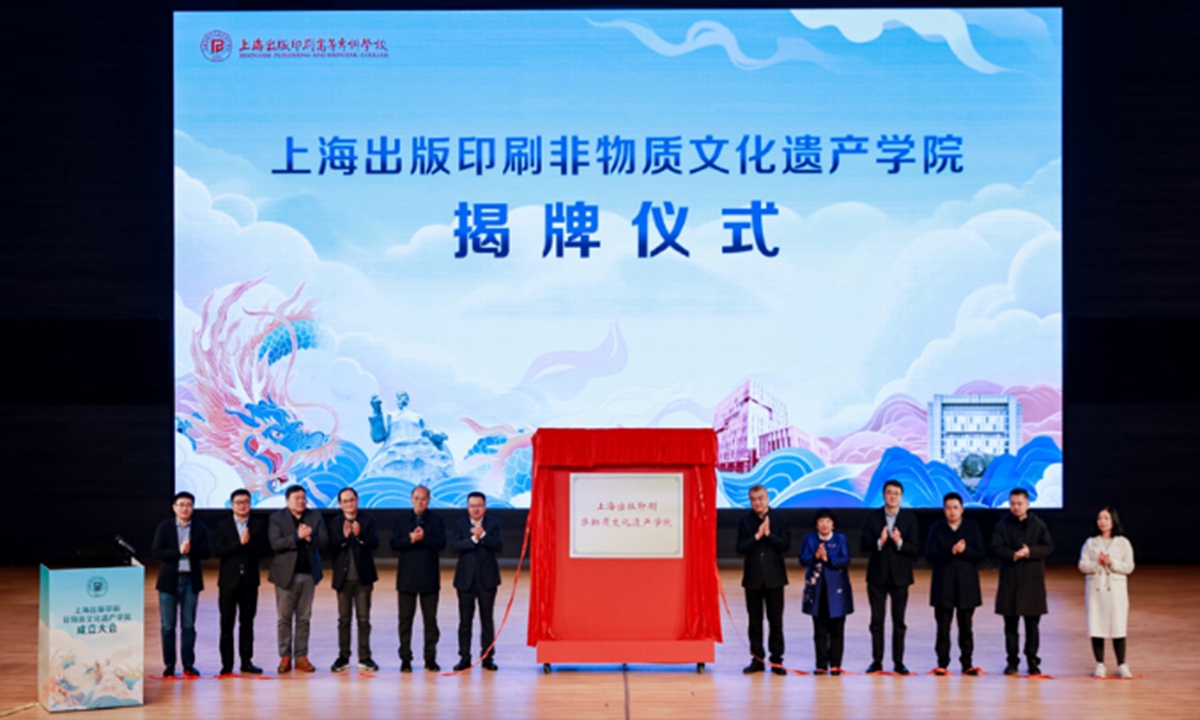
The launch ceremony of the Shanghai Academy of Intangible Cultural Heritage
Based at the Shanghai Publishing and Printing College, a new academy focused on intangible cultural heritage (ICH) in the domain of publishing and printing has officially opened in Shanghai, marking the nation's first higher education institution purpose-built for this specialized ICH sector.Among China's sprawling ICH categories, the publishing and printing sector may not steal the limelight, it is a fully-fledged field that includes subcategories such as ancient book restoration and mounting, woodblock watermark printing, movable type printing and more.
The new academy is called the Shanghai Academy of Intangible Cultural Heritage. To better cultivate talents in this field, it plans to develop curricula across several disciplines, including in-studio types such as printing and mounting as well as out-reaching ones like ICH exhibition curation. A guideline called the "Three Inheritances, Four Researches, and Five Modes" was also produced using actual teaching practices.
Yang Ailing, vice president of the Shanghai Publishing and Printing College, explained to the Global Times that the "Three Inheritances" focus on how traditional ICH skills can be passed down to the younger generation of students. This includes inviting veteran ICH inheritors to demonstrate and spread their craftsmanship, as well as teaching students how to "apply inherited skills to their own projects."
"Many ICH inheritors have a deep understanding of their crafts. But due to their age and other factors, how to help them popularize their skills or explore cross-sector applications, such as integration with cultural tourism, is still a task for them and for us. This requires training through a specialized system," Yang told the Global Times. Although the academy was just founded, it has already begun arranging "master classes" for students, inviting ICH inheritors such as Li Zhi, a known woodblock printmaker in Shanghai, to the campus for exchanges.
Different from many universities' "broad major" approach to student classification in traditional education systems, the academy adopts a "micro-specialty" class system.
Zhang Bo, the academy's lead who also serves as the college's Academic Affairs Office director, told the Global Times that this teaching method is organized "in the form of workshops" with a few students in one group. The new academy is now launching "six to nine" such micro-specialty programs, including the course of "ICH cultural and creative products."
"We also promote 'apprenticeship' and 'customer-order based' class models for cultivate students who harness both knowledge and practical experience," Zhang said.
Noting that this refined teaching method "can help clarify students' career paths," educational expert Gu Chengyue told the Global Times that it also reflects how much college educational organs value the "integration of industry and education."
"When students' skills can match the needs of the market and industries, this will greatly promote the revitalization of ICH and the socialization of its value," Gu noted.
Focusing on this type of school-to-market integration, the academy has highlighted "cultural and creative research and development" among its "Four Researches" guidelines. Meanwhile, its "Five Modes" refer to guiding students to better integrate their ICH knowledge with society through modes such as static exhibitions, regular displays and sales and dynamic performances.
Taking woodblock New Year prints as an example, the unique opera stories embedded in them "are planned to be reinterpreted by students through live performances, as well as through methods such as offline performances and online 3D animation," said Zhang. Meanwhile, an exhibition co-curated by teachers and students has already opened in Shanghai's Fengxian district.
Facility-wise, a new center within the academy dedicated to activities such as inheritor training and research, as well as archive construction, is also set to be established. "'Outreach' will always be our main goal. We will also promote ICH initiatives in communities, schools, and scenic areas," said Yang.
"This academy can serve as a reference for other ICH schools. Not every ICH school needs to pursue all-roundness; instead, it should focus on cultivating its areas of academic strength," said Xiong.
Behind the new academy's establishment lies policy support, including the release in November 2023 of an implementation opinion focused on strengthening ICH protection in Shanghai. The implementation opinion encourages the establishment of ICH research institutes and promoted training programs for ICH inheritors and practitioners.
"Intangible cultural heritage is fluid and requires people as carriers to be passed down. Without the cultivation of the young generation, it is difficult for traditional crafts to respond to the current cultural and social environment, and also difficult to integrate them with the contemporary era," Yang, the college's vice president, told the Global Times.
Founded in 1953, the Shanghai Publishing and Printing College is the first publishing and printing education institution established after the founding of the People's Republic of China.
RELATED ARTICLES