China’s Minister of Commerce meets with European business executives, vowing to make pie of economic and trade cooperation bigger
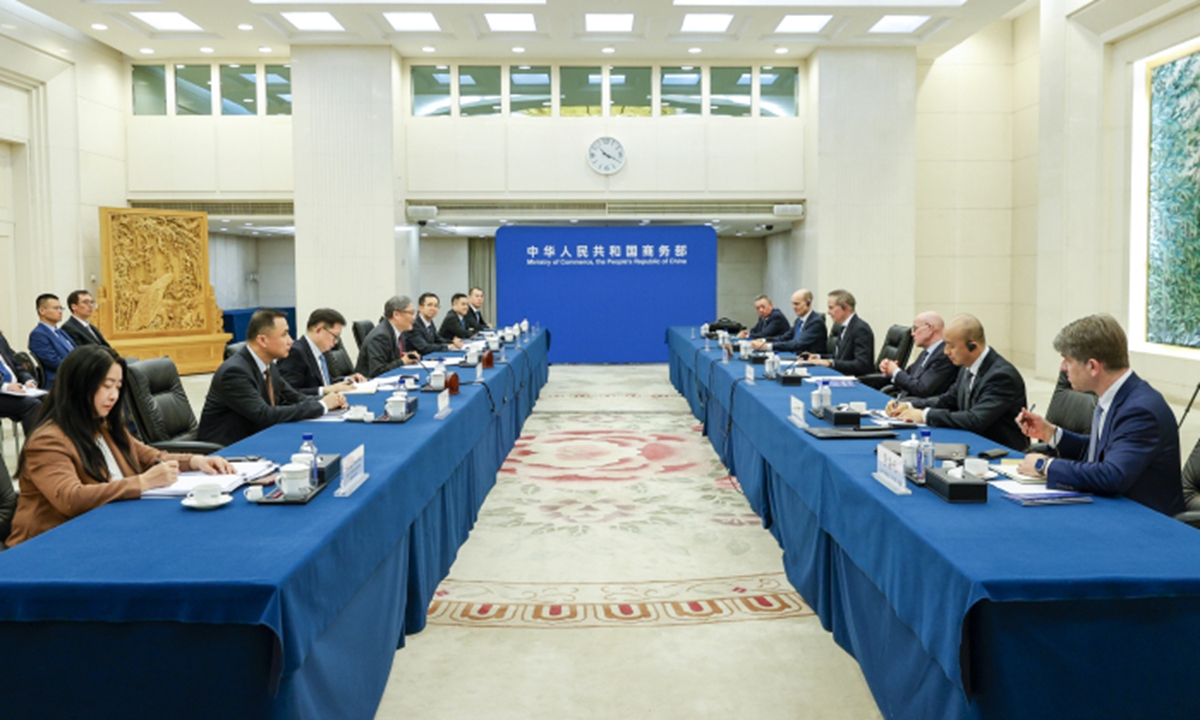
China's Minister of Commerce Wang Wentao holds a meeting on March 22, 2026, with representatives from Volkswagen AG, including Oliver Blume, chairman of the Board of Management of Volkswagen AG. Photo: The Ministry of Commerce
China's Minister of Commerce Wang Wentao held meetings on Sunday with European business executives from Volkswagen, Bosch, and BASF, encouraging foreign companies to continue investing in China, the Ministry of Commerce (MOFCOM) said on Monday.
The minister noted that China is providing foreign-invested enterprises with stable expectations and broad development space for their investments in the country as the country embarks on its 15th Five-Year Plan (2026-30) journey. He called for enhanced dialogue between China and Europe to jointly oppose protectionism and unilateralism.
The executives are in Beijing to attend the China Development Forum (CDF) 2026, under the theme of "China in its 15th Five-Year Plan Period: Advancing High-Quality Development and Creating New Opportunities Together."
When meeting with Markus Kamieth, chairman of the Board of Executive Directors and CEO of German chemical giant BASF, Wang said that foreign-invested companies such as BASF are welcome to continue investing in China and serve as a bridge to help China and Germany, as well as China and Europe, expand market space in emerging industries and work together to make the pie of economic and trade cooperation bigger.
Wang said that currently, unilateralism and protectionism are affecting the international economic and trade order. China and Europe should strengthen dialogue and exchanges, firmly uphold free trade and the World Trade Organization-centered multilateral trading system, and enhance certainty in the development of China-Europe economic and trade relations.
Similar comments were also made when meeting with Volkswagen Group Chairperson Oliver Blume, as Wang said that the Volkswagen Group has been deeply rooted in the Chinese market and achieved remarkable success over the past few decades.
It is hoped that Volkswagen will seize the favorable opportunities presented by China's technological and industrial innovation to empower its global market expansion, Wang added.
Regarding China-EU economic and trade relations, Wang said that protectionism will lead to a lose-lose outcome. Both sides should take a rational view of their competitive and cooperative relationship, engage in fair and orderly healthy competition, and deepen mutually beneficial cooperation.
He expressed the hope that the European business community, including Volkswagen, would play an active role in encouraging the European side to work together with China and properly handle economic and trade frictions through dialogue and consultation.
When meeting with Stefan Hartung, chairman of the Bosch board of management, Wang also said that Bosch Group is welcome to actively participate in China's consumer goods trade-in program and to research, develop, and produce more high-quality products and technologies.
"The tone of Wang's statements still centers on the issue of confidence," Cui Hongjian, a professor at the Academy of Regional and Global Governance at Beijing Foreign Studies University, told the Global Times on Monday.
In Cui's view, trade frictions between China and Europe are, to a large extent, a matter of confidence, and boosting confidence is key to continuing to steadily advance bilateral economic and trade cooperation.
Only when confidence is restored will Europe be able to view China-EU economic and trade issues more rationally and objectively, and will its business community find a more appropriate way to manage business relations with China, Cui said.
In the first two months of the year, China's trade with the EU surged 19.9 percent year-on-year to reach 998.94 billion yuan ($144.54 billion), outpacing the 18.3 percent growth rate of China's total foreign trade during the same period, data from China's General Administration of Customs showed earlier this month.
Chinese experts said that the figures demonstrated the resilience and strong complementarity of bilateral economic and trade relations in a turbulent global environment.
EU companies have also shown their confidence in China's market.
Last year, Roche announced an investment of 2.04 billion yuan to build a new biopharmaceutical manufacturing facility in Shanghai. The move aims to further strengthen Roche's pharmaceutical value chain in China by enhancing its supply chain and localizing production map.
Roche will continue to increase its investment and expand its footprint in China, the company said on Monday.
Recently, Volkswagen Group announced that its first model jointly developed with China's XPENG has officially entered production in Hefei, the capital city of East China's Anhui Province, the company told the Global Times in a statement.
Hartung from Bosch said that the group will continue to increase its research and development investment and production footprint in China, taking concrete actions to promote the stable and healthy development of German-Chinese and European-Chinese economic and trade relations.
RELATED ARTICLES