Japan to release oil reserves to curb soaring crude prices, but domestic concerns mount over economic impact
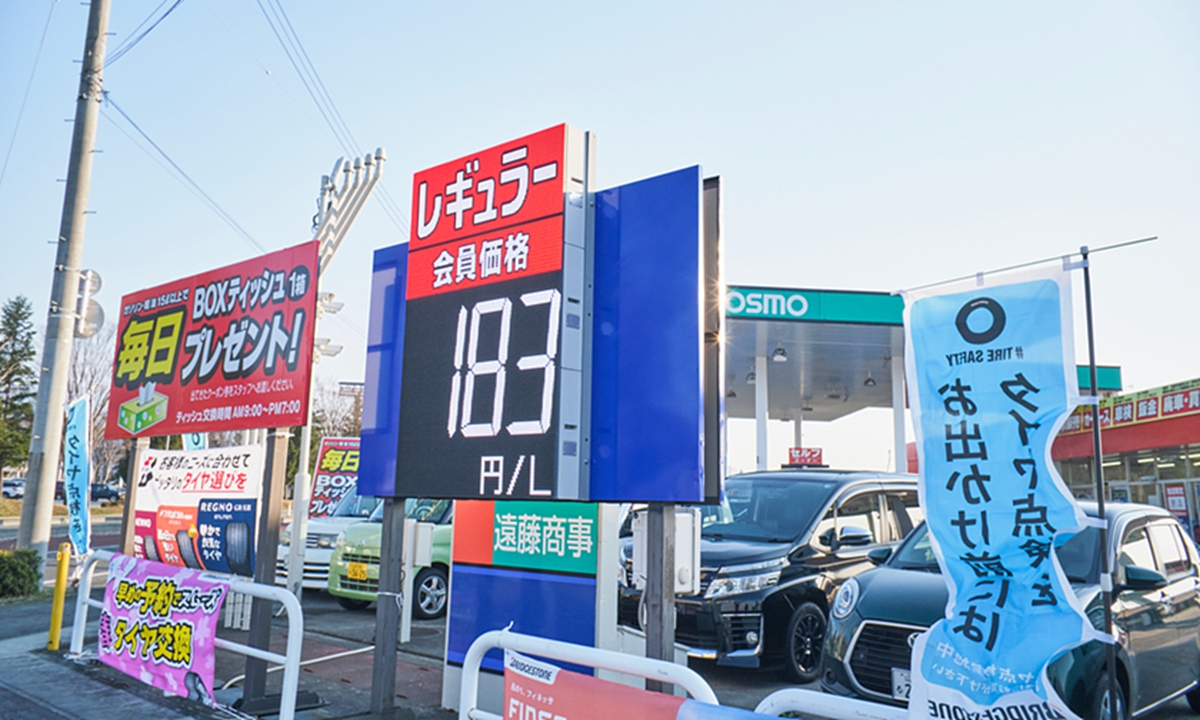
The price of regular gasoline is displayed as 183 yen per liter at a gas station, amid the US-Israel conflict with Iran, in Yamagata, Japan, on March 17, 2026. Photo: VCG
Japanese Prime Minister Sanae Takaichi announced on Tuesday that Japan will begin releasing emergency oil reserves on Thursday as the Japanese government attempts to curb surging energy prices due to the situation in the Middle East, according to Japanese media reports. Will such a move be effective in dealing with soaring prices? How has the Japanese public reacted to the government's response to the crisis?
Notably, some Japanese media outlets have highlighted the "limits" of Japan's domestic policies in dealing with surging energy prices, while many Japanese netizens pointed to the already extensive impact on various areas and the lack of "substance" in the government's response.
A Chinese expert told the Global Times that Japan is facing triple, overlapping crises, including its extreme dependence on oil imports and long-standing structural economic problems.
Japan will start releasing oil from state reserves on Thursday, Takaichi said on Tuesday, Japanese media outlet Mainichi reported, while noting that "concerns over supply mount and oil prices soar amid the ongoing [US]-Israeli war with Iran." The move comes after Japan started releasing oil from private-sector stockpiles last week, and the Japanese government plans to sell about 8.5 million kiloliters of oil from its reserves into the market, the report said.
Altogether, about 80 million barrels of stockpiled oil - equivalent to 45 days of domestic demand - is being provided to Japanese refiners, according to The Guardian, which noted that this is Japan's "biggest-ever release of oil." Japan imports more than 90 percent of its crude oil from the Middle East, making it particularly vulnerable to the current situation in the Middle East, The Guardian reported.
As of the end of last year, Japan held reserves of about 470 million barrels of oil, equivalent to 254 days of domestic consumption, The Guardian reported.
However, some experts cautioned that the emergency release offers only temporary respite. Masahide Takahashi, a senior Japanese research fellow, warned that crude oil inventories must be maintained at minimum levels, meaning Japan could face four to five months of oil shortages once the release concludes.
"Social anxiety will spread. That would be the worst-case scenario," he told Japanese broadcaster abema.tv.
On social media, many Japanese netizens expressed dissatisfaction over the measures. Under an X post of Takaichi announcing the oil release, an X user posted in Japanese that "the problem isn't solved; it's merely been made less visible."
"Stuck in a situation where we can't import without individual negotiations with Iran. What good is subsidizing prices, releasing stockpiles, and getting people to consume it like that?" another X user commented on Takaichi's post, adding that "impacts are already showing up all over the place, yet there's no substance to it."
Despite measures taken by Japan's government, some Japanese media outlets have also highlighted the limits of such moves. "There are limits to domestic policy responses to high oil prices, and there is no 'solution' better than stability in the Middle East," The Asahi Shimbun wrote in a Japanese-language editorial on Monday.
Lü Chao, a professor at the Liaoning Academy of Social Sciences, told the Global Times on Tuesday that Japan is facing triple, overlapping crises: extreme dependence on oil imports, long-standing structural economic problems, and compounded anxiety from current geopolitical shocks.
"In recent years, Japan has been under inflationary pressure and suffering from lackluster growth; if energy prices rise further, domestic economic instability could worsen," Lü noted.
Public anxiety and social media complaints have surged as consumers and businesses confront higher filling-station prices and broader inflationary effects. On social media, Japanese consumers voiced mounting frustration over the economic strain.
One X user expressed concern about permanent price shifts: "What's worrying is that even if crude prices stabilize, many commodity prices will likely remain unchanged. Recovery takes time, and even if the war ends now, prices probably won't fall until around next year - or may keep rising. If construction costs continue climbing, no one will be able to afford houses or apartments."
Another X user pointed out the temporary nature of government interventions, saying that "while I understand the intent to curb violent price fluctuations, the effects are usually temporary. Ultimately, it depends on supply-demand dynamics and geopolitical risks, so high volatility seems likely to continue."
Japan has long tried to diversify its energy supplies, but its low energy self-sufficiency rate has remained largely unchanged, according to Lü. "Since the first oil crisis in 1973, Japan has repeatedly faced volatility in fossil fuel prices and risks to stable supply due to geopolitical developments. The root cause lies in its low energy self-sufficiency rate," the expert said.
Japan sources about 95 percent of its oil imports from the Middle East, of which some 70 percent passes through the Strait of Hormuz, Reuters reported on March 2.
Notably, the country imported 2.8 million barrels per day (bpd) in January, of which 1.6 million bpd came from Saudi Arabia with supply also coming from the United Arab Emirates, Kuwait and Qatar, the report said.
One Japanese X user complained: "Japan has promised to increase crude imports from the US to meet demand. The country has been completely being played — forced to buy inferior crude at Trump's inflated prices. This will accelerate unprecedented price hikes. With Takaichi in charge, Japan won't survive."
RELATED ARTICLES