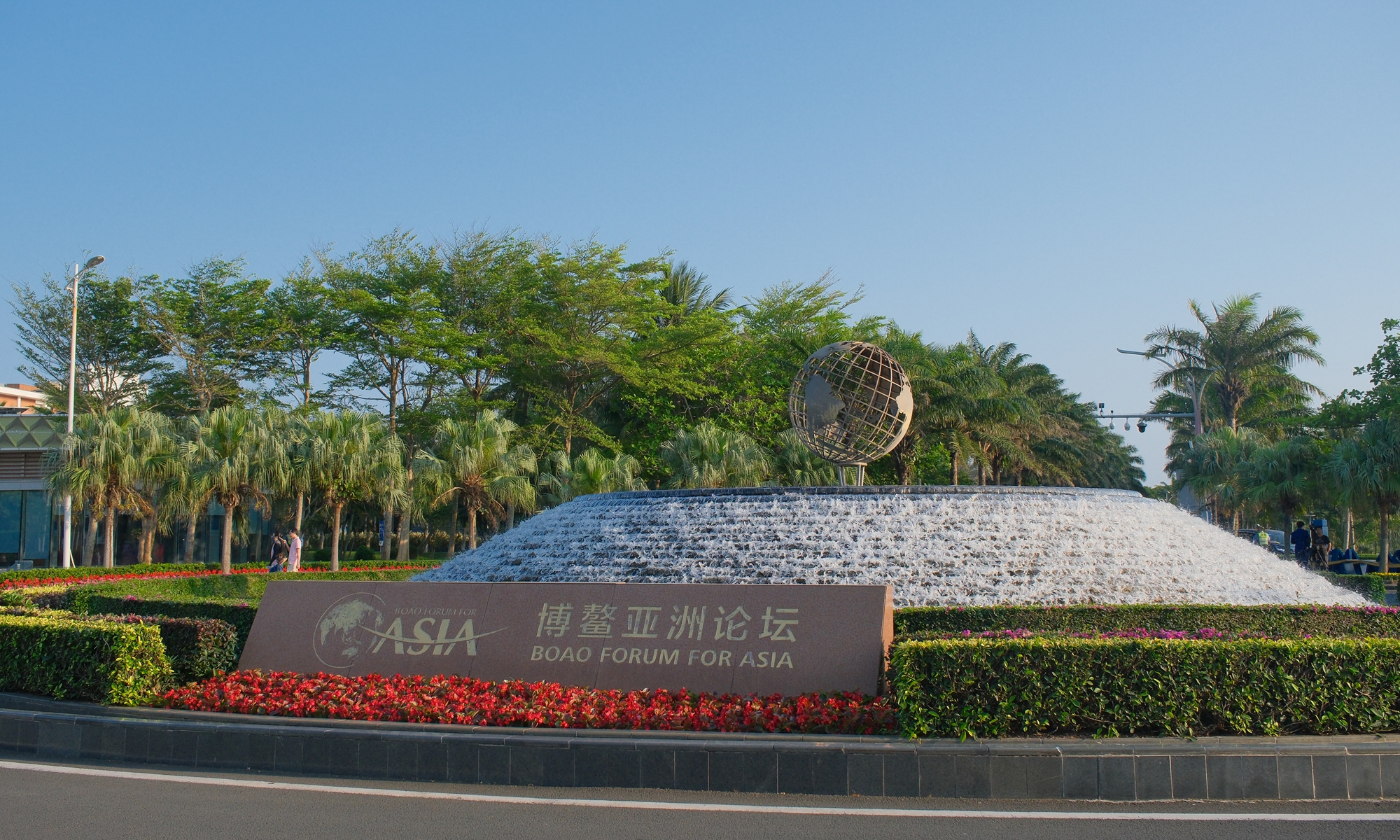
The Boao Forum for Asia Annual Conference 2026 kicks off on March 24, 2026 in South China's Hainan Province. Photo: Zhang Yiyi/GT
"Many people believe that the 'Asian Century' has already arrived," Zhang Jun, secretary-general of the Boao Forum for Asia (BFA), said on Tuesday at the release of flagship reports during the BFA Annual Conference 2026. The forum kicked off on Tuesday and will last until Friday, attracting about 2,000 delegates from more than 60 countries and regions, along with more than 1,100 journalists from around 150 media organizations covering this conference.
Apart from government leaders, heads of international and regional organizations, leading business delegates as well as prominent academics will also attend the Annual Conference. This fully demonstrates the significant influence and appeal of the BFA as a high-level platform for dialogue, while reflecting the strong commitment of all parties to jointly tackle challenges, create development opportunities and promote pragmatic cooperation, Zhang said.
This gathering holds special significance as it marks the 25th anniversary of the BFA, the first annual conference after the independent operations at the Hainan Free Trade Port (FTP), and the opening year of China's 15th Five-Year Plan period (2026-30). Amid profound global changes, the central question echoing through the forum is: How can China and Asia act as stabilizers in a turbulent world?
China provides the stability for the world and Asia is a major force in global growth, several participants in the BFA Annual Conference told the Global Times.
Dániel Palotai, deputy governor of the Magyar Nemzeti Bank (Hungary), told the Global Times on Tuesday at the forum that stability is always key.
"China's role in the global economy is very, very important because of long-term stability, predictability, and the clear direction of its development. This is one reason why China matters so much to Hungary and other European countries - we can count on this partnership going forward."
"China is trying to have good cooperation with other Asian countries... The stability of China is important for the stability of Asia and the world. China is the stability," Giovanni Tria, former Italian Minister of Economy and Finance, told the Global Times at the forum.
"The most prominent features of the current world economy can be summarized in two words: fragility and resilience. Resilience is strongly supported by Asia, particularly through the outstanding resilience of the Chinese economy, which has played the role of a stabilizer for the world economy," Xu Xiujun, vice dean of the National Academy of Chinese Modernization at the University of Chinese Academy of Social Sciences, told the Global Times at the forum.
"China can also drive forward the Asian and global economies. This involves what China is doing now - advancing high-level opening-up to create new growth momentum for Asia and the world. The Hainan FTP is acting as a pioneer, charting new paths for high-level opening-up worldwide," Xu noted.
Lin Guijun, former vice president of the University of International Business and Economics, told the Global Times on Tuesday at the forum that "In an era of global governance deficits, the vision of a community with a shared future and harmonious development offers a Chinese solution to global governance."
According to Lin, the term "global governance deficits" refers to the absence of an international organization's performance of its functions.
"The BFA itself embodies China's consistent principle of extensive consultation and joint contribution," said Lin.
Participants also pointed out that China continues to unleash the dividends of new quality productive forces, with high-tech and green low-carbon industries leading in growth. Through the Regional Comprehensive Economic Partnership and other mechanisms, China is deepening regional cooperation.
The BFA Annual Conference is also being held at a time when Asian nations are working together to counter volatility caused by the ongoing Middle East conflicts. According to multiple international reports, the conflicts have triggered sharp rises in global energy prices, supply chain disruptions, and inflationary pressures, with Asia - as a major importer of energy and hub of global manufacturing - particularly vulnerable.
Lin said that "Asia's development cannot be separated from unity. The BFA has always practiced multilateralism, aiming to build Asian consensus and promote regional integration."
Despite challenges, participants agreed that Asia is a major force of global growth.
Murtaza Syed, head of ecosystem in the Economics Department at the Asian Infrastructure Investment Bank, told the Global Times on Tuesday on the sidelines of the BFA that "Asia has emerged as a very important engine of the global economy. Almost three-quarters of global growth will come from Asia in the next few years."
"More importantly, for the first time since the industrial revolution, technology has begun to flow from the East to the West. The biggest force in this technological revolution is China. The biggest opportunity is to use the technology we have now in Asia and start to export it to the rest of the world," said Syed.
RELATED ARTICLES