Calls for upholding multilateralism, avoiding tariffs, protectionism resonate at Boao Forum amid global trade uncertainty
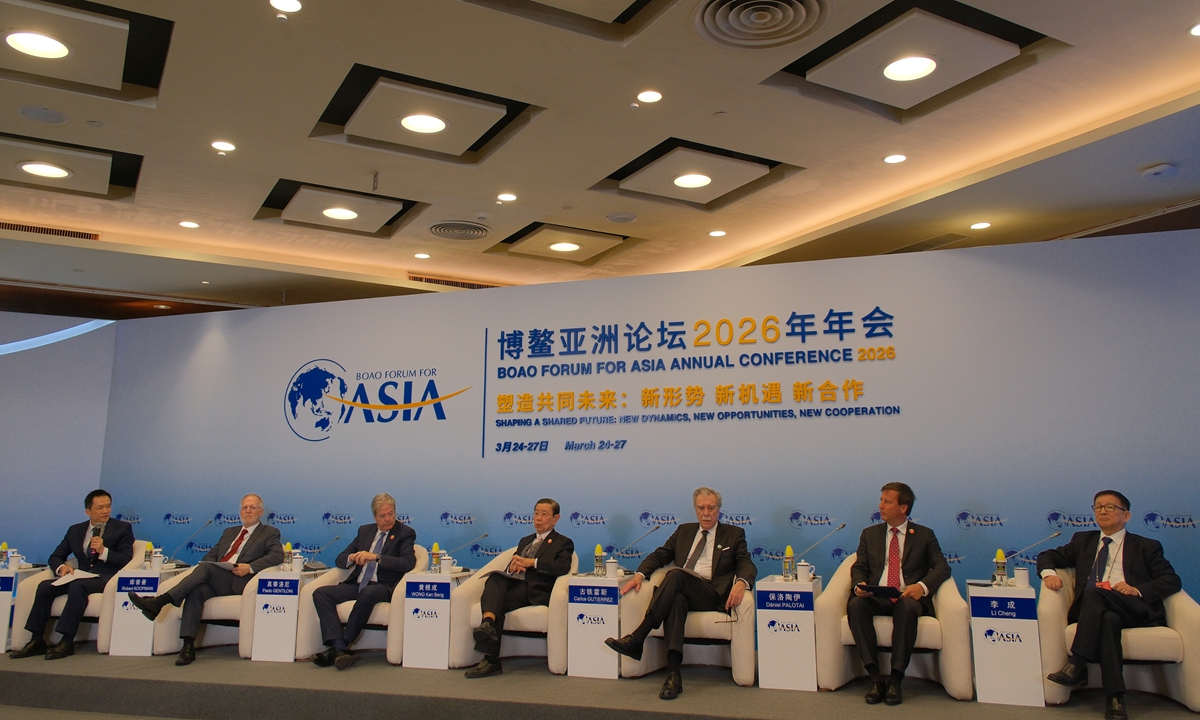
During the thematic session "New Global Trade Landscape under Tariff Wars" at the Boao Forum for Asia Annual Conference 2026 on the afternoon of March 24, 2026, global political figures and scholars engage in a heated discussion on the impact of tariff policies. Photo: Zhang Yiyi/GT
Trade frictions "cannot be resolved by raising protectionist barriers," a former official from Italy said at a Tuesday seminar themed "New Global Trade Landscape under Tariff Wars" during the Boao Forum for Asia Annual Conference 2026, calling on countries to uphold multilateralism and "keep rules-based trade, free trade, going" amid escalating tariff tensions.
Participants during the seminar warned that such shifts are increasingly eroding rules-based multilateralism.
Giovanni Tria, Italy's former minister of economy and finance, told the Global Times that tariff tensions are having "a big impact on the global economy," stressing that countries "have to try to keep globalization and avoid protectionism," which he described as "the basis for development around the world."
Paolo Gentiloni, former prime minister of Italy, said during the Boao Forum seminar that while globalization will continue, "the risk is that global trade in the future will not be based on rules, but on force and coalition," stressing that the EU is "very concerned" about such a shift. He added that the solution to trade frictions cannot be raising protectionist barriers, and called for efforts "to keep rules-based trade, free trade, going," and urged countries to "invest in WTO reform… and give credit to the WTO."
The economic cost of such policies is also becoming more evident. Former US secretary of commerce Carlos M. Gutierrez told the Global Times that "tariffs are not a way to manage the global economy permanently," warning against using them as a long-term policy tool.
Gutierrez also noted that despite ongoing frictions, there remains room for China-US economic cooperation.
Li Cheng, a professor in the Department of Politics and Public Administration, the University of Hong Kong said that the current wave of tariff and trade tensions should be rather seen as part of a broader and widely shared trend in the West, particularly in the US.
He noted that protectionist sentiment and skepticism toward globalization have been growing across political and economic circles, reflecting deeper structural issues in the US, especially related to domestic distribution challenges and shifts in the global economic landscape.
He added that trade conflicts are unlikely to disappear in the near term, as they stem from deeper tensions within US society. Rather than reflecting strength, such policies are more a result of weakness, confusion and fear. He stressed that these trends indicate a fundamental transformation in the global landscape, and called for greater emphasis on multilateralism, international cooperation and respect for global institutions such as the WTO.
Wong Kan Seng, former deputy prime minister of Singapore, who is also the chairman of CLA Real, said during the seminar that rising trade tensions, supply chain reconfigurations and increasing government interventions, including subsidies and investment screening, are driving up costs and fragmenting global trade. He noted that such shifts have led to duplicated supply chains, higher trading costs and conflicting regulatory regimes, placing greater pressure especially on smaller economies.
He added that the global trading system is becoming more polarized and unpredictable, with growing uncertainty acting as a hidden cost on investment, education and regulatory coordination. He stressed that restoring trust in multilateral institutions such as the WTO and strengthening regional cooperation are essential to stabilizing expectations and supporting global growth.
However, China has shown strong resilience and adaptability amid rising tariff pressures and global trade uncertainty.
Robert Koopman, former chief economist of the World Trade Organization and Hurst Senior Professorial Lecturer at American University, told the Global Times that China's been very resilient, and started to diversify its trading portfolio, noting that it "has successfully done this diversification."
Tria added that China's stability is crucial to the global economy, noting that "the stability of China is important for the stability of Asia and also for the stability of the world." He also said China is working to strengthen cooperation with other countries, which could help support global economic governance.
RELATED ARTICLES