Mexico’s tariff hikes on products from China constitute trade and investment barriers: MOFCOM
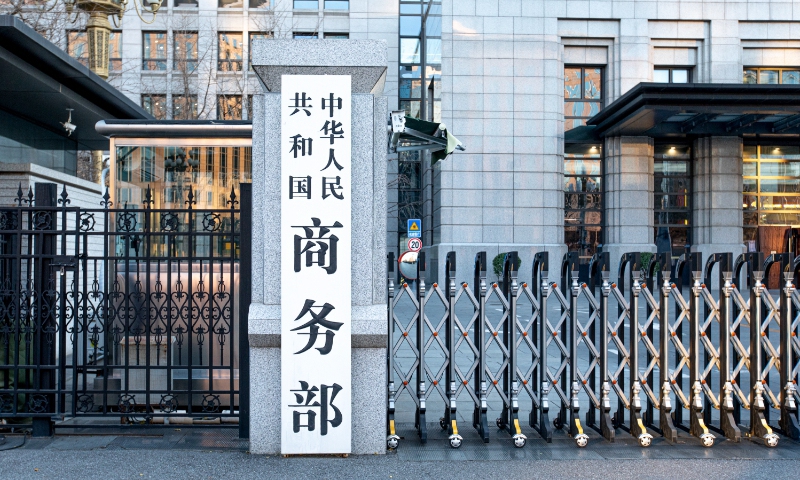
The Ministry of Commerce of China File photo: VCG
China's Ministry of Commerce (MOFCOM) said on Wednesday that it has determined that measures taken by the Mexican government — such as raising import tariff rates on products from China and other countries that are not its free trade partners — constitute trade and investment barriers.
Chinese experts noted that an investigation by the MOFCOM complied with relevant laws and regulations, while emphasizing that Mexico's move essentially succumbs to US pressure, which will raise living costs for its people and disrupt global trade chains.
The ministry said that Mexico's measures have restricted and hindered the entry of products, services and investment from Chinese companies into the Mexican market, undermining the competitiveness of relevant Chinese firms and their products there.
In light of this, the MOFCOM has, in accordance with the law, determined that Mexico's China-related restrictive measures constitute trade and investment barriers.
On September 25, 2025, the MOFCOM announced the launch of a trade and investment barrier investigation into Mexico's restrictive measures involving China.
Following the initiation of the case, the ministry, in accordance with the law, verified relevant facts with all interested parties through questionnaires, on-site investigations and other means, and widely solicited opinions to ensure the probe was fair, impartial, open and transparent, according to a MOFCOM spokesperson, who noted that during the investigation, the Mexican government did not submit any comments to the investigating authority.
The Xinhua News Agency reported on December 11, 2025 that the Mexican Congress had approved a proposal to raise tariffs on non-free trade agreement (FTA) partners. The new tariffs were to take effect on January 1, 2026, it said, citing local media reports.
The measures, if implemented, will substantially harm the interests of relevant trading partners, including China.
After a review by the Finance and Economy ministries [of Mexico], at least 750 changes were made to the original proposal. Of more than 1,400 products initially targeted, more than 300 ultimately ended up exempt. Even so, the levies will apply to a wide range of products, from clothing and footwear to steel, aluminum and auto parts, Bloomberg reported.
Mexico's imposition of high tariffs on non-FTA partners, including China, was primarily aimed at taking actions favorable to US interests before the US-Mexico-Canada Agreement joint review, in order to avoid unfavorable outcomes by the US during the review process, Shi Xiaoli, director of the WTO Law Research Center at the China University of Political Science and Law, told the Global Times on Wednesday.
Under the trilateral trade deal that took effect in 2020, the US, Mexico and Canada must launch a joint review of the trade pact by July 1, 2026, its sixth anniversary, to confirm their intention to renew it for a 16-year period or make modifications, Reuters reported.
Jiang Shixue, a professor at the Center for Latin American Studies at Shanghai University, told the Global Times that the move reflects the severe damage unilateralism and protectionism can cause to international trade relations. Amid the global energy crisis, tariffs directly translate into higher prices, exacerbating Mexico's inflation and affecting its economy, he noted.
The move has also drawn widespread criticism. A report by the Mexico News Daily on January 1, 2026, said that the tariffs could increase domestic consumer prices and hurt small businesses that rely on imported inputs.
As for Mexico's other trade partners, the Economic Times of India on December 12, 2025, reported exports of automobiles and intermediate goods to Mexico will be affected. Critics said that the move could disrupt supply chains, raise manufacturing costs, and trigger trade frictions, while increasing Mexico's input costs and inflation.
As the MOFCOM has released the results of the probe into Mexico's unilateral measures, China will notify Mexico and demand bilateral consultations, according to Shi, who noted that should Mexico refuse to reach a fair resolution through dialogue, China will promptly bring a formal complaint to the World Trade Organization and reserve the right to impose countermeasures.
RELATED ARTICLES