Chinese renewable-energy stocks rise as PV exports surge
Trend highlights China’s role as a stabilizer, anchor in global supply chain
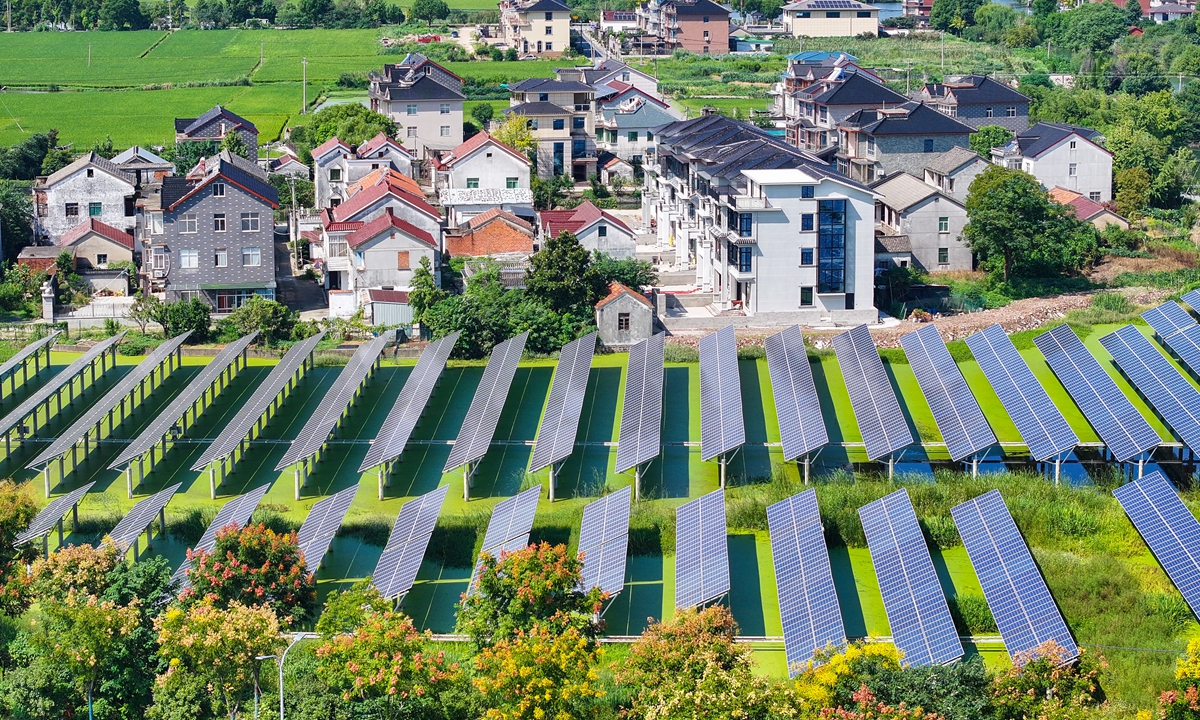
Solar panels are installed above a rural fish pond in Huzhou, East China's Zhejiang Province, on September 22, 2025. Photo: VCG
Chinese makers of photovoltaic (PV) products have seen their exports surge in recent days, several companies told the Global Times. Investors have been snapping up the stocks of Chinese renewable-energy companies, on a bet that the energy crisis triggered by escalating geopolitical tensions in the Middle East could boost global demand for China's green-energy sector.
A spokesperson for Chinese new-energy company Jinko Solar told the Global Times on Wednesday that "there's been an increase in the company's export business" since the energy crisis began. The spokesperson did not provide details on the destination countries.
The company mainly produces solar modules, solar cells, energy storage systems, and silicon wafers and provides multi-scenario application solutions. In recent days, it has secured major orders in Europe's solar market, signing agreements totaling nearly 150 megawatts of its flagship Tiger Neo 3.0 high-efficiency PV modules with a Spanish customer and a German distributor.
A senior executive in charge of new-energy products at a company based in Xiamen, East China's Fujian Province, told the Global Times on Wednesday that the European energy crisis has somewhat boosted the export of the company's products. The company's self-developed residential lithium battery energy-storage systems have seen strong demand, and "some products are in short supply," he said on condition of anonymity.
Another Chinese new-energy supplier -- Longi -- confirmed to the Global Times that from March 10 to 12, it signed strategic partnership agreements with major European companies, with total commitments reaching 600 megawatt-hours of energy storage systems and 100 megawatts of high-efficiency modules.
The capital market has reflected and priced in the steady growth in overseas orders.
A Reuters report on Tuesday took note of the trend, saying that "money has been moving into Chinese stocks in areas ranging from solar and wind energy to electric vehicles and batteries" since late February. It noted that the CSI Green Electricity Index had climbed 6 percent as of Tuesday in March, while the CSI New Energy Index was up 2 percent, despite the benchmark Shanghai Composite Index slumping 8 percent during the same period amid market turbulence.
The two indices edged up 3.07 percent and 1.47 percent on Wednesday.
The Reuters report, quoting a research note from Goldman Sachs, noted that "with China's leadership in key industries such as EVs, batteries and power-generating equipment, Chinese exports and growth in 2027 and beyond may benefit from increased demand for these products."
Lin Boqiang, director of the China Center for Energy Economics Research at Xiamen University, told the Global Times on Wednesday that China's stable renewable exports have highlighted the country's role as a stabilizer and an anchor in the global supply chain, especially in times of crisis.
According to a report by think tank Ember, the cost of gas-fired power in the EU increased by more than 50 percent in the first 10 days of the conflict, which began on February 28. As prices jumped, the EU paid an additional 2.5 billion euros ($2.9 billion) for fossil fuel imports during that period.
"The global oil and gas price spikes caused by rising geopolitical tensions have warned every country against the dire consequences of overreliance on fossil resources. As a result, everyone has been pursuing energy localization to secure its own energy supplies as much as possible. For regions such as Europe, which suffer from skyrocketing prices and a gap in domestic supplies, it is an economically viable and feasible option to embrace wind and solar power," Lin said.
The Jinko Solar spokesperson said that some Chinese PV products, which have superior low-light performance and strong anti-shading capability, are particularly well-positioned to fit Europe's distributed solar market.
Lin noted that China has an overwhelming edge across the new-energy supply chain, ranging from price and quality to technology.
"It typically takes four to 12 months from start to completion and grid connection, which addresses the imminent demand for the clean-energy transformation," Lin explained.
As to how China and the EU carry out green cooperation, Danilo Turk, former president of Slovenia, told the Global Times on Wednesday that China is a superpower in the PV industry, leading in the output of these products and the application of relevant technologies. The EU also has PV production capacity.
"China and the EU need to hold serious negotiations on cooperation in renewable-energy technologies such as photovoltaics, combine the local production capacity of both sides, and negotiate to formulate a common discourse system for cooperation. The EU also needs to vigorously promote renewable-energy technologies such as photovoltaics and wind power," Turk said.
"Global events demonstrate there's not a moment to waste in our drive for clean power because there can be no energy security while we are so dependent on fossil fuels," UK Energy Secretary Ed Miliband said in March, according to a post on the UK government's website.
According to Lin, taking account of rising geopolitical conflicts that could weigh on the price of bulk commodities, the shift to renewable energy will be a long-term trend, which could open up more room for expanding cooperation with China in related industrial chains.
RELATED ARTICLES