Boao Forum for Asia highlights Hainan FTP’s new opportunities fueling BRI’s green and digital transition
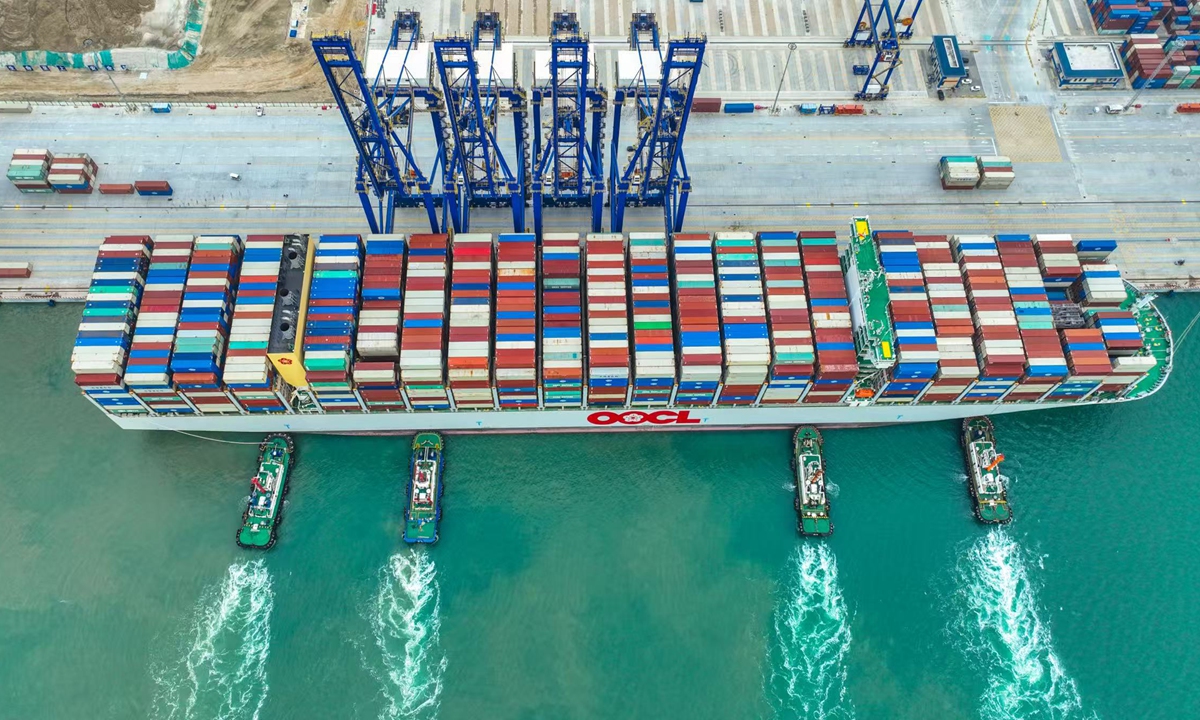
An international navigation vessel loaded with containers docks at Yangpu International Container Terminal in Danzhou, South China's Hainan Province on November 23, 2025. Photo: VCG
In the small coastal town of Boao in South China's island province of Hainan, about 2,000 representatives from over 60 countries and regions gathered for the Boao Forum for Asia (BFA) Annual Conference 2026, which runs from Tuesday to Friday.
Green transformation and digital connectivity have emerged as hot topics, closely aligned with high-quality cooperation under the China-proposed Belt and Road Initiative (BRI).
The annual conference coincides with a significant milestone: Nearly 100 days since the Hainan Free Trade Port (FTP) began full island-wide independent customs operations. Participants view the Hainan FTP as a key convergence point for China's major strategies, including opening-up, green development, digital economy, and BRI cooperation.
The policy dividends of the Hainan FTP are being released at an accelerated pace. Effects such as smoother flows of goods, greater convenience for travelers, and rapid concentration of economic activity are becoming evident, Feng Fei, secretary of the Hainan Provincial Committee of the Communist Party of China, said on Tuesday at a session of the BFA Annual Conference.
Since December 18, 2025, newly established foreign-invested enterprises in Hainan have increased by 33.5 percent, the import and export volume has grown by 32.9 percent, and visa-free visitors from 86 countries have risen by 53.6 percent, said Feng.
"Hainan is becoming a new frontier of China's opening-up, a new hot spot for mutually beneficial regional cooperation, and a new engine driving economic globalization," Feng noted.
Relying on policies such as zero tariffs and tariff exemption on processing value-added goods, Hainan FTP is rapidly building industrial clusters in offshore wind power, green finance, and low-carbon shipping. These efforts enable the port to export green and digital solutions to BRI partner countries, creating a replicable "Hainan model," BFA participants told the Global Times.
Turning vision into action
International participants praised the practical opportunities created by the Hainan FTP.
"Since Hainan FTP's independent customs operations took effect in December 2025, many companies have begun planning to use Hainan as a competitive hub for trade, shipping, and customs advantages," Denis Depoux, global managing director at Germany's strategy consulting firm Roland Berger, told the Global Times on Wednesday.
Depoux noted particular interest from medical-device manufacturers and healthcare service providers seeking research and development (R&D) and client-service platforms in the port.
Peter Burnett, CEO of the China-Britain Business Council, described the zero-tariff and local-production policies of Hainan FTP as "exceptionally favourable" and "a very enlightened policy" for overseas companies.
"The fact that you can import tariff-free and manufacture here is a great boon. It would be great to see the policy extend to more than just Hainan. But I'm sure Hainan will do very well," Burnett told the Global Times on the sidelines of the BFA on Wednesday.
At the same time, Chinese enterprises are already turning Hainan FTP's policy advantages into tangible BRI outcomes.
"Deeply rooted in Hainan for 38 years, we have invested over 50 billion yuan ($7.2 billion) in major local projects including Haikou Meilan International Airport, and the island-wide power grid," Ni Zhen, chairman of China Energy Engineering Group Co Ltd. (Energy China), told the Global Times on Wednesday at the BFA.
Looking ahead, Energy China will focus on the "clean energy island" goal, advancing new energy, new infrastructure, digital economy, and modern services to support the FTP's development, said Ni.
Beyond Hainan, Ni noted that Chinese enterprises are translating policy advantages into concrete BRI results. Energy China's newly signed contracts under the BRI exceeded 600 billion yuan in the past five years.
According to Ni, Energy China has led the completion of multiple energy cooperation plans and built landmark projects under the BRI such as the Caculo-Cabaca Hydropower Station in Angola, known locally as the "Three Gorges Dam of Africa," which meets over 40 percent of the country's electricity demand. The company's overseas new-energy projects are offering Chinese solutions for the global energy transition.
Dániel Palotai, deputy governor of the Magyar Nemzeti Bank (Hungary), the country's central bank, told the Global Times at the BFA that Chinese manufacturers like BYD are establishing major plants and European headquarters in Hungary, supported by strong infrastructure and logistics cooperation zones.
Palotai also cited the Budapest-Belgrade railway, a flagship BRI project, as proof of successful connectivity.
A bridge for shared future
From Hainan's dual-track layout in green and digital industries to the pragmatic collaboration between Chinese and international enterprises, the BFA continues to serve as a vital bridge for BRI dialogue. It is helping transform policy vision into practical cooperation and injecting fresh momentum into building a shared future.
As Zhang Jun, secretary general of the BFA, noted on Tuesday during the release of two flagship reports of the forum that one of the aims of this year's annual conference is to boost innovation-driven transition, which includes green transition paths and actions, industrial upgrading empowered by digital intelligence, and achieving sustainable development.
"This is the first year following the implementation of the Hainan FTP's independent customs operations, as Hainan serves as the host venue of the BFA. It is hoped that participants can find new opportunities via investing in China, and in Hainan [in particular]," said Zhang.
BFA participants are also optimistic that the FTP and BRI framework will turn global challenges into new opportunities, offering a replicable path toward high-quality and sustainable development.
RELATED ARTICLES