IN-DEPTH / IN-DEPTH
A vibrant senior life: embracing youthful culture and AI tech, Chinese elderly show vitality, get closer to digital age
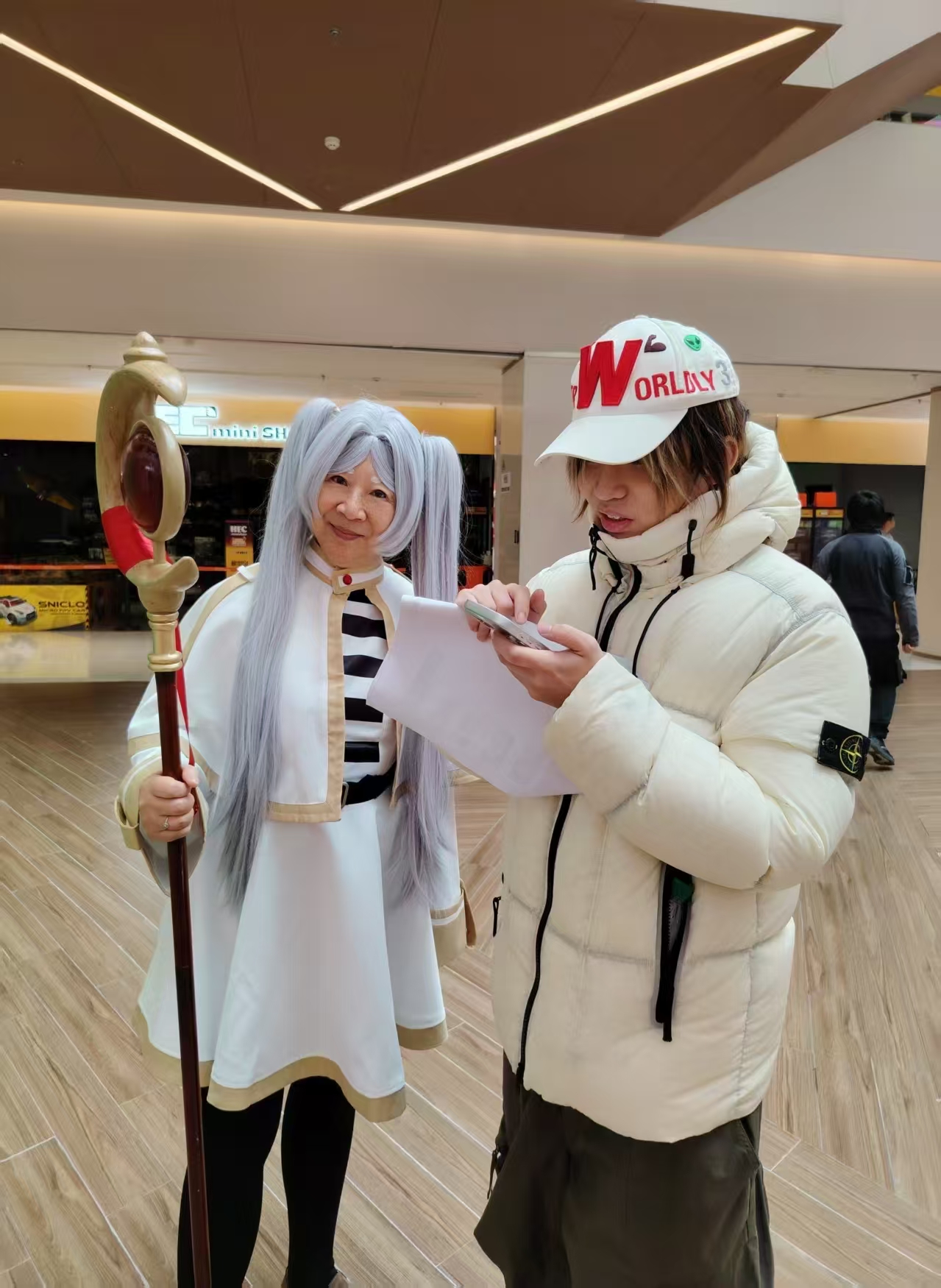
Wang Xuefang (left) wears an anime costume before shooting. Photo: Courtesy of Wang
Editor's Note:
With China's population of seniors over 60 surpassing 300 million, ensuring a happy and fulfilling life for all seniors has become a pressing issue for both families and the nation. How can the new generation of seniors in China break away from traditional norms and embrace a different lifestyle, supported by AI technology, multiculturalism, and an elder-friendly society?
The series "Old Age, New Trends" will explore emerging trends in the silver economy, creative social norms among senior citizens, and innovative eldercare services. It will examine the opportunities and challenges presented by an aging society, highlighting the diverse lifestyles of seniors and the booming eldercare industry in China. Beneath these new trends lies a reflection of Chinese modernization, which aims to provide more secure systems and dignified lives for its senior population.

Photo: A screenshot from video uploaded by @shenqidelaopi
Two da ye (elderly man) and a da ma (elderly woman) sit around a table playing Dou Di Zhu (a Chinese card game called Fight the Landlord). While two challengers keep playing their cards nonstop, the "landlord" sits there with one eye covered, deep in thought and seemingly at a loss.
Suddenly, when one challenger shouts, "A pair of Queens!" The "landlord" opens his eyes, a red glow seemingly flashing in his right eye, and slams down a bomb - four sixes. At the same time, a burst of purple light blazes behind him, and the anime character JoJo from JoJo's Bizarre Adventure appears in the glow, holding oversize poker cards and slamming them on the table together with the "landlord."
At the same time, golden light erupts across the table, and a Fight the Landlord battle infused with special effects officially begins.
This scene is from a cosplay video posted on Bilibili by the blogger @Shenqidelaopi (thereafter as Laopi). To date, the video has racked up nearly 22 million views.
On Bilibili, one of China's largest video-creation platforms, stunning cosplay videos are nothing new. What makes this one uniquely captivating is that all the performers are senior citizens.
Revived youth
"How did the blogger persuade these elderly people to star in the video?" Many viewers asked after watching the video.
Wang Xuefang, a 68-year-old retired office worker and now a performer who has appeared in several of Laopi's videos, gave an unexpected answer, "No persuasion was needed at all." It was the fun and novelty of the works that led her to take the initiative to join this cross-dimensional adventure.
Wang first got to know Laopi through an anime video featuring her friend. Watching her friend brimming with energy in unique costumes and exaggerated moves, she was both amazed and impressed. "It is incredible that these senior citizens can have such fun with something so new!"
When her friend invited her to join and Laopi soon extended an offer, Wang said she agreed, almost without a second thought.
"Before this, my performing experience was limited to mainstream, conventional content such as film and television dramas, stage shows, and commercial promos. Working with Laopi's team was a completely different, offbeat experience for me," Wang told the Global Times.
The exaggerated body movements required in the shoots were a challenge for someone of her age, yet Wang loved every minute of it, saying it was an excellent workout that got her whole body moving. She also relished the need to speak loudly and project her voice: it not only exercised her breathing but also filled her with vitality, making her feel exhilarated with every shout.
What touched Wang even more were Laopi's creative ideas and the exquisite ACGN (animation, comics, games and novels) costumes. "We never got to wear clothes like this when we were young, so it's an incredibly fresh experience to dress up in such fairytale-like outfits in our old age," she said. These unprecedented experiences reawakened the youthful spirit in her heart and brought back a long-lost sense of youth.
After the videos were released, she received messages from relatives, friends and acquaintances from all over the country, delighted by this innovative form of creation. The rising views and attention brought Wang a great sense of accomplishment.
After filming several episodes, she had nothing but praise for the blogger and his team: the blogger himself was sincere and warm, always patiently guiding the elderly performers; the young team members were energetic, forward-thinking, broad-minded and insightful. Most importantly, they enabled these senior citizens to enjoy youthful culture just like the young, quietly bridging the generation gap.
"What touches me most is that it gets everyone moving, shouting and make them feel alive," Wang said.
She added that while the world ultimately belongs to the young, the elderly can also participate and enjoy experiencing new things.
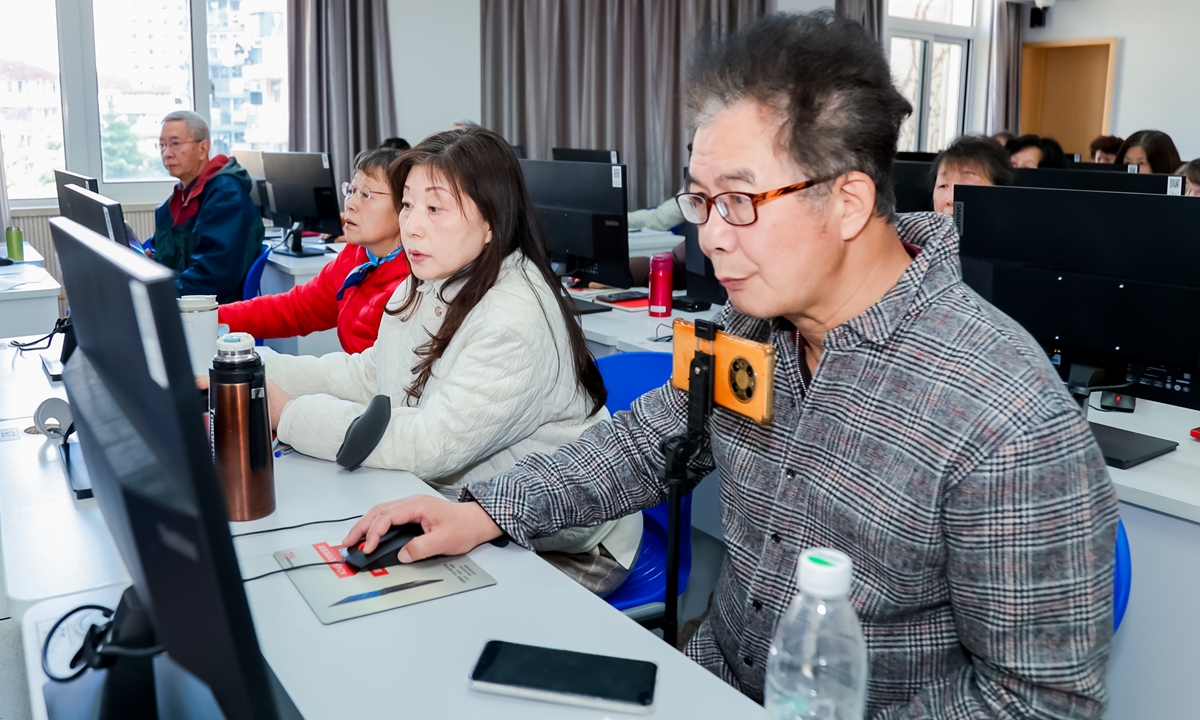
A few elderly people attend class at the Shanghai University for the Senior. Photo: Courtesy of the university
From onlookers to participants
Wang Xuefang's experience is far from unique. Today, more and more elderly people in China are no longer content with being onlookers of trendy life, but are taking the initiative to step forward and become participants.
Cheng Yan (pseudonym), 56, is one such pioneer. In May 2025, she put on an anime costume she couldn't even name and walked into a comic-con in Shanghai with her daughter. "It's like discovering another world. A world that exists just to make you happy," Cheng told the Global Times.
Wang Chaoyao, a 90-year-old retired teacher, is another example. He lives within walking distance of an anime-themed mall and often drops by in his spare time. Seeing young people in a variety of distinctive costumes and eye-catching hair colors, he always feels like an observer in another world, filled with curiosity. "I've always been interested in new things, and after watching for so long, I wanted to give it a try myself."
With this thought in mind, Wang Chaoyao walked into a photo studio with his granddaughter and took his first set of cosplay photos.
He was excited the entire time, from makeup to the shoot. Watching his eyebrows, facial features and even hairstyle being transformed little by little in the mirror, and feeling like a different person under the photographer's guidance and the constant click of the shutter, he was filled with pride when he saw the final photos.
He couldn't wait to share them with relatives, friends and former students, who are now in their 60s and 70s. All of them praised him, saying, "You still have the same vitality you had when you were young!"
Today, Wang Chaoyao shares his vibrant senior life on Xiaohongshu, having amassed more than 100,000 followers, and cosplay has become a bright highlight of his life.
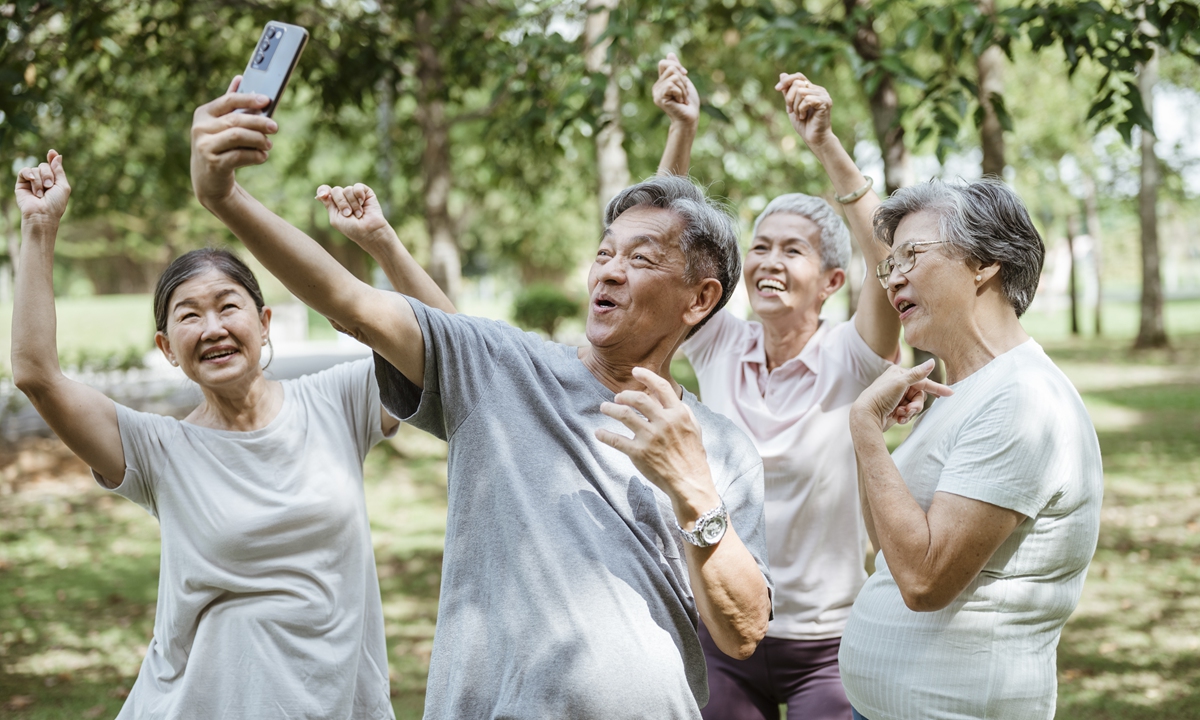
Vital elderly people Photo: VCG
Embrace digital age
If cosplay is the silver-haired generation's trendy adventure in entertainment, then attending AI classes and mastering smart technology is their proactive quest to bridge the digital divide and integrate into the information age.
One afternoon in March, 69-year-old Huang Kai sat intently in a classroom at the Shanghai University for the Senior, staring at a computer screen. On it, an AI program was transforming a street photo he had recently taken into a nostalgic sepia scene of old Shanghai alleys. He smiled and showed the result to a classmate beside him: "Look, doesn't this look just like the Shanghai alleys of our childhood?"
This is a common sight in the AI classes at the Shanghai University for the Senior. In the classroom, silver-haired seniors type image prompts into computers or mobile phones, or ask AI assistants to compare different models of the same product. Their eyes brim with curiosity about cutting-edge technology as they engage in lively discussions about AI, never having been so close to science and technology.
Huang is a student in the university's "AI Software Application and Creation" course. In 2024, he first truly realized that AI had quietly integrated into daily life: hospital appointment mini-programs, voice assistant responses, and even his children's casual remark of "Let AI handle it" all made him aware that the age of AI had arrived.
"Our generation witnessed the rise of the internet, and we know that every technological wave creates a gap between people," Huang said. In his view, the current AI wave is advancing more rapidly than any previous technological revolution, and "if you don't take the initiative to integrate, you'll be left behind."
Therefore, when the Shanghai University for the Senior launched AI-related courses, Huang signed up without hesitation. Starting from scratch in a completely new field was no easy feat at first, but thanks to the low entry threshold of various AI tools and the university's step-by-step, clear teaching, Huang and his classmates gradually found their footing and mastered the use of AI.
Today, AI has become a practical helper in Huang's daily life. When he goes shopping, instead of wading through countless reviews and comparing product parameters, he simply tells AI his budget, preferences and concerns, and receives a detailed product comparison list within seconds. Even for specific needs, such as choosing a folding table for a small apartment, AI can suggest screening criteria he never would have thought of. "It really saves me a lot of trouble," he said.
Huang's learning experience is a microcosm of how students at the Shanghai University for the Senior are embracing AI.
In the spring semester of 2026, the university offered more than 28,000 places across the city, with AI and digital life courses being particularly popular. The introductory course A Complete Guide to Everyday AI was fully booked within 10 minutes of registration opening, said Zhang Juanjuan, deputy director of academic affairs office at the university.
This year, the university has built a multi-level AI curriculum system for its senior students, ranging from free entry-level courses on practical daily use to advanced courses exploring how AI can empower the elderly in health, travel, entertainment and safety, meeting the learning needs of different students.
This need is in line with the upgrading consumption structure of China's elderly population. According to a report by the Southern Metropolis Daily in early March, the demands of the new generation of silver-haired group in China are undergoing a significant shift: their consumption outlook has changed from "prudence and frugality" to "proactively enjoying life," and their demand structure has upgraded from "subsistence-oriented" to "enjoyment-oriented and quality-oriented."
In response to the growing demand of the group, the Chinese government stressed in its 2026 government work report that it will help healthy seniors who want to keep working and volunteering, draw up measures to boost the silver economy, and refine supportive policies for products designed for seniors, pension finance, and seniors' seasonal relocation for wellness and care, according to the Xinhua News Agency.
"We are committed to helping elderly learners bridge the digital divide," Zhang told the Global Times. "We hope not only to help the elderly keep pace with the information age but also enable them to become active users of new technologies, enjoying the convenience and joy brought by science and technology, and no longer being onlookers in the digital age," Zhang said.
RELATED ARTICLES