GT Voice: Fixation on ‘alternative’ narrative won’t serve EU’s global infrastructure efforts
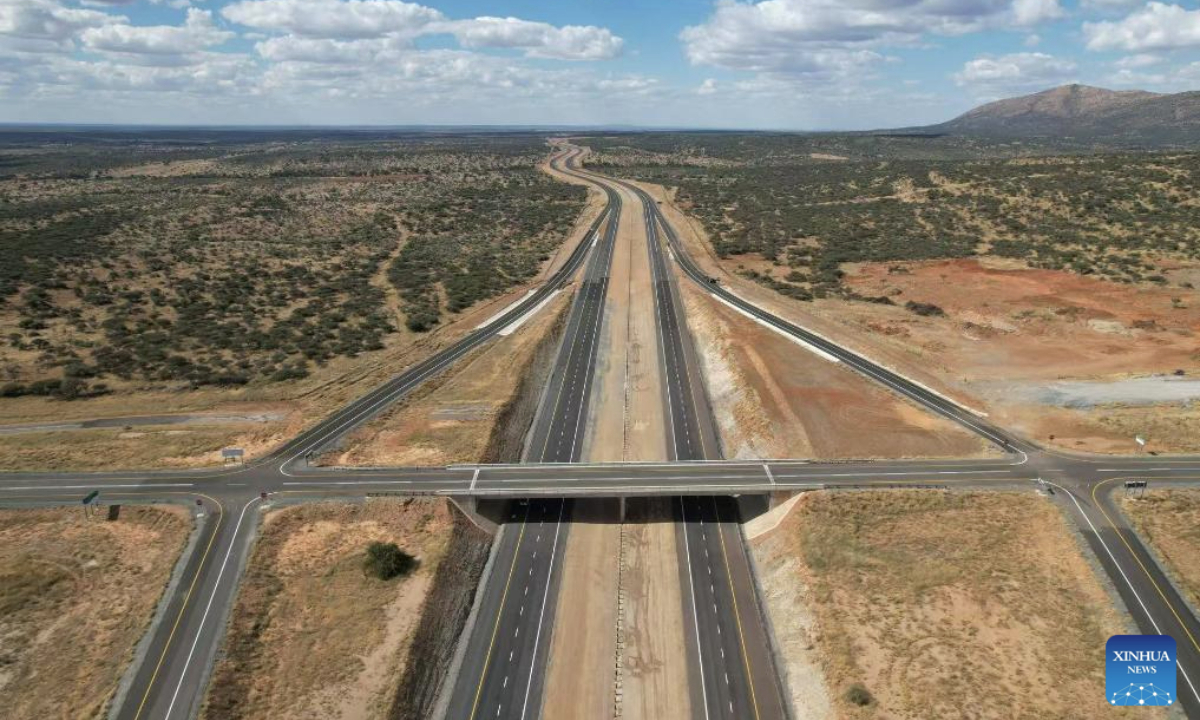
Drone photo taken on May 25, 2025 shows the Chinese-aided Dr. Hage G. Geingob Freeway, a 21.3-kilometer four-lane dual carriageway linking downtown Windhoek and Hosea Kutako International Airport in Namibia. (Zhong Mei Engineering Group/Handout via Xinhua)
Members of the European Parliament are set to assess the EU's global infrastructure investment efforts under the Global Gateway Initiative on Thursday, according to a briefing published on the European Parliament's website.
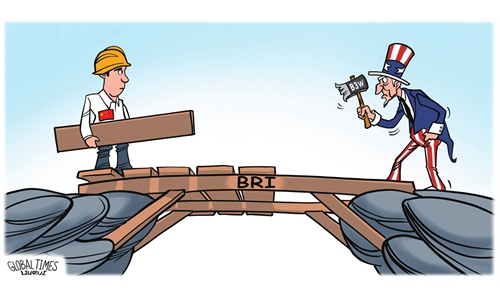
What is drawing attention is a particular part of a relevant report, which expresses concern over "reports that a number of Global Gateway projects are being implemented by Chinese companies in direct violation of the initiative's objective of presenting an alternative to the Belt and Road Initiative (BRI)." It even goes so far as to call for an investigation into the reported involvement of Chinese companies in Global Gateway-funded projects.
Such rhetoric not only strays from the original purpose of global infrastructure cooperation but also reveals a shortsighted and harmful geopolitical obsession.
Launched in December 2021, the EU's Global Gateway Initiative aims to mobilize 300 billion euros ($346.27 billion) in investment between 2021 and 2027 to meet global infrastructure development needs.
The initiative has indeed facilitated certain infrastructure projects in some developing countries, a development worth acknowledging. However, from its very inception, the initiative has been framed by certain European politicians and Western media outlets as an "alternative" to the BRI, thus casting a geopolitical shadow over it.
It is precisely this geopolitical obsession that renders the report's so-called concerns over Chinese companies' reported involvement in Global Gateway projects utterly absurd. In today's globalized world, multi-party cooperation in cross-border infrastructure projects has become the norm. Project owners naturally opt for contractors that offer the best value, reliability, and quality. Ultimately, the participation of Chinese companies in global infrastructure projects is a result of market choice, driven by their proven technical expertise, efficient execution, and extensive experience in the sector.
In Georgia, part of the E60 European Transit Road that links Europe with Asia navigates steep, mountainous terrain and is one of the most challenging sections of the highway. It is funded by the Asian Development Bank, the World Bank and the European Investment Bank and constructed by Chinese companies, according to a Politico report. The success of such projects demonstrates that Chinese companies' involvement actually injects pragmatic and efficient energy into them.
Regrettably, some within the EU continue to politicize this normal cooperation, exposing a zero-sum mindset that views infrastructure development through the lens of rivalry.
Both China and the EU are major global economies, each possessing distinct strengths in infrastructure development. The EU excels in standard-setting, green transition, and sustainable financing, while China brings advantages in engineering efficiency, cost control, and large-scale project delivery. The two sides are well-positioned to complement each other and make greater contributions to global sustainable development, rather than wasting energy on the false premise of rivalry.
The global infrastructure gap is immense, far beyond what any single country or regional initiative can fill. According to McKinsey & Company's latest report, a cumulative $106 trillion in investment is imperative to meet global infrastructure requirements through 2040, not only for traditional assets such as roads, ports, bridges, and power grids but also for the next generation of those assets.
Against this backdrop, the EU's 300-billion-euro Global Gateway Initiative, while significant, is but a fraction of the overall need. In this context, diverting resources to futile competition instead of focusing on collaboration is irresponsible to the cause of global development.
As early as the launch of the Global Gateway Initiative, China's Foreign Ministry had already made it clear that China welcomed all initiatives that help developing countries improve their infrastructure and promote common development. The country also believes that different initiatives should not replace or exclude each other. Instead, it advocates inclusiveness, communication and coordination for greater synergy.
No matter what initiative is involved, the fundamental purpose should be to deliver tangible infrastructure improvements and development opportunities to developing countries. If the EU remains fixated on the "alternative" narrative and defines the value of its own initiative in opposition to others, it will not only stray from the original goal of supporting development but also risk draining its initiative of the vitality and influence it seeks to achieve.
If the EU truly wishes to establish the Global Gateway Initiative as a global public good, it needs to set aside ideological biases, return to the pragmatic spirit of cooperation, and embrace with an open mind all participants who can contribute value to its projects.
RELATED ARTICLES