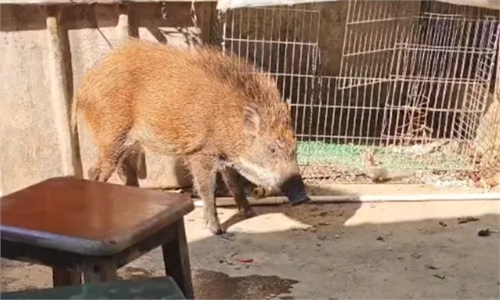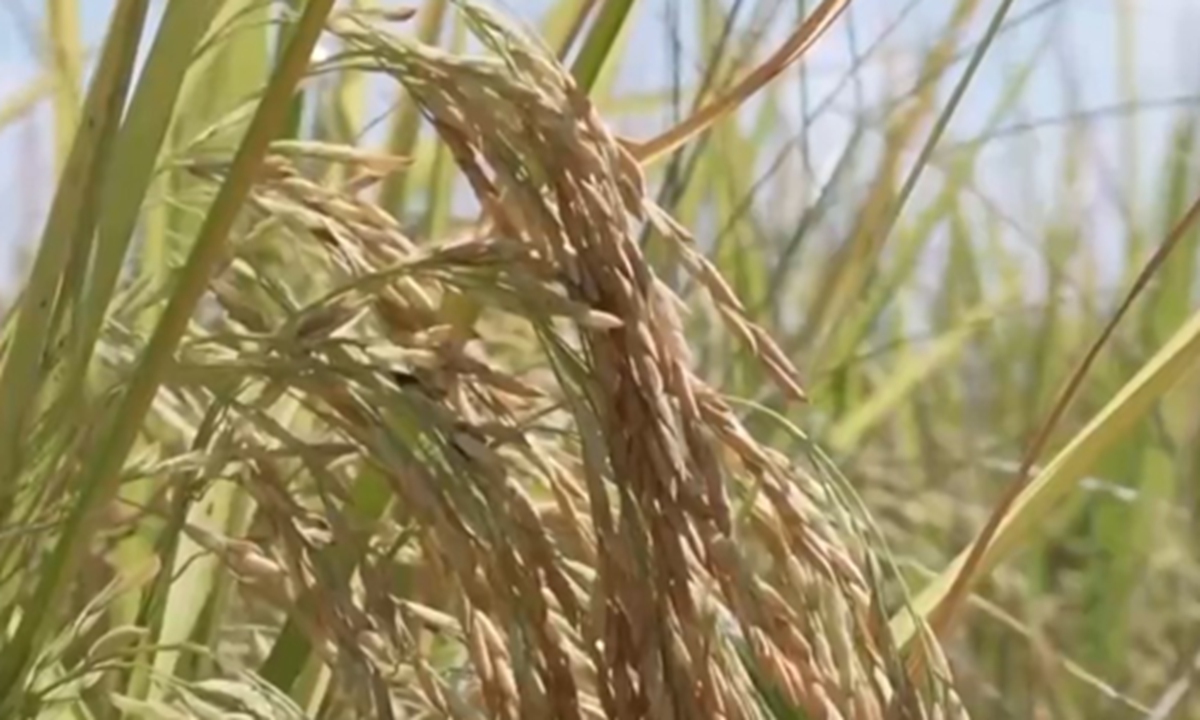
The new type of "longevity rice" Photo: Courtesy of CCTV News
A Chinese research team has recently made a breakthrough in developing "long-lifespan rice" by identifying the key gene and mechanism that enable wild rice to be harvested multiple times, and has successfully introduced this gene into cultivated rice variety, marking a new advancement that has drawn widespread attention, CCTV News reported.
This latest research achievement has been published in the international academic journal Science.
According to the paper, the Chinese team identifies two genes that help the wild rice Oryza rufipogon flourish year after year by adding these genes to the cultivated rice O. sativa, which gave it a key perennial trait: the ability to stop flowering and resume vegetative growth, instead of dying off after flowering as annual plants generally do.
According to the team, more than two years of experimental planting have already been conducted. The new type of "longevity rice" can survive for over two years after a single planting and be harvested multiple times during its lifespan.
Experts say that while the genetic basis of rice longevity has now been uncovered, the research remains largely at a fundamental stage. Current work focuses on understanding the molecular mechanisms behind the perennial traits of wild rice. Systematic evaluations of yield, taste, and other agronomic characteristics have yet to be completed, and the variety has not undergone official approval or large-scale promotion. Overall, the new rice is not intended to replace existing high-yield varieties, but rather to serve as a supplement to current farming systems.
The research team further highlighted key differences between "longevity rice," ratoon rice, and previously developed perennial rice varieties in China.
According to the team, "longevity rice" differs fundamentally from ratoon rice, as the latter relies on dormant buds on the remaining stubble after the first harvest to regrow a second crop within the same year. It is essentially a double-cropping system that does not require the plant to survive across years. By contrast, "longevity rice," drawing on perennial genes from wild rice, enables a single planting to yield multiple harvests over several years, with the root system capable of surviving across seasons, as demonstrated for more than two years.
Meanwhile, the new development also differs from perennial rice previously cultivated in Southwest China's Yunnan Province. That variety propagates through rhizomes, similar to bamboo's underground stems, though its exact growth mechanism remains unclear. Breeding new varieties through conventional hybridization can take 10 to 20 years. In contrast, the latest breakthrough is based on cloning key perennial genes identified in wild rice, significantly accelerating the development and potential application of new varieties.
Researchers noted that the cultivation methods, field management practices, and suitable planting regions for "longevity rice" are still under study and differ notably from conventional rice farming. Without plowing, soil nutrients tend to accumulate in the surface layer, requiring precise fertilization techniques such as side-deep fertilization and integrated water-fertilizer management, alongside straw return and crop rotation systems.
The choice of planting regions is also critical. Experts say that as current single-season yields cannot yet compete with conventional or hybrid rice, large-scale promotion in high-yield plains is not considered suitable. Instead, the rice shows potential in low-productivity areas such as sloped farmland and hilly regions, where its "plant once, harvest multiple times" characteristic could reduce labor input and help conserve soil, offering distinct ecological and economic value.
Global Times
RELATED ARTICLES