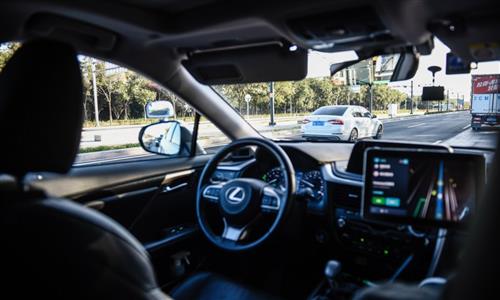
Proposal by some US lawmakers to ban govt use of Chinese humanoid robots lays bare US anxiety over China’s tech advancement: expert
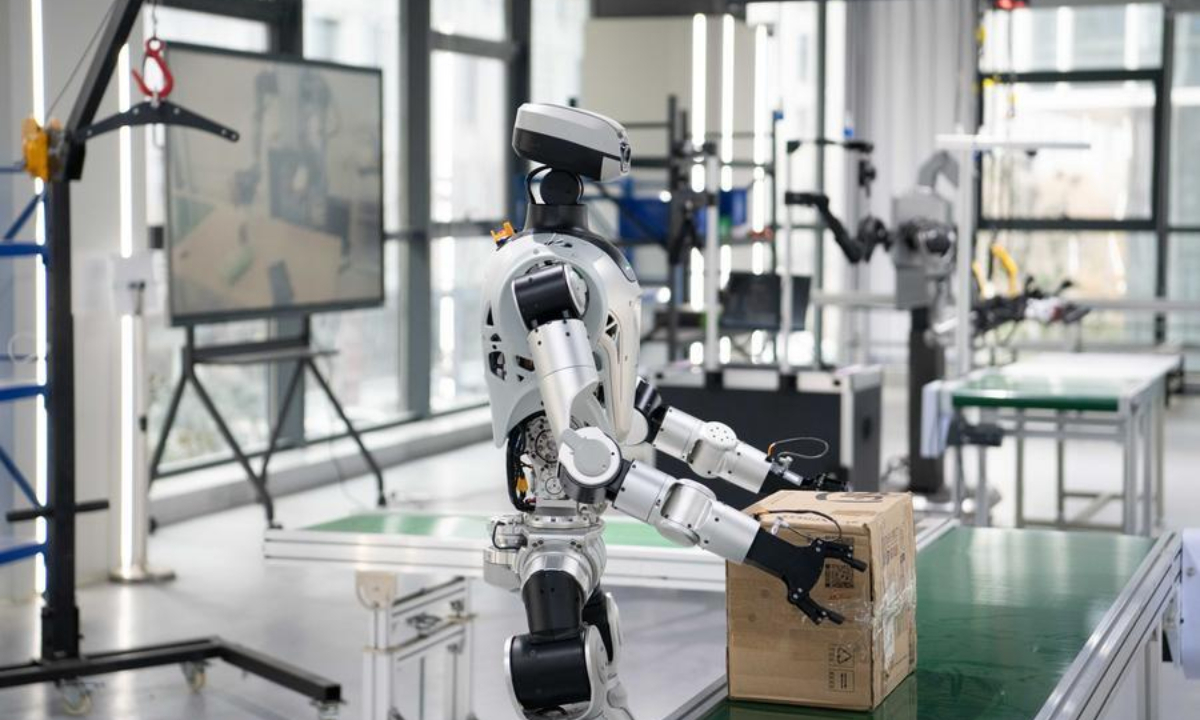
A humanoid robot conducts box-carrying training at a data collection pre-training center for humanoid robots in Hefei, east China's Anhui Province, Dec. 4, 2025. (Xinhua/Zhang Duan)
US lawmakers have planned to propose a bill to bar federal agencies from buying or operating Chinese-made humanoid robots for "security" concerns, a move a Chinese expert said reflects growing unease in Washington over competition with China in emerging technologies and one that could weigh on US innovation capacity and industry interests.
According to Reuters, Republican Senator Tom Cotton and Democratic Senator Chuck Schumer planned on Thursday to introduce the "American Security Robotics Act", which would prohibit the US federal government from buying or using unmanned ground vehicles made by "adversaries" such as China and bar the use of federal funds in connection with the robots.
In statements on Thursday, the lawmakers claimed that such robots present a national security risk because they could be used to gather data to send back to China or could be remotely controlled from China, the Reuters report said.
The move is notable because it targets a sector that has rapidly become one of the most closely watched arenas in the global technology race, where Chinese companies are emerging as strong contenders alongside US firms such as Tesla. The Reuters report said at least two Chinese firms, Agibot and Unitree, are preparing share listings in China this year as their products gain growing attention.
Rather than being driven by long-repeated, groundless security concerns, the move appears to reflect mounting strategic anxiety in the US over China's growing competitiveness in the still-nascent robotics sector, as well as a mismatch between the US' policy stance and industrial priorities, Xiang Ligang, director-general of the Zhongguancun Modern Information Consumer Application Industry Technology Alliance, told the Global Times on Friday.
The robotics sector depends heavily on real-world deployment and continuous iteration, with competitiveness driven by data from practical use and the ability to scale, Xiang said, adding "In this regard, the US does not have clear advantages in large-scale manufacturing, commercialization or industrial chain coordination."
Analysts noted that the move runs counter to the highly globalized nature of the robotics industry, where supply chains and innovation are deeply interconnected. Restricting access to competitive foreign products could reduce efficiency and slow technological iteration in a sector that relies on openness and real-world application.
Notably, the proposed bill would contain exemptions allowing US military and law enforcement agencies to research Chinese robots, provided the machines cannot transmit data to or receive data from China, Reuters reported.
US scrutiny of Chinese technology has been building for some time. A group of US lawmakers last December urged the Pentagon to add Unitree to a list of entities allegedly assisting the Chinese military.
"Some US lawmakers appear increasingly detached from industrial realities, pushing hardline proposals that do not align with the interests of the sector, while overlooking the fact that businesses generally favor openness and cooperation, with a focus on efficiency, costs and technological progress," Xiang said.
This lack of policy clarity and coherence has added to internal friction and policy disarray in the US, Xiang said, adding "In this context, such restrictions are unlikely to curb China's technological development and may instead constrain innovation within the US itself."
The proposed robotics bill comes as Washington sharpens its focus on China's advances across emerging technology sectors. A Reuters report on Monday, citing the US-China Economic and Security Review Commission, a US congressional legislative commission, said China's open-source AI ecosystem is creating a "self-reinforcing competitive advantage", potentially positioning it to gain ground in embodied or physical AI, including humanoid robotics and autonomous systems.
A Morgan Stanley report said China has pulled far ahead in the race to develop humanoid robots. It also estimated that building a supply chain for Tesla's Optimus Gen 2 would cost nearly three times as much without China's participation, the South China Morning Post reported in December.
Chinese officials have repeatedly voiced opposition to US tech restrictions. Responding in December after Washington added a Chinese tech company to a US national security list, Chinese Foreign Ministry spokesperson Lin Jian said that China firmly opposes the US overstretching the concept of national security and making discriminatory lists to go after Chinese companies. "The US should stop its wrong practice and create a fair, just and non-discriminatory environment for Chinese companies," he added.
China also holds about three-fifths of the world's AI patents and two-thirds of robot-related patents, recent data showed. Foreign Ministry spokesperson Mao Ning said in February that scientific and technological innovation should benefit the people and be used for good, stressing that it should help narrow the technology gap. She added that China remains committed to openness and to promoting international exchange and cooperation.
RELATED ARTICLES