Official Chinese media unveils world's first case of soft-body bionic manta ray submersible detecting simulated underwater explosive devices
By Zhang Yuying and Published: Mar 27, 2026 09:35 PM

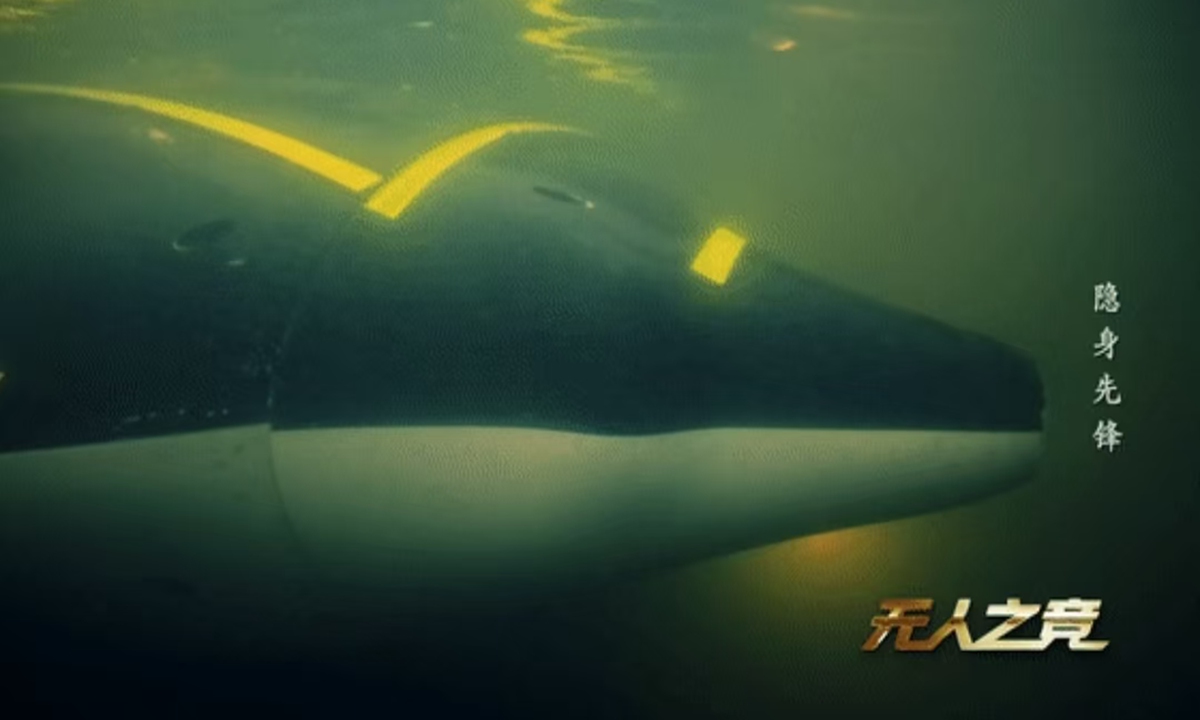
An official Chinese media report on March 27, 2026 unveils world's first case of a soft-body bionic manta ray submersible detecting and locking onto simulated underwater explosive devices in dark waters with visibility of less than one meter. Photo: Screenshot from CCTV News
An official Chinese media report on Friday unveiled the world's first case of a soft-body bionic manta ray submersible detecting and locking onto simulated underwater explosive devices in dark waters with visibility of less than one meter.
Equipped with a forward-looking sonar that penetrates darkness to pinpoint targets and a set of side-scan sonars that simultaneously maps the seabed, the soft-body bionic manta ray submersible transmits data on identified targets back to the command terminal screen instantly, per a report by the military channel of CCTV News.
The manta ray was chosen as the bionic design reference for a key reason. Unlike ordinary fish that sway left and right while swimming, the manta ray features a flat body and broad pectoral fins, propelling itself forward like waves undulating while keeping its main body nearly stationary. This design grants the bionic manta ray ample internal space to carry complex mission payloads. Its stable locomotion also ensures the proper operation of sensitive equipment such as high-precision sonar, the report said.
In addition, the submersible boasts exceptional endurance, as its battery capacity supports full-speed navigation for dozens of hours, covering a range of hundreds of kilometers. When gliding by adjusting buoyancy, its range can extend to thousands of kilometers, the report said.
According to CCTV News, the submersible also demonstrates remarkable pressure resistance. Its core equipment is encased in a high-pressure-resistant hull, capable of withstanding deep-sea water pressure equivalent to about 200 atmospheres. Even if wired communication is cut off, the bionic manta ray will not lose its way in the deep sea and can autonomously approach its target.
The submersible is also capable of performing missions in groups. Multiple bionic manta rays can form a sonar "local area network" through relay cooperation, converting satellite signals into sonar signals that reach deep into the ocean.
Zhang Junshe, a Chinese military affairs expert, told the Global Times on Friday that this type of bionic manta ray submersible boasts relatively strong survivability, navigation capabilities, and detection capabilities. It has good stealth as well as pressure resistance underwater, so it should have considerable military value for future applications.
"It may be applied in defensive scenarios, such as against submarines and other surface vessels under complex and high-threat environments," Zhang said.
RELATED ARTICLES