Pentagon report hyping China’s military buildup distorts facts, untrustworthy: expert
By Published: Dec 24, 2025 12:53 PM

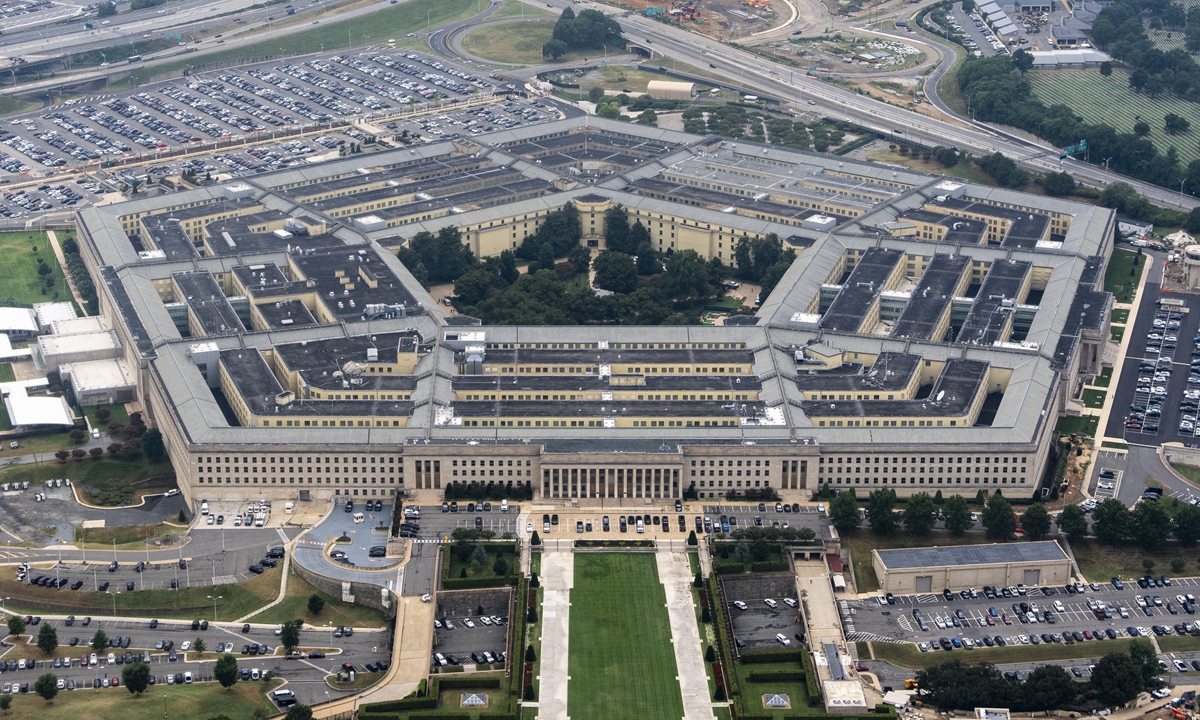
View of Pentagon Photo: VCG
The Pentagon on Tuesday released its latest edition of report on the capabilities of the Chinese military, reportedly claiming that the Chinese military is in the midst of a "historic military buildup" that has made the US homeland "increasingly vulnerable," according to media reports on Wednesday. Chinese experts said that the Pentagon's annual report is merely another hype of the "China threat" rhetoric, containing untrustworthy speculations and distorting facts.
The congressionally mandated report describes a Chinese military that is increasingly sophisticated and resilient, while also hyping the Taiwan question and China's strategic partnership with Russia, according to a Bloomberg report.
Reuters reported on Monday that a draft of the Pentagon report claimed that China has loaded more than 100 intercontinental ballistic missiles into three newly constructed silo fields and showed little interest in arms control talks. This information is also found in the Pentagon report that was released on Tuesday.
Zhang Junshe, a Chinese military affairs expert, told the Global Times that the Pentagon releases reports on the Chinese military on a yearly basis, but they contain much false and speculative information, exposing the Pentagon report as an untrustworthy document aimed at hyping up the so-called "China threat" rhetoric.
Song Zhongping, another Chinese military affairs expert, also said that the Pentagon report is speculation that distorts facts. He told the Global Times that the report serves to maintain US military hegemony, and its hype over China's normal national defense development is groundless and is based on double standards.
In response to the Reuters report on Monday that cited the draft Pentagon report claiming that China is likely to have loaded more than 100 intercontinental ballistic missiles across its latest three silo fields, and that the Pentagon report also claimed that China has no desire for arms control talks, Chinese Foreign Ministry spokesperson Lin Jian said at a regular press conference on Tuesday that "I'm not familiar with what you cited as a US draft report, but we've been hearing the same story told and retold by the US to create pretext for speeding up the upgrade of US nuclear power and disrupting global strategic stability. The international community needs to be soberly aware of that."
The US, as a nuclear superpower sitting on the world's biggest nuclear arsenal, must fulfill its special and primary responsibility for nuclear disarmament, further make drastic and substantive cut to its nuclear arsenal, and create conditions for other nuclear-weapon states to join the nuclear disarmament process. This should be a high priority for the US, Lin said.
In a statement responding to the Pentagon's China military report last year, Zhang Xiaogang, a Chinese Defense Ministry spokesperson, said that the 2024 Pentagon report distorts China's national defense policy, indulges in unfounded speculation about the development of China's military capabilities, grossly interferes in China's internal affairs, goes to great lengths to spread rumors and smear the Chinese military, and hypes up the so-called narrative of a "China military" rhetoric. We express our strong dissatisfaction with and firm opposition to such acts.
China is firmly committed to the path of peaceful development, unswervingly pursues a defensive national defense policy, and actively fulfills the international responsibilities of a major-country military, Zhang Xiaogang said.
For more than two decades, the US side has cobbled together and issued such highly deceptive and hypocritical reports year after year. This is nothing but an excuse to justify its own military development and mislead public opinion, said the Chinese Defense Ministry spokesperson. He urged the US side to stop fabricating false narratives, correct its wrong perceptions of China, and promote the sound and steady development of bilateral relations and military-to-military ties.
RELATED ARTICLES