How do high-quality Chinese products go global?
Quality, green tech, cultural storytelling drive firms' intl success
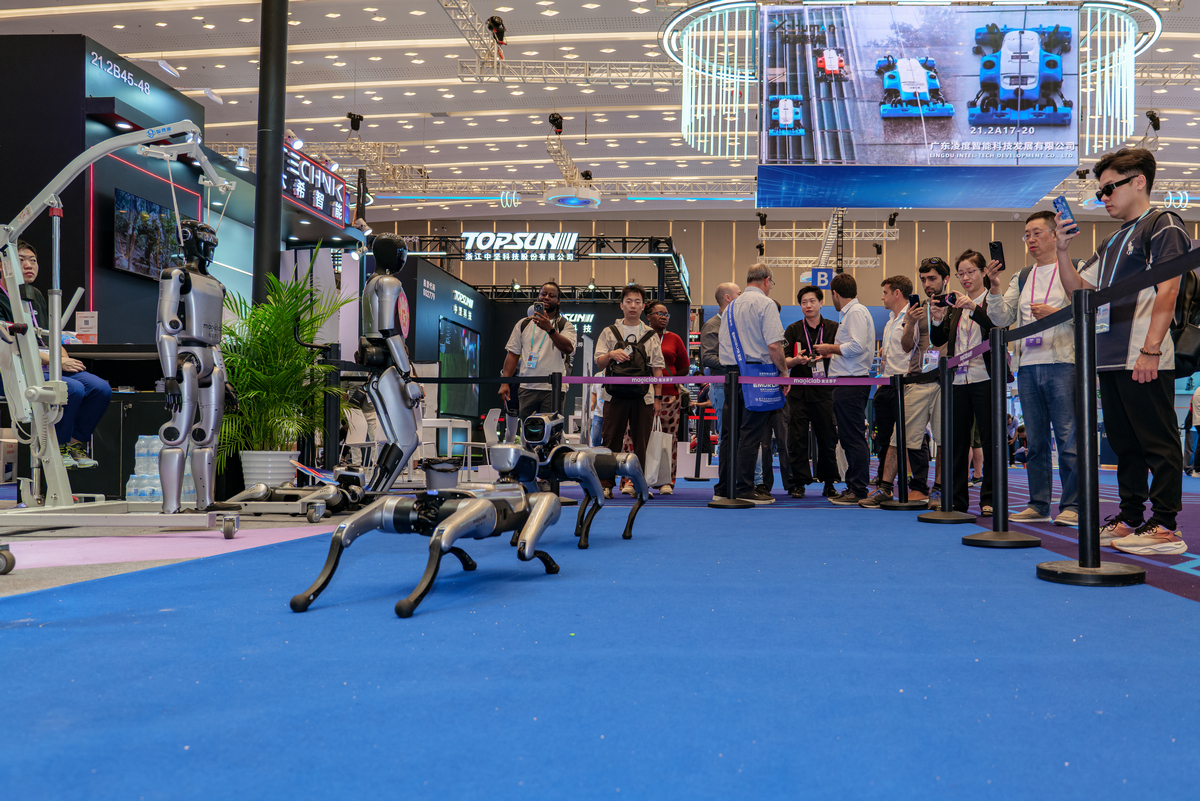
Robot dogs developed by MagicLab attract visitors' attention during the 138th Canton Fair in Guangzhou, South China's Guangdong Province, on October 17, 2025. Photo: VCG
Editor's Note:
From robots capable of complex maneuvers to air conditioners operating stably at 68 C and ceramic Christmas trees blending traditional Chinese craftsmanship with overseas cultures… China's high-quality products are increasingly crossing borders and enriching global consumer choices while ensuring stable global industrial and supply chains.
The outline of the 15th Five-Year Plan (2026-30) for national economic and social development pointed out that China should enhance both quality and performance in foreign trade and work faster to turn China into a strong trading nation.
China's total exports grew 6.1 percent year-on-year to 26.99 trillion yuan ($3.90 trillion) in 2025, demonstrating remarkable resilience and vitality. This rational quantitative growth stems from effective qualitative improvements, as popular Chinese-made products showcase the nation's enhanced innovative capacity, deeper commitment to green development, and brighter prospects for open and win-win cooperation.
Recently, People's Daily reporters conducted site visits and interviews with executives at Zhuhai Gree Electric Appliances, Magiclab Robotics Technology (Wuxi), and Fujian Dehua Xinliang Ceramics Co. Their stories demonstrate that robust green infrastructure, cutting-edge innovation, and rich cultural storytelling form the three pillars behind China's export success, illuminating why Chinese products resonate with consumers across the globe.
'Pain points create demand, and demand breeds business opportunities': Gree Electric Appliances chairwoman Dong Mingzhu
By Wang Yunna from People's Daily
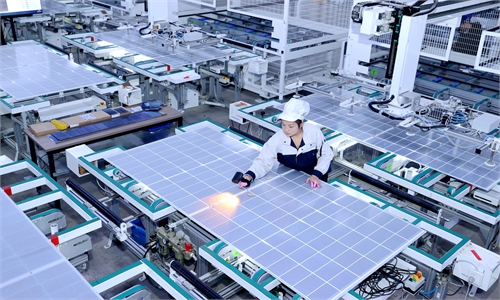
To serve desert and other high-temperature regions, Chinese home appliance giant Zhuhai Gree Electric Appliances Co has developed "desert air conditioners" (ultra-high-temperature cooling air conditioners) capable of stable operation at 68 C. Building on this foundation and leveraging the abundant sunshine in desert areas, Gree has also developed a green, low-carbon photovoltaic energy storage product — the Zero Carbon Source Photovoltaic Storage Air Conditioning Smart Energy System (PV-Storage-Air System). This system can generate electricity while cooling and store excess power for use at night or in cloudy conditions.
Currently, nearly 10,000 sets of the PV-Storage-Air System have been deployed in the Middle Eastern market, reducing carbon emissions by approximately 110,000 tons annually.
Recently, People's Daily reporters conducted an exclusive interview with chairwoman Dong Mingzhu to hear her insights on Gree's exploration and thinking in expanding into global markets.
People's Daily: Since China proposed its "dual carbon" goals, the momentum for green development has continued to strengthen. Meanwhile, an increasing number of countries are exploring green transformation, and demand for green products keeps growing. Facing this trend, how has Gree responded proactively?
Dong: Pain points create demand, and demand breeds business opportunities. For a long time, air conditioning has been a "major energy consumer." In 2013, when I conducted research in the Middle East, I discovered that temperatures there were extremely high, creating strong demand for air conditioning. Units operated for more than 300 days per year, with air conditioning energy consumption accounting for about 70 percent of building energy use. I immediately thought: isn't this precisely the application scenario and market potential for "desert air conditioners"? Solar energy is inexhaustible — why not use it to solve the high energy consumption problem?
In the early stages of research and development (R&D), "desert air conditioners" had a weakness: abundant sunlight meant abundant electricity, but any excess was wasted. Later, after seven years of technical breakthrough efforts, we finally developed the PV-Storage-Air System, which stores excess electricity from air conditioning for use by other home appliances or for integration into the power grid, achieving a circular utilization of "power generation, storage, and consumption."
Years of painstaking effort went into this achievement — the process was arduous. But we always firmly believe: the market does not lack products; it lacks "quality goods." In the home appliance industry, the goal is to move toward green development. Only by enhancing the "green content" of products can new market spaces be opened up.
Facts are the most persuasive. A garment factory in Saudi Arabia previously used traditional air conditioning equipment with monthly electricity bills as high as 80,000 yuan. After adopting the PV-Storage-Air System, monthly electricity costs dropped to 20,000 yuan, with annual carbon emissions reduced by 2,000 tons.
In fact, achieving a good match between supply and demand is also a choice and commitment to a development model.
The outline of the 15th Five-Year Plan (2026-2030) for national economic and social development propose actively promoting green and low-carbon transitions in industry. The fundamental reason we actively seek change and remain committed to developing green products is our belief that China, riding the momentum of comprehensive green transformation, will surge forward, and that enterprises embracing innovation and green development have a promising future.
People's Daily: In 2025, China's exports of home appliances exceeded 4.45 billion units, maintaining a high level. Business opportunities wait for no one, yet the R&D cycle for the PV-Storage-Air System was relatively long. Why did Gree stick to patient R&D, and where does this resolve come from?
Dong: True innovation is not about who is faster, but about who can better solve problems. Although the home appliance industry develops rapidly, merely hyping concepts and focusing on packaging will not win the market. For example, some air conditioners may look attractive with many functions, but their cooling and heating performance is mediocre, with high energy consumption and loud noise — this is putting the cart before the horse.
We do not make products that "put the cart before the horse." There are no shortcuts in technological innovation. At Gree, with 20,000 R&D personnel, only "slow R&D" can build solid capabilities, maintain true quality, and earn good reputations.
Take the PV-Storage-Air System as an example. Its development encompasses photovoltaic, energy storage, air conditioning, and energy information management systems. Every link has technical bottlenecks, and every step requires technical breakthroughs. But we never gave up; we remained steadfast.
In the past, because we did not master the core technology of air conditioning compressors, units would frequently "go on strike" in high-temperature environments. Forget deserts — even in cities with relatively high summer temperatures like Southwest China's Chongqing Municipality and Nanjing in East China's Jiangsu Province, they sometimes couldn't withstand the heat. As we confronted challenges and focused on R&D, our compressors can now operate stably even at 68 C, becoming the "big heart" of "desert air conditioners."
All of this represents accumulated strength in the technical field and also reflects the enterprise's firm commitment to green development. The "green content" of a product depends on its "innovation content." For "China's quality goods" to go global, we must compete on technology and innovation, ensuring customers use our products with confidence and satisfaction.
At the just-concluded two sessions, "innovation" and "reform" became hot topics. This reminds us to maintain our focus, prioritize innovation, and dedicate ourselves to tackling challenging problems.
People's Daily: China boasts the world's most comprehensive and complete manufacturing industry, yet some domestic companies' overseas expansion remains limited to original equipment manufacturing (OEM). Gree's own brand accounts for nearly 70 percent of its export sales; what are the keys to this success?
Dong: Quality is the core competitiveness of a company and brand. In the past, some people were skeptical of "Made in China" products, stemming from concerns about product quality and standards.
Gree's success overseas is due to product quality and technological capabilities. The world recognizes us because our products are of superior quality. In the Middle East, high temperatures, sandstorms, and strong salt spray corrosiveness cause some equipment to break down after a year, but our "desert air conditioner" can last for many years, possessing exceptional resistance to corrosion, sand, and high temperatures.
OEM manufacturing involves processing according to others' standards, while independent brands define their own technologies and set their own standards. Once a new standard becomes a consensus, it can break down prejudices and replace old rules. In recent years, the global green transformation has accelerated, and we have led the development of many green standards within the industry, promoting more green technologies to the world. This fully demonstrates that China's green development and high-quality development also provide a "list of opportunities" for global development.
Guangdong has a strong industrial base, complete supporting facilities, and a strong atmosphere of innovation and open development, which is a solid backing for Gree's independent brand to go global. Rooted in this rich industrial soil, we have always adhered to quality as our foundation. For example, in our decades-long cooperation with upstream suppliers, one ironclad rule has remained unchanged: quality must meet standards, and anything that does not meet standards will be returned. Strict standards drive the transformation and upgrading of the entire upstream and downstream industrial chain.
In the future, we will continue to move toward green and intelligent manufacturing, step by step, so that the world will continue to embrace products made in China.
(Jiang Xiaodan and Tu Sheng also contributed to this article.)
'Popularity should be built on product quality, not hype': MagicLab co-founder Gu Shitao
By Yao Xueqing from People's Daily
From performing complex movements with stability, such as high-speed rotation and aerial jumps, to skillfully performing everyday tasks like scooping noodles and controlling water flow, Chinese robotics startup Magiclab Robotics Technology (Wuxi) has continuously expanded the application boundaries of robots through repeated innovation and breakthroughs. Currently, the company's business has expanded to 27 countries and regions.
Recently, People's Daily reporters conducted an exclusive interview with Magiclab's co-founder Gu Shitao to hear the story of how the company is reaching global markets through innovation.
People's Daily: In recent years, the technological leaps in robotics have been astonishing. Some believe that robots will enter daily life more and faster; others feel that this is just a passing fad and may not last. What is your opinion?
Gu: Short-term buzz relies on luck; long-term success relies on strength.
Many people's first reaction to seeing robots dancing or doing somersaults is that they are just trying to grab attention. But from a technological perspective, this is precisely a demonstration of strength. Take the "Thomas Flare" movement as an example. For a robot to complete actions like support, leg swing, aerial rotation, and re-support, it needs to smoothly shift its center of gravity in an extremely short time. This poses a significant challenge to motion control algorithms and high-precision joint modules.
"One minute on stage takes years of practice off stage." Popularity should be built on product quality, not hype. Ultimately, innovation drives core competitiveness.
MagicLab's core project team was formed in 2021. We started with the most basic joints, released our first humanoid robot in 2023, and have now completed five generations of product iteration. Along the way, with support from government project funding and our persistent efforts, we overcame one technical challenge after another, gradually building our technological moat. Some of our technologies have moved from following others to leading globally.
Innovation is not a solo performance, but a concerto. In our team, research and development (R&D) personnel account for 80 percent, many of whom come from top universities worldwide. We also have R&D centers overseas, maintaining close collaboration with local research institutions. In this industry, cross-border flows of cooperation, talent, and capital are common. Any company aspiring to go global must possess the ability to integrate global resources.
Chinese robots are not merely technological products; their vigorous development represents a certain image and temperament: the sharpness of innovation, the courage of exploration, an open attitude, and a cooperative mindset. I believe that the future of China's robotics industry is bright, and the pace of innovation will not slow.
People's Daily: At the 2026 Spring Festival Gala of the Year of the Horse, four robotics companies, including MagicLab, made a joint appearance. Why has the robotics industry experienced such a flourishing period in the past two years? What tailwinds has MagicLab experienced?
Gu: The emergence of this wave of "entrepreneurship" is no accident; Chinese robotics has advanced step by step with solid effort.
On the production side, breakthroughs have been made in the localization of core components, leading to a continuous decline in costs; on the demand side, industrial upgrading and changes in population structure have created rigid demand; on the policy side, the government supports the development of future industries such as embodied intelligence. With a clear direction and stable expectations, everyone dares to think and act.
The company's choice to cultivate this field is both a response to the trend and an attempt to ride the wave.
As a young company, we face many challenges: we need to iterate rapidly in application development while simultaneously strengthening our fundamental capabilities in basic software and core component R&D. However, developing hard technology is not a sprint, but a marathon. The robotics field is characterized by long R&D cycles, large investments, and slow commercialization, making it difficult for companies to achieve profitability in a short period.
Fortunately, in Liangxi district in Wuxi, East China's Jiangsu Province, where our company is located, local authorities have prioritized humanoid robots and industrial embodied intelligence, establishing a multi-billion yuan parent fund and special industry fund specifically for early-stage, small-scale, and hard-tech investments. In the company's early stages, the district injected over 100 million yuan ($14.4 million) through an "investment instead of recruitment" approach, supporting the company's initial development. More importantly, the local ecosystem is crucial; the district is continuously building industrial platforms and opens application scenarios, promoting the improvement of the entire supply chain support capabilities from technology R&D and product verification to mass production.
Therefore, the flourishing and rapid growth of the robotics industry in the past two years, at a deeper level, is the result of various regions respecting industry trends, fostering patient capital, and adhering to long-term principles. This reflects the nation's strategic resolve to focus on long-term development, and also the company's unwavering commitment to progress.
Riding the wave of industrial growth, we will continue to deepen our expertise. We will solidify innovation, refine technology, and optimize product iteration, bringing more "sharp-eyed" and "skillful" robots into every household.
People's Daily: Last year, China's industrial robot exports increased by 48.7 percent year-on-year. MagicLab's business has expanded to 27 countries and regions. In your opinion, why are Chinese robot products so popular overseas? What are your insights into the globalization of enterprises?
Gu: The success of a product ultimately depends on innovation. In the short term, the market may chase concepts; in the long term, it will pay for value. The growth of China's robot exports reflects consumers' recognition of reliable delivery, high adaptability to various scenarios, and high comprehensive value of the products.
Looking overseas, some countries and regions face problems of "labor shortages" and "high labor costs," and many high-risk work scenarios call for "machines to replace humans."
Where there is demand, there is a market. Taking MagicLab as an example, we have launched industrial quadruped robot solutions in some overseas factories for nighttime inspections and equipment testing in confined spaces; for the warehousing and logistics industry, we have developed mobile operation robots that can collaborate with humans.
These scenarios share a common characteristic: they don't pursue "complete automation," but rather fill the gaps in tasks that humans cannot, are unwilling to, or face high risks for. The value of technology lies not in how flashy it is, but in its usefulness. Overseas consumers choosing us is also an endorsement of our corporate values: innovation must adhere to a problem-oriented and demand-oriented approach.
To accurately identify problems and discover needs, from day one, we did not follow the old path of "domestic first, then overseas," but instead insisted on being "born global." By 2025, the company's global sales network had been largely in place, with sales and after-sales support teams established in many countries and regions. The closer we are to our customers, the more genuine their needs are, and the faster we can respond. The efficiency and innovation capabilities of the Chinese supply chain, combined with the warmth of localized overseas services, are our advantages.
However, going global in the robotics industry also requires navigating a complex trade environment. Technical standards barriers and differences in cross-border data regulation are real challenges. In the next few years, the industry will move from the exploratory stage to the mature application stage. We are willing to be advocates of open technology, practitioners of responsible innovation, and promoters of value co-creation, helping Chinese robots to go global and take root in the world.
'Tradition is not a shackle on development, but fertile ground for innovation': general manager of Dehua Xinliang Ceramics Co Lin Liangbi
By Shi Yu from People's Daily
For 14 years, Xinliang Ceramics Co in Dehua county, East China's Fujian Province, has focused on producing ceramic trees, adhering to innovative research and development (R&D), integrating traditional Chinese techniques with overseas cultures. They have developed over 4,000 ceramic tree designs for different overseas festivals, with cumulative exports exceeding 50 million pieces. Ceramic trees have become popular Chinese products chosen by many foreign families for holiday celebrations.
Recently, People's Daily reporters interviewed Lin Liangbi, the company's general manager, to hear his thoughts on how to bring traditional Chinese techniques to the world.
People's Daily: When people think of ceramics, they first think of cups, bottles, bowls, and plates. How did you come up with the idea of making ceramic trees? Nowadays, many companies are going global, gradually shifting from selling products to selling experiences and culture. What are your thoughts on this?
Lin: In 2011, I returned to my hometown, Dehua county in Quanzhou, Fujian Province, to start a business. The first thing I did was research: What does Dehua have? What does the market want? In 2006, Dehua porcelain firing techniques were included in the National Intangible Cultural Heritage List. Dehua is an important ceramic craft production base in China. It can be said that Dehua ceramics have both traditional techniques as a foundation and a complete industrial chain as a support.
However, in the past, many ceramic factories focused on producing cups, bottles, bowls, and plates, resulting in homogeneous competition, thin profits, and fierce price wars. To succeed, one must choose the right track.
Once, while watching television, I saw a report on a foreign holiday. The Christmas tree in the program had beautiful lights, which inspired me. So I began to research how to combine light beads with ceramics to design a small, exquisite ceramic tree suitable for desktop display. In 2012, I sent samples to overseas clients, and they placed orders on the spot without even negotiating the price. The product's profit margin is 15 percent to 20 percent higher than ordinary cups and plates, and it is still in short supply. This year, our orders are already booked until August.
I believe the reason for our success lies in the openness and inclusiveness of the Chinese culture. Ceramic texture is warm and moist, with rich craftsmanship possibilities. On this foundation, we have delved deeply into overseas holiday cultures, working hard on color presentation and element design. For example, for Thanksgiving ceramic tree products, we added elements like turkeys and pumpkins. Ultimately, selling ceramic trees is not just selling merchandise — it is selling a sense of ritual; they are not merely decorations, but also touch consumers' emotions.
Products are carriers of culture. In recent years, many ceramic products have incorporated traditional Chinese cultural elements such as landscape paintings and paper-cutting patterns into their designs, gaining popularity both at home and abroad. Recently, we've also been experimenting with integrating traditional cultural elements into our ceramic tree designs, allowing consumers to appreciate both the exquisite craftsmanship of Dehua porcelain and the profound heritage of Chinese culture.
As early as the Song and Yuan dynasties (618-1368), Dehua porcelain set sail from Fujian, traveling overseas along the Maritime Silk Road. Today, our ceramic products embark again from this same place, using culture as their sail to voyage afar.
In my view, product globalization comes down to three things: understanding both yourself and the market; upholding tradition while broadening horizons; competing on craftsmanship while knowing how to tell stories.
People's Daily: Since 2012, the company has remained focused on ceramic trees. Why such unwavering commitment?
Lin: For a company, the number of products isn't important; what matters is producing products that others can't make and that customers can't live without. Over the years, we've focused on one thing: perfecting our ceramic trees, accumulating an "irreplaceable" advantage.
Innovation is a company's greatest bargaining power. We insist on investing over 20 percent of our annual profits in R&D. This percentage isn't low, but it's well worth it. For example, recently we collaborated with a glaze factory in Foshan, South China's Guangdong Province, to develop a new type of glaze that creates a snow-like visual effect on ceramic trees, while maintaining a ceramic feel. After applying for a patent, it quickly went into production and has already been tested overseas, with potential to become a hit product.
The foreign trade market has been quite turbulent in recent years, but we're not afraid. The market will eliminate products that don't evolve, but the demand for good products will always exist. Pressure is also a driving force. I often ask myself, if I were a customer, would I buy this product? If not, then we must change it. The more complex the environment, the more proactive we must be in seeking change; the fiercer the competition, the more steadfast we must be in following our own path.
In cross-cultural dialogue, traditional crafts are being revitalized.
Ordinary ceramic glazes are prone to cracking in ultra-low temperature environments. Some of our exported ceramic trees and certain accessories have suffered frost damage, resulting in the company paying over $20,000 in compensation. The amount is small, but the lesson is profound. Product quality is the foundation of a company's confidence. Without good quality, excellent design is meaningless.
Starting in 2022, we collaborated with raw material suppliers of porcelain clay and glaze, as well as kiln equipment suppliers, to tackle these challenges. Relying on modern technological strength, we adjusted traditional formulas and firing techniques. Now, our products can withstand temperatures from minus 35 C to 60 C. Next, we also plan to develop outdoor ceramic trees over two meters tall, suitable for foreign courtyard scenes. As long as our products continue to improve, the company will keep moving forward.
People's Daily: In 2025, China's high-tech product exports increased by 13.2 percent year-on-year. Faced with the continuous optimization of the foreign trade structure and the accelerated upgrading of industries, how should traditional manufacturing enterprises respond?
Lin: "Traditional" doesn't equal "low-end," and even an "old tree" can sprout "new buds."
Dehua ceramics have a long history, and what they have left us is not a burden, but an inescapable advantage. For example, to ensure product uniqueness, core ceramic manufacturing processes, such as throwing and painting, still rely on manual labor. Our factory has over 100 skilled workers. Dehua's abundant and stable human resources are hard to find elsewhere. Furthermore, ceramic manufacturing involves ceramics, electronics, and iron parts, requiring five or six component suppliers, all of which can be found in Dehua.
Of course, traditional industries also have shortcomings: insufficient levels of intelligent and green manufacturing, and weak R&D capabilities. In recent years, the government has introduced supportive policies, and enterprises are increasing investment in intelligent manufacturing. Everyone is working together to find ways to promote industrial transformation and upgrading. Currently, in the initial processing stages, over 60 percent of ceramic enterprises in Dehua have achieved automation, and both output value and efficiency are increasing.
Taking our company as an example, we have introduced automated equipment in early-stage processes such as rolling and slip casting, freeing workers' hands to do more "handicraft work" and "brainwork."
Regarding green transformation, equipment is also being upgraded. Seven years ago, the energy cost of firing a 30-centimeter-tall ceramic tree was 2.8 yuan; now, using energy-saving kilns, the energy cost is only slightly over 1 yuan.
Tradition is not a shackle on development, but rather fertile ground for innovation. By safeguarding our industrial advantages and cultural heritage, and actively upholding tradition while innovating, traditional industries can also forge new paths and create new prospects.
This was compiled from an article originally published on the 13th page of the People's Daily on March 27, 2026.
RELATED ARTICLES