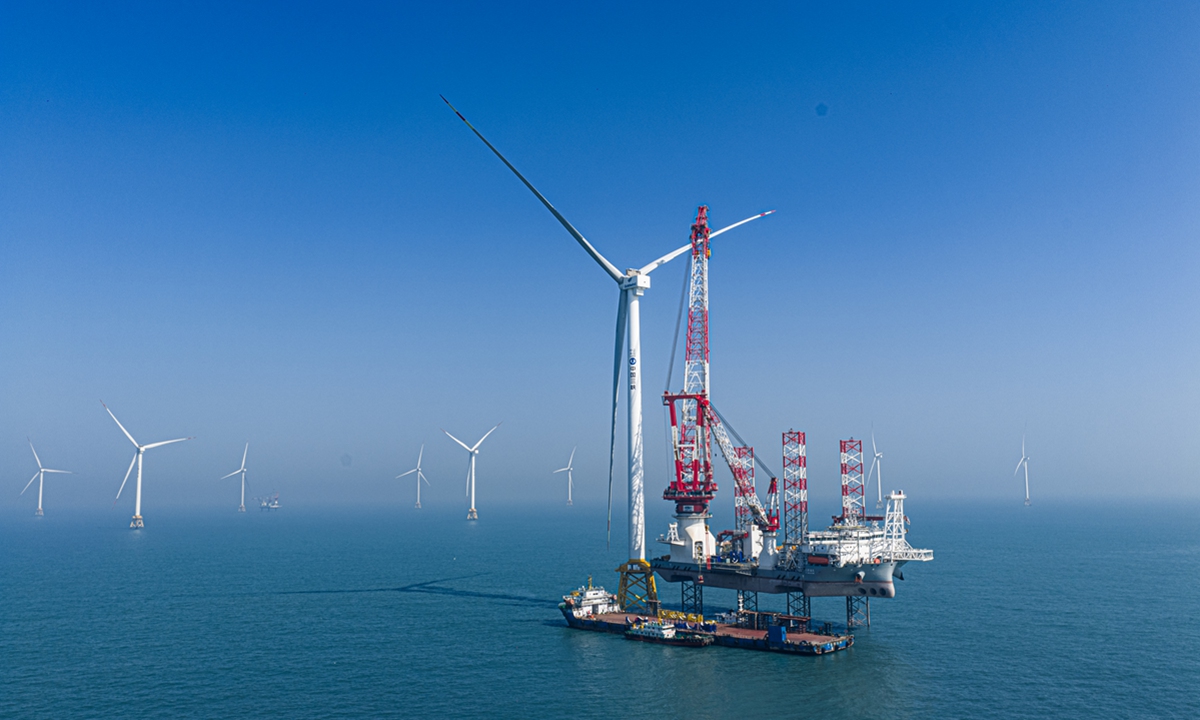
The world's first 20-megawatt offshore wind turbine installed in waters off East China's Fujian Province Photo: Courtesy of China Three Gorges Corporation
Green development and sustainability took center stage at the Boao Forum for Asia (BFA) Annual Conference 2026, with many participants highlighting China's remarkable progress in low-carbon transition, environmental protection, and its green development model that offers a valuable example for the world.
Bright Murr, representative of the Wirtschaftskammer Österreich (Austrian Economic Chambers), told the Global Times at the BFA that she has witnessed great changes in China's approach to environmental protection and sustainability during the past 35 years.
"China is clearly at the forefront of alternative energies, including wind power, solar energy, and electric mobility," Murr said.
While acknowledging significant progress in China, she noted that new challenges for the world remain. "We are fighting climate change, global imbalances, and environmental degradation together. The key is not to focus solely on economics, but on the real impact our economies have on the planet. In this regard, China and Asia can play a vital role in shaping the world's sustainable development," said Murr.
In terms of the role that China and Asia can play in green development, Denis Depoux, global managing director at Germany's strategy consulting firm Roland Berger, noted China's abundant supply of green energy for a wide range of industries.
"Chinese companies and industries, as well as multinationals operating in China, are now far more prepared to go low-carbon than they were five years ago. Five years ago it was difficult because there wasn't enough green energy and it was too costly," Depoux told the Global Times on Wednesday.
"But now we have a very different picture. Massive investment in renewable energy has created abundant low-carbon electricity. China is actually accelerating its pace of decarbonization because it has become a competitive advantage. The launch of China's national carbon market and its continued policy push toward peaking carbon emissions by 2030 and achieving carbon neutrality by 2060, clearly demonstrates this commitment."
According to the latest data from the Ministry of Ecology and Environment, the trading volume of carbon emission quotas in China reached 235 million tons in 2025, marking an increase of 24 percent year-on-year, with a turnover of 14.63 billion yuan ($2.08 billion).
China has also helped other countries and regions advance green development in the past years.
Ni Zhen, Chairman of China Energy Engineering Group Co. Ltd. (Energy China), told the Global Times on Wednesday on the sidelines of the BFA that the company's overseas new-energy projects now exceed 20 gigawatts in total installed capacity.
"The concept of 'future energy' has been written into the Government Work Report for the first time this year, marking the transition of the 'energy powerhouse' goal from vision to concrete action. We will focus on cutting-edge fields such as green hydrogen and ammonia, high-altitude wind power, and carbon capture, while aiming to scale up green energy demonstration projects and provide Chinese solutions for global energy transition," said Ni.
When it comes to the role of Asia as a whole in boosting green transition, Volkan Bozkir, President of the 75th UN General Assembly, said on Wednesday at a BFA session discussing the sustainable development goals that Asia's experience offers an important example of diverse development models.
"Asia has developed very rapidly in digital infrastructure, and technological progress can help us achieve multiple goals. The pragmatic approach to green transition enables greater access to renewable energy and more production facilities, allowing us to strike a balance between growth and sustainable development," said Bozkir.