EP delegation reportedly to visit China after 8-year gap; one visit unlikely to end entrenched biases, but direct talks could help some politicians see China more objectively: Chinese expert
By and Ma Tong Published: Mar 27, 2026 11:53 PM

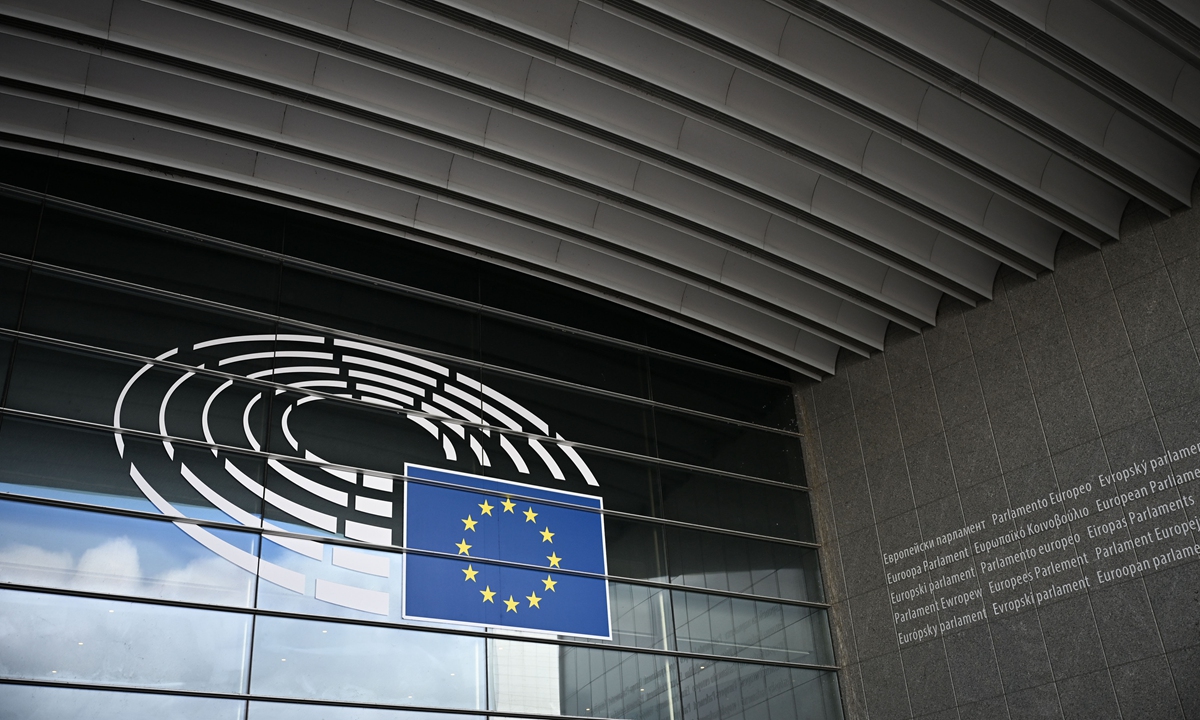
A view of the logo of the EU Parliament in Brussels on March 26, 2026. Photo: VCG
A European Parliament delegation will travel to China from March 31 to April 2, marking the first such visit in eight years, according to a release from the European Parliament website. A Chinese expert noted that one visit alone is unlikely to fundamentally shift the European Parliament's entrenched biases of China, but such direct contact may help some European politicians view China's development more objectively.
This is the first Parliamentary delegation to China in eight years and an important opportunity to address shared digital and e-commerce challenges and foster fair EU-China competition, according to the release on Thursday.
The nine-member delegation will visit Beijing and Shanghai. In Beijing, the delegation is scheduled to meet with Chinese officials and visit the EU Chamber of Commerce to discuss online trade and market access challenges faced by European companies in China. They will also discuss consumer and product safety standards with the e-commerce giants Shein and Alibaba. In Shanghai, members of the European Parliament will continue discussions on compliance with EU digital market rules and fair competition with Temu, according to the release.
The release also noted that 'the visit will enhance EU lawmakers' understanding of China's innovative tech sector and e-commerce dominance, while examining how EU rules are complied with in practice.
The visit comes as China and the EU resume legislative exchanges after years of disruption. The channel began reopening last year, when a delegation from China visited the European Parliament, signaling a gradual restoration of contact, Cui Hongjian, a professor at the Academy of Regional and Global Governance at Beijing Foreign Studies University, told the Global Times on Friday.
According to the release, the delegation will be led by the chair of the Internal Market and Consumer Protection committee Anna Cavazzini. In an interview with Heinrich Böll Foundation in June 2024, Cavazzini backed the EU's additional tariffs on Chinese EVs and claimed that the move was rules-based and necessary to respond to Chinese subsidies.
The members of the European Parliament participating in the delegation also include Andreas Schwab (European People's Party, Germany), Dirk Gotink (European People's Party, Netherlands), Christel Schaldemose (Progressive Alliance of Socialists and Democrats, Denmark), Pierre Jouvet (Progressive Alliance of Socialists and Democrats, France), Virginie Joron (Patriots for Europe, France), Piotr Muller (European Conservatives and Reformists, Poland), Stephanie Yon-Courtin (Renew Europe, France), and Engin Eroglu (Renew Europe, Germany), chair of Parliament's delegation to China, according to the release.
Some members of the European Parliament have long been widely known as the spearhead of anti-China rhetoric. In recent years, the European Parliament has passed multiple motions and resolutions criticizing China over topics related to China's Xinjiang and Hong Kong, leading to firm opposition from the Chinese side.
The European delegation's agenda reflects the EU's main economic concerns over China, particularly in the internal market and digital sector. In recent years, Brussels has increasingly stressed "de-risking," cast China as a source of unfair competition, and stepped up scrutiny of Chinese firms in cross-border e-commerce and the digital economy, including Alibaba, Shein and Temu. However, Europe's e-commerce growth has been slower and traditional consumption patterns remain more entrenched, making the rise of Chinese platforms a growing pressure on European competitors, Cui said.
The expert pointed out that one visit alone is unlikely to fundamentally shift the European Parliament's view of China, but the direct contact could help giving European lawmakers firsthand exposure to China's economic development, tech innovation, and the operations of its digital platforms and logistics systems, which may help some European politicians move beyond entrenched biases and view China's development more objectively.
Meanwhile, on Thursday, the European Commission has cast aside German Chancellor Friedrich Merz's suggestion to pursue a trade deal between the European Union and China, calling instead on Beijing to "meaningfully" address its "distortive economic practices," according to a report from the Euronews.
"I can envision further agreements, for example, in the longer term, an agreement with the People's Republic of China. We now need strategic partnerships worldwide to strengthen ourselves, especially in exports," said Merz, per Euronews.
Brussels' snubbing of Merz's proposal for EU-China trade deals shows that the split perception on China and negative tendencies in the EU's approach toward China are unlikely to fade in the short term. Whether in the European Parliament or the European Commission, "de-risking" remains a priority, often coupled with the politicization of differences and repeated emphasis on ideological and systemic divides. These factors will continue to complicate China-EU relations, said Cui.
Against this backdrop, China could continue using such visits to present a real and comprehensive picture of the country, while firmly safeguarding its legitimate rights and interests against misguided European policies , said the expert.
Merz paid an official visit to China from February 25 to 26. Aside from Merz, several European leaders have visited China since the beginning of 2026, including Irish Taoiseach Micheal Martin, Finnish Prime Minister Petteri Orpo, British Prime Minister Keir Starmer.
Cui said stable China-EU relations should be maintained through principled engagement that helps the European side better understand China's intentions and position, with cooperation and Chinese companies and products rights protection advancing in parallel.
RELATED ARTICLES