Over 1,000 demand Takaichi to apologize to China over embassy intrusion, yet media urges China to drop its ‘bad habit’ of criticizing Japan; experts warn of cover-up fueling militarist shift
Evasive handling widely criticized, arousing concerns of Japan’s rightward shift
By Published: Mar 29, 2026 12:18 PM

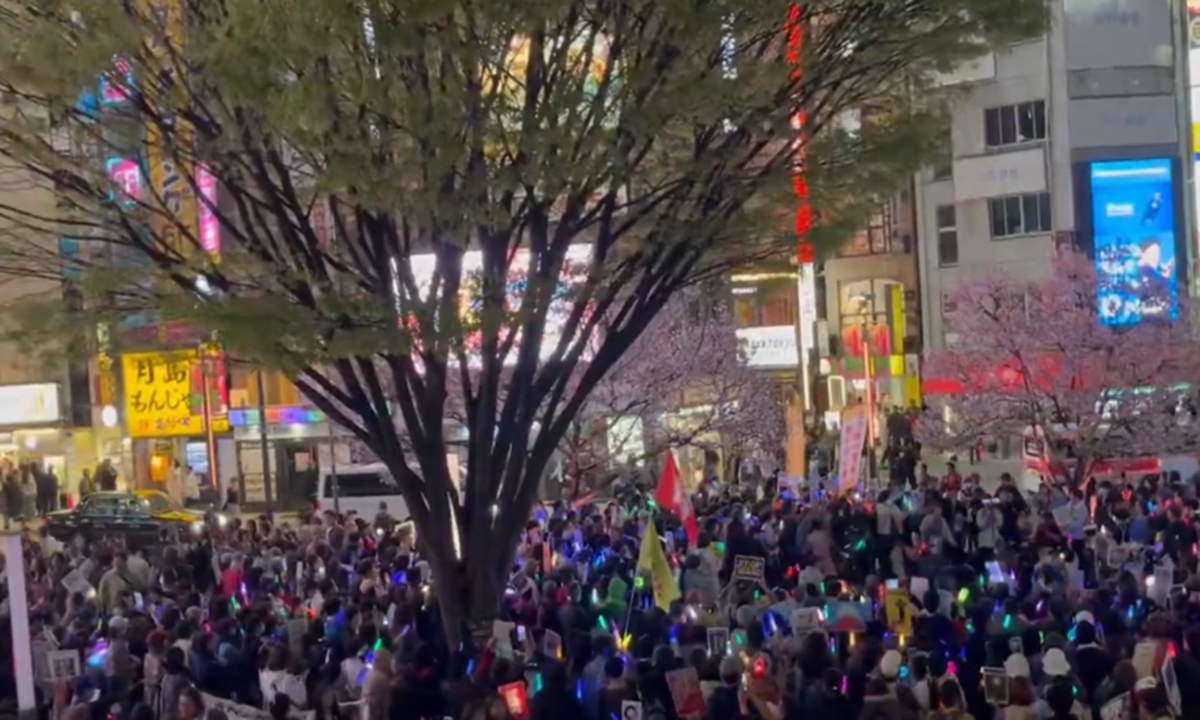
Photo: a screenshot of the demonstration at Tokyo's Shinjuku Station on March 28, 2026
Viral videos circulated online showed that more than 1,000 Japanese demonstrators gathered in Tokyo's Shinjuku station on Saturday to mark a local peace festival. Holding placards and glowing sticks, the people at the gathering chanted "Apologize to China" and "Prime Minister Takaichi, apologize," just a few days after a 23-year-old second lieutenant in Japan's Ground Self-Defense Force, forcibly broke into the Chinese Embassy in Tokyo while carrying a 31-cm blade and threatened to kill diplomatic personnel on March 24.
Around 1,400 people, per organizers' estimate gathered at the event held in front of Shinjuku Station, according to a report by Japan's Kanagawa Shimbun on Saturday. However, even this rare report over the event did not cover the criticism message against the government response to the incident.
However, contradicting the seemingly deliberate silence of the Japanese mainstream media, Japanese people are voicing their message on social media platform X. Per on-site Japanese participants and the event organizer, approximately 5,000 watched the live broadcast, wrote @mit0919Sahne, one of the promoters of the relevant videos, on X.
Many people at the gathering were seen chanting slogans such as: "Apologize for the terrorism of Self-Defense official, government!" "Takahashi, apologize!" "Koizumi, apologize!" "We apologize on your behalf!" "China, we're sorry," according to a video of the Saturday gathering released by Japanese netizen going by @cobta on X.
Some demonstrators also gathered under the cherry blossoms at the Shinjuku Station Southeast Exit Plaza and their voices rose together in a powerful finale, with the chorus of Japanese version of "Do you hear the people sing" echoing through the plaza, according to a video of the gathering posted by @asaoka_akiko.
"Will you join in our crusade? Who will be strong and stand with me? Beyond the barricade, is there a world you long to see? Then join in the fight. That will give you the right to be free!"
And according to a post by Japanese X user @pplgovote, even after the Saturday demonstration officially ended, the raw voices calling "Takaichi, step down!" continued for quite some time without stopping.
Collective silence
Japanese media have largely remained silent about the Shinjuku protest.
Instead, Japan's Sankei Shimbun published an editorial on Sunday in which it turned a deaf ear to the protests, downplayed the severity of the intruder's crimes, and instead urged that China correct its so-called "bad habit" of criticizing Japan.
After stating that "it is natural that the Chinese side protested to Japan regarding the incident," the Sankei Shimbun editorial claimed that "on the other hand, it is unreasonable for China's Ministry of Foreign Affairs to criticize the incident as reflecting the formation of 'new militarism' in Japan. Militarism is not running rampant in Japan." The editorial went further to even urge that China should break its "bad habit" of using anything and everything as a tool to criticize Japan.
"It is safe to say that the mainstream Japanese media is actively cooperating with the Takaichi administration's crisis public relations efforts. They are attempting to downplay a major issue into a minor one, dilute its seriousness, confuse right and wrong, and mislead the public. The Sankei Shimbun is particularly notable in this regard," Liu Jiangyong, a professor at the Institute of International Studies at Tsinghua University, told the Global Times.
Global Times reporters noticed that as of press time Japanese mainstream media services including Asahi Shimbun, Yomiuri Shimbun and Mainichi Shimbun, have not covered the rally or released commentary.
By remaining silent on the pro-peace forces in Japan and reinforcing the "China-threat theory," they are creating a public opinion environment for the Takaichi government to pursue constitutional revision and military expansion, while covering up the rampant far-right ideology within the Self-Defense Forces and the fact that the education system beautifies Japan's history of aggression, Xiang Haoyu, a distinguished research fellow at the China Institute of International Studies, told the Global Times.
The stark contrast between the Shinjuku protest and the media's silence reflects the core dilemma that Japanese society is currently facing. The awakening of peace forces is still far from sufficient, said the expert.
More investigation yet no apologies
So far, Japanese authorities including Defense Minister Shinjiro Koizumi and Chief Cabinet Secretary Minoru Kihara had only expressed so-called "deep regret" over the incident without offering an official apology, which has also met floods of criticism from Japanese political elites such as former prime minister Yukio Hatoyama.
On Saturday, the Japanese former leader wrote in a post on X that "by intruding while carrying a weapon, it is entirely reasonable to view this as a deliberate border violation carried out with the intent to kill the Chinese Ambassador. The Ministry of Defense should immediately take action - the Defense Minister himself, or at minimum the Chief of Staff of the Ground Self-Defense Force, must assume responsibility without delay."
However, the case is now only handled by the police authorities, which was seen by Chinese observers as deliberate downplay of the seriousness of the incident.
TBS News, a Japanese cable and satellite news channel owned by Tokyo Broadcasting System Television updated Sunday morning that Tokyo Metropolitan Police Department's Public Security Bureau has just conducted a search of the garrison in Miyazaki Prefecture where the man belongs. The target of the search by the Public Security Bureau, according to the report, carried out moments ago on suspicion of building trespassing, is the JGSDF Ebino Garrison located in Ebino City, Miyazaki Prefecture.
The report cited investigative sources and claimed that 3rd Lieutenant Kodai Murata, 23, of the Ground Self-Defense Force was arrested on suspicion of intruding into the Chinese Embassy in Tokyo's Minato Ward on the 24th of this month. The Public Security Bureau conducted the search as it relates to the suspect Murata. Through this search, authorities plan to proceed with confirming the details of the charges and other matters going forward, the report clamed.
Also criticizing on the Japanese authorities' reluctance to formally apologize to China over the incident, Hitoshi Tanaka, Japan's former deputy minister for foreign affairs, wrote on X on Sunday that "Will the fact that a Self-Defense Force member broke into the Chinese Embassy armed with a knife be dismissed with a mere 'regrettable'?"
An intrusion into a foreign diplomatic mission by someone wielding public authority is an extremely serious issue, and the discipline of the Self-Defense Forces must be called into question, he wrote, while noting that "In the past, maintaining strict discipline within the Self-Defense Forces has always been emphasized. However, in recent years, signs of declining discipline and former Self-Defense Force officers casually speaking about war in an unrestrained manner have become increasingly noticeable."
"Protect the Article 9" was also one of the sounding voices chanted at the Saturday gathering, according to Japanese X user @otomi333san, and the user noted that "the voices of young people, especially young women, are particularly loud." "Young people are feeling a strong sense of crisis toward the Takaichi administration."
Japan's investigation into the embassy intrusion incident remains confined to the police level, deliberately sidestepping the severe diplomatic damage caused and the grave violation of international law. This fully exposes the arrogant attitude of the Japanese authorities in obfuscating facts and evading responsibility Lü Chao, Dean of the Institute of American and East Asian Studies at Liaoning University, told the Global Times on Sunday.
As Japan's Prime Minister and head of the cabinet, Takaichi should offer a formal apology to China. The Japan Self-Defense Forces, as the party directly responsible, must also conduct a thorough investigation into the incident and issue a formal apology to China. This is by no means a mere internal disciplinary issue, as even the Japanese public widely recognize it as a symbolic event marking the resurgence of Japan's far-right and militaristic forces," the expert noted.
Japan is not without historical experience in handling security breaches against foreign diplomats. On March 24, 1964, then US ambassador to Japan Edwin Reischauer was stabbed in front of the US Embassy in Tokyo. The Japanese government at the time displayed an "extraordinarily" swift response: then prime minister Hayato Ikeda personally called the US president and apologized to the American people on behalf of the Japanese people via satellite broadcast; the following day, then chairperson of the National Public Safety Commission, Takashi Hayakawa, resigned. This incident directly led to the establishment of the Protection Section of Japan's Tokyo Metropolitan Police Department.
Knowingly blurring
Within the Japanese government, there is a strong atmosphere of not wanting to escalate the incident, with some officials describing it as "not the kind of matter that would develop into a major issue," local media Asahi Shimbun reported Saturday, citing senior government official. Some voices in the defense ministry have also expressed concern that "this could serve as a useful political card for China," per the report.
"Is this the reason Japan is not apologizing? It's astonishing," Koichi Kawakami, a professor of Laboratory of Molecular and Developmental Biology of the Japan's National Institute of Genetics and Department of Genetics wrote on X.
"Mere fact that 'a Self-Defense Force officer who broke into the embassy carrying a weapon and hid inside was handed over to Japanese judicial authorities' already gives China a card to play. Precisely because of that, the only way to neutralize the effect of that card is for Japan to apologize and take appropriate responsibility, isn't it?," he questioned in the X post on Saturday.
RELATED ARTICLES