China achieves first full-performance milestone in megawatt-class liquid hydrogen aviation engine
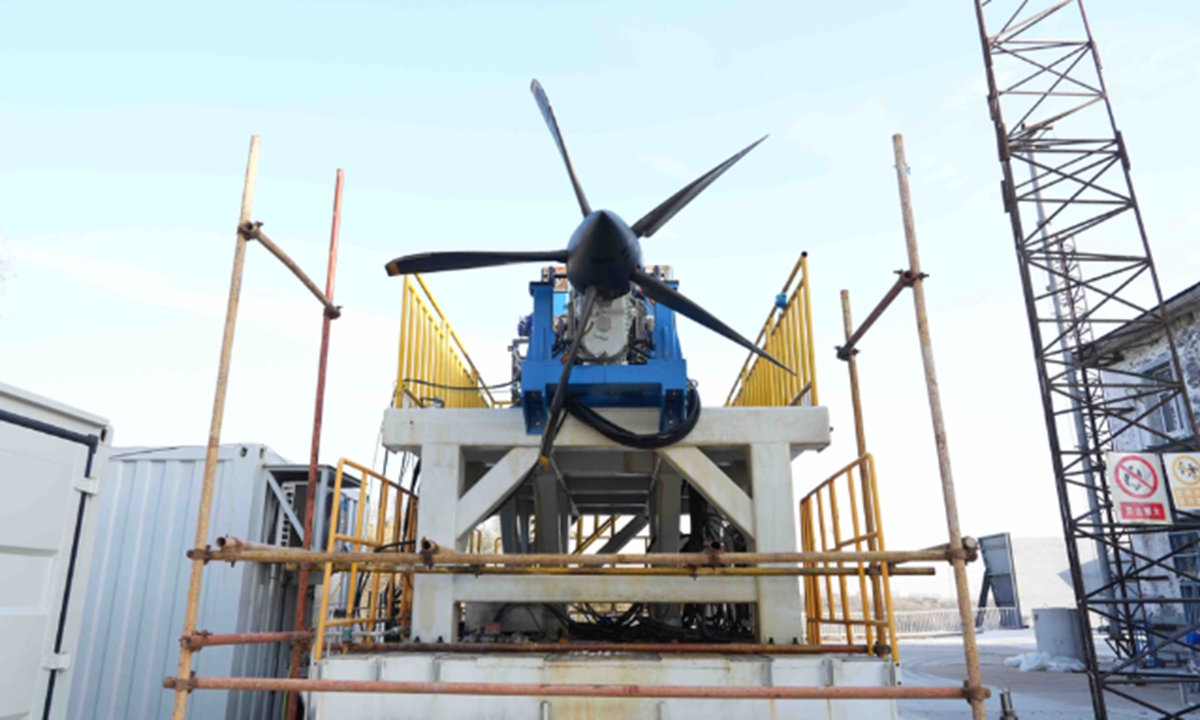
AEP100 turboprop Photo: Science and Technology Daily
The AEP100 turboprop, independently developed by a research and development institute of Aero Engine Corporation of China (AECC), has successfully completed full ground-tests. It marks China's first liquid hydrogen engine to meet megawatt-level full-performance standards, the Science and Technology Daily reported on Sunday.
Developed by the AECC Hunan Aviation Powerplant Research Institute in Zhuzhou, Central China's Hunan province, the turboprop conducted ignition and performance adjustment tests under ground test conditions. During the tests, all indicators of the engine and the liquid hydrogen transport system were normal, and the engine operated stably under full conditions.
Liquid hydrogen's high energy density and zero emissions make it a promising solution for aviation decarbonization. The successful test of the liquid hydrogen turboprop engine demonstrates technical feasibility, marking a breakthrough in key technologies for liquid hydrogen turbine power in China. It lays a solid foundation for transitioning liquid hydrogen turbine power from the experimental stage to engineering applications, according to the report.
In the next step, liquid hydrogen aviation engine technology is expected to be first applied in scenarios such as unmanned aerial logistics and regional aviation, and later gradually extended to mainline aviation. The technology could help support the development of a trillion-yuan industrial chain spanning green hydrogen production, hydrogen liquefaction, cryogenic storage and transport, and refueling infrastructure. It would also drive collaborative innovation in high-end equipment manufacturing and new materials, and fostering strong momentum where breakthroughs in advanced aviation technology lead the development of strategic emerging industries, it said.
According to Wang Yanan, editor-in-chief of Beijing-based Aerospace Knowledge magazine, liquid hydrogen aviation engines are currently still in the exploratory stage worldwide. Due to limitations in equipment lifespan, energy density, storage costs and safety, they are unlikely to be applied to commercial passenger aircraft in the short term. In the future, they are more likely to be first used in research or specialized aviation fields, while their feasibility for emerging low-altitude applications has yet to be demonstrated.
While liquid hydrogen engines offer decarbonization potential, challenges in cost, performance, safety and reliability mean they are not yet ready to replace conventional aviation fuels, Wang told the Global Times on Sunday.
To replace existing aviation engine systems, new technologies must meet two core conditions: achieve decarbonization while ensuring that cost, performance, safety, and reliability do not fall below current levels, Wang said.
RELATED ARTICLES