Illustration: Xia Qing/GT
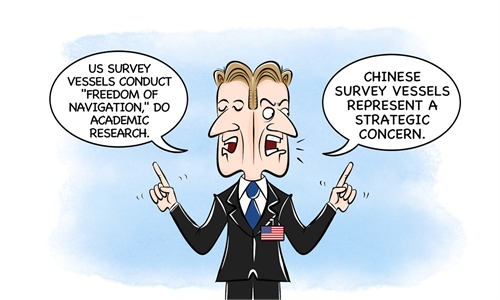
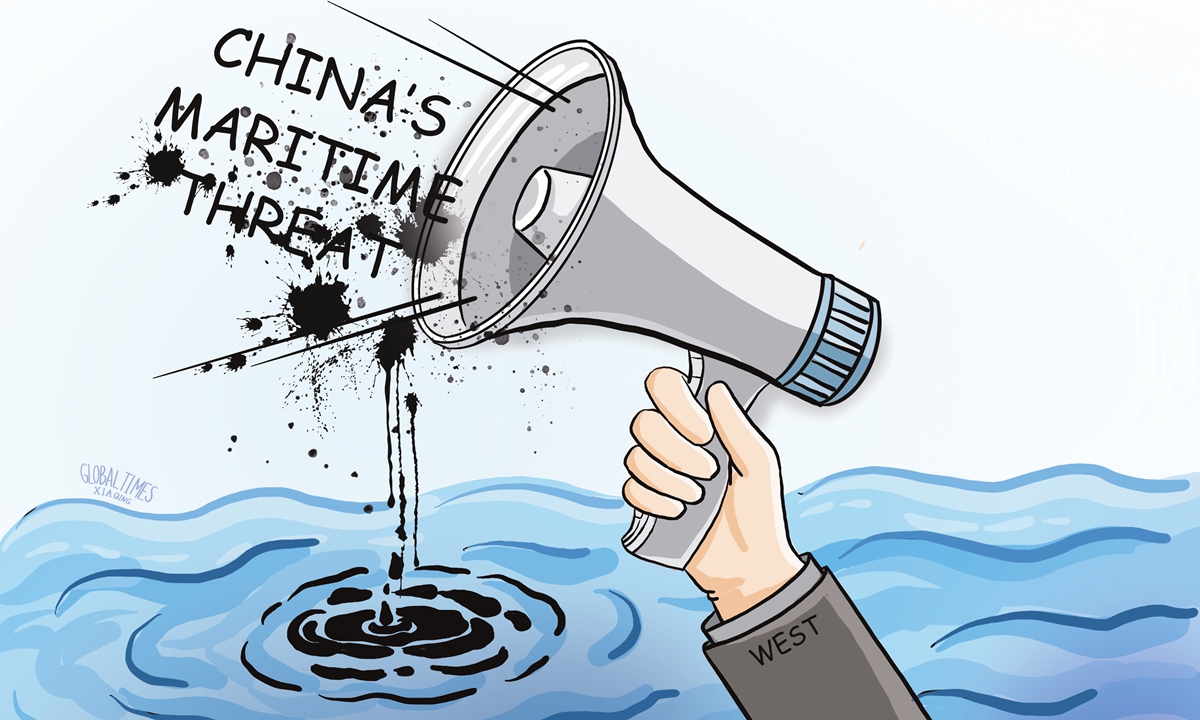
Recently, international media outlets have engaged in disinformation regarding China's marine scientific research activities, distorting normal scientific expeditions China conducted in the Pacific Ocean, Indian Ocean and other areas as "seabed mapping" and "submarine warfare preparation" serving military confrontation.Such reports are not isolated incidents; rather, they represent a targeted narrative constructed by the US and Western countries within the context of great-power competition to serve their own geopolitical agendas. Notably, an official from the US Office of Naval Intelligence recently listed China's normal marine scientific research activities as a "strategic concern" in congressional testimony. The synergy between media and official narratives makes these reports appear more as attempts to shape public opinion to suit Western agendas.
In recent years, certain countries have smeared China's normal marine scientific research as a "gray zone tactic" and continuously hyped the "China threat" rhetoric. These reports substitute subjective speculation for objective facts, alleging that the activities of Chinese research vessels have the value of military applications, yet they have consistently failed to provide any direct evidence that these activities are actually used for military purposes. In contrast, the Chinese marine scientific research activities and vessels in question have publicly stated these missions are clearly aimed at legitimate purposes such as scientific research, climate change monitoring and marine resource surveys. Equating "speculative military value" with "actual military purpose" is a typical logical fallacy of "presumed intent."
An objective assessment of China's marine scientific research activities should be grounded in the legal framework of the United Nations Convention on the Law of the Sea (UNCLOS).
Article 238 of the convention explicitly states that all states, irrespective of their geographical location, and competent international organizations have the right to conduct marine scientific research subject to the rights and duties of other states as provided for in this convention.
Article 239 emphasizes that states and competent international organizations shall promote and facilitate the development and conduct of marine scientific research in accordance with this convention.
Article 242 highlights that states and competent international organizations shall, in accordance with the principle of respect for sovereignty and jurisdiction and on the basis of mutual benefit, promote international co-operation in marine scientific research for peaceful purposes.
In reality, traditional maritime powers like the US and Western countries have long relied on asymmetric maritime battlefield information to maintain their dominance at sea. They have consistently treated the deep ocean as an arena for their geopolitical contests, attempting to monopolize the advantages and institutional power in global ocean governance.
These traditional maritime powers harbor significant resistance and apprehension toward emerging nations, Global South countries and geographically disadvantaged states exercising their legal rights, participating in global ocean governance and sharing in the benefits of ocean development. This mind-set is closely tied to their entrenched traditional sea power thinking, which was already evident in the intense exchanges between different states and groups during the negotiation of UNCLOS.
Currently, facing the continuous growth of China's marine science and technology capabilities and the rapid advancement of its marine research levels, as well as its open and inclusive attitude, the US and Western countries are experiencing discomfort and anxiety. Within the narrative context of "pan-securitization," when dealing with a "maritime player" like China, which possesses late-mover technological advantages, a deep understanding of international maritime law and continuously proposes leading governance concepts, the US and Western countries mostly choose a simple but misguided path: serving their own strategic agendas by "manufacturing the China threat" and "amplifying China-related anxiety." This approach is evident in issues concerning China's peripheral seas, and it largely applies to deep-sea and ocean issues as well.
Marine scientific research is a common endeavor for all humanity. China's active pursuit of marine scientific research, conducted in strict compliance with international law and customary practices, is not only legitimate but also holds significant importance for enhancing global marine knowledge, addressing climate change, and promoting sustainable marine development.
Forcibly linking marine scientific research to "military threats" represents a distortion of the spirit of international law and undermines the consensus for cooperation in global ocean governance. The deep ocean should not become an arena for geopolitical confrontation, but rather a shared space for all nations to explore together and safeguard collectively. As a defender of the international maritime order and a contributor to global ocean governance, China will, as always, based on mutual respect, equality and mutual benefit, promote the building of a maritime community with a shared future, making the ocean a bond connecting nations and fostering cooperation, rather than a barrier dividing the world.
The author is the director of the Research Center for International and Regional Studies at China's National Institute for South China Sea Studies. opinion@globlatimes.com.cn
RELATED ARTICLES