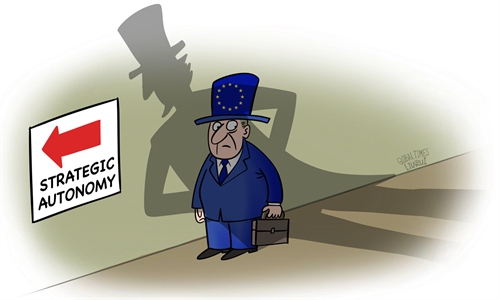
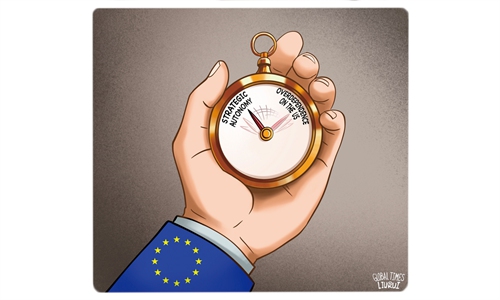
‘Disparity between the economic and geopolitical interests of EU and US can no longer be denied’
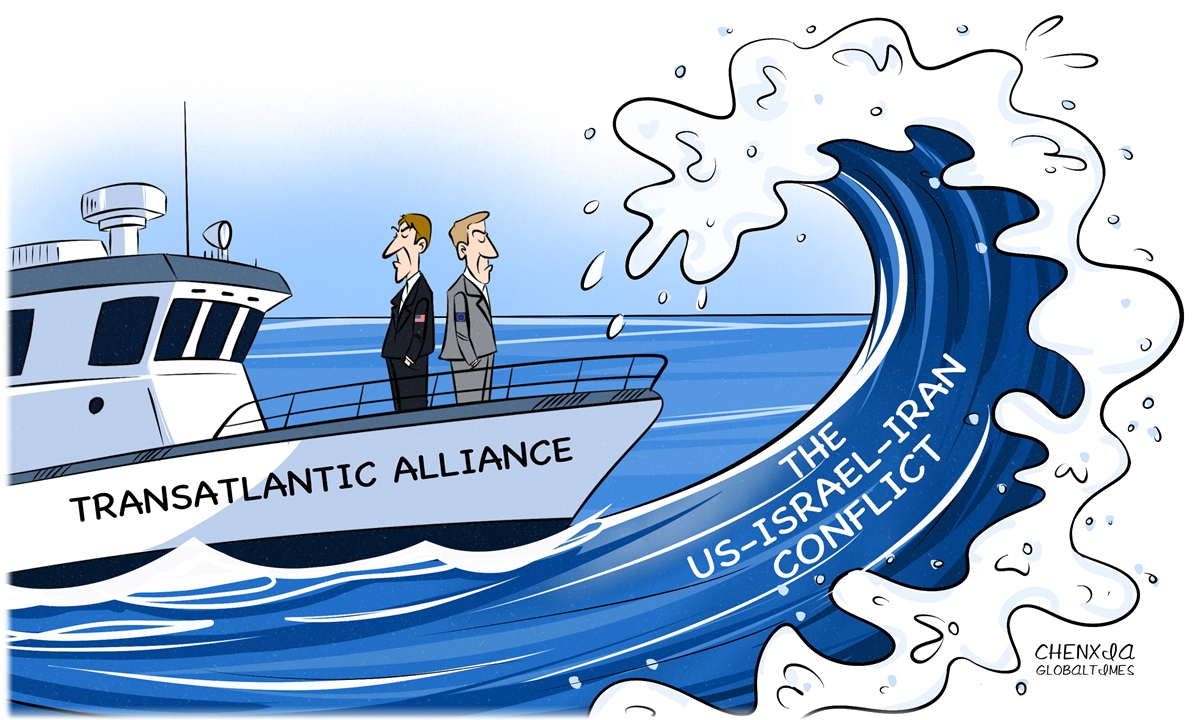
Illustration: Chen Xia/GT
Editor's Note:Across the Atlantic, transatlantic unity has begun to show significant cracks, as disagreements between the US and the EU have resurfaced over issues of trade, industrial policy and strategic autonomy following a substantial shift in US foreign policy under the current administration. In this context, the Global Times (GT) has launched a commentary series, "The widening transatlantic rift," inviting scholars and experts from both home and abroad to share their views. In an interview with GT reporter Wang Wenwen, Martin Sonneborn (Sonneborn), a German member of the European Parliament, said that EU political leaders will have to address the public's awareness of the divergence between the EU's interests and those of the US.
GT: As the US-Israel-Iran conflict exacerbates, many observers have pointed to the already fracturing transatlantic alliance between the US and Europe. In your view, how will the conflict transform the transatlantic alliance?
Sonneborn: During the long period of relative peace prior to 2022, NATO was increasingly confronted with the question of its own justification for existence. More and more Europeans - including those with transatlantic leanings - couldn't see the point of this alliance, a sentiment reflected, for example, in French President Emmanuel Macron's remark that NATO was "brain-dead."
While the start of the Ukraine conflict initially seemed to provide the alliance with the long-sought justification for its existence, it also marked the beginning of a process that, from the perspective of European transatlanticists, was counterproductive - a process that was further intensified by the war in Iran. While it was previously plausible to argue that European and US interests were fundamentally aligned, if not identical, the deep contradictions that have always existed but were previously hidden have now come to light, most recently in the US-Israel war against Iran. The disparity between the economic and geopolitical interests of the EU and the US can no longer be denied.
GT: Do you think the disparity is amendable or irreversible?
Sonneborn: I believe this process is irreversible. The European public has developed an awareness of the factual divergence between the EU's interests and those of the US, a reality that EU political leaders will have to address sooner or later if they do not wish to further jeopardize their credibility.
If the EU is to survive the current state of crisis, it faces a crucial decision that will determine its very existence: Either it will succeed, for the first time in its history, in repositioning itself autonomously, guided by the fundamental interests of its citizens, respectful engagement with other cultures and peaceful coexistence with the world's centers of power, or the EU will go down in history as the last major colony of a declining empire - having become, through its stubborn refusal to learn, an openly subjugated and exploitable developing nation on the periphery of the US.
There would be a certain irony if the Europeans - the very inventors of colonialism, organized exploitation, and systematic subjugation - were to meet the same fate as those whose suffering in America, Africa and Asia once laid the foundation for Europe's wealth and power in the first place.
GT: There have always been calls within Europe for strategic autonomy. What challenges does Europe face on the path to achieving strategic autonomy?
Sonneborn: I see the biggest challenge here being the political thinking that necessarily precedes political action. The key problem is the - in my perspective, inadequate and now outdated - mental predisposition of European politicians. After 70 years, Europe's asymmetrical ties to the US and the pervasive dogma of transatlanticism have become such a fundamental part of Europe's self-image that most people are now barely able to even identify Europe's own interests. To articulate this openly - perhaps even in direct confrontation with the US - would likely strike some people - to put it bluntly - as a form of heresy.
However, this is precisely where an EU seeking to free itself from its historical and ideological dependencies would need to begin in order to achieve an autonomous strategic position.
GT: The US believes that if allies benefit from its protection, they should reciprocate in moments of American strategic need. Do you think the pattern of collective security still applies in the current era? Does the US provide security protection to Europe, or is it, in fact, a security threat?
Sonneborn: The concept of collective security dates back to the Cold War era and the intense confrontation between the two blocs. At a time when the hegemonic order dominated by the US following the collapse of the former Soviet Union is itself disintegrating, and the "Pax Americana" - which in reality was always a "Bellum Americanum" - a struggle by the US to maintain its own global supremacy, is being replaced by a multipolar system, the concept of "collective security" can only survive if it is imbued with contemporary meaning.
Against the backdrop of European history, the Peace of Westphalia must be cited here as a guiding principle - a protracted process of balancing interests in which the warring parties viewed war and diplomacy, combat and mediation, cannon fire and negotiation not as opposites, but as interconnected parts of an overarching process that, through the recognition of power interests, a substantial willingness to compromise, and concrete guarantees, ultimately led to a peace settlement and pan-European stability.
I am a proponent of this historical yet timeless understanding. As long as the binary thinking of the US - borrowed from the friend-or-foe absolutism of the German philosopher Carl Schmitt - prevails in the EU, there will be no progress and no path to peace in Europe.
And as long as the old (Great Britain) and new colonial powers (the US) maintain extraterritorial military bases across the entire European continent - which they use at will to wage wars of aggression, from Ramstein to Cyprus - a growing number of EU citizens perceive the alliance not as a source of protection, but rather as a threat.
GT: As a German member of the European Parliament, how will you persuade your government and even the whole Europe to seek diplomatic and security policies that are more independent from Washington?
Sonneborn: Ultimately, the only way to exert pressure on national and European officials and so-called political elites will be "from below." This can only come from the democratic base and can only be achieved through persistent awareness-raising and political education of citizens.
RELATED ARTICLES