Illustration: Liu Xidan/GT
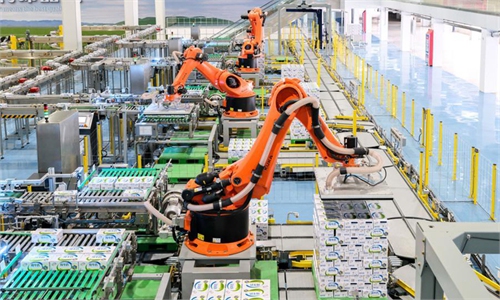
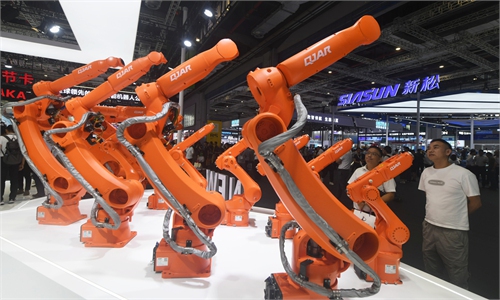
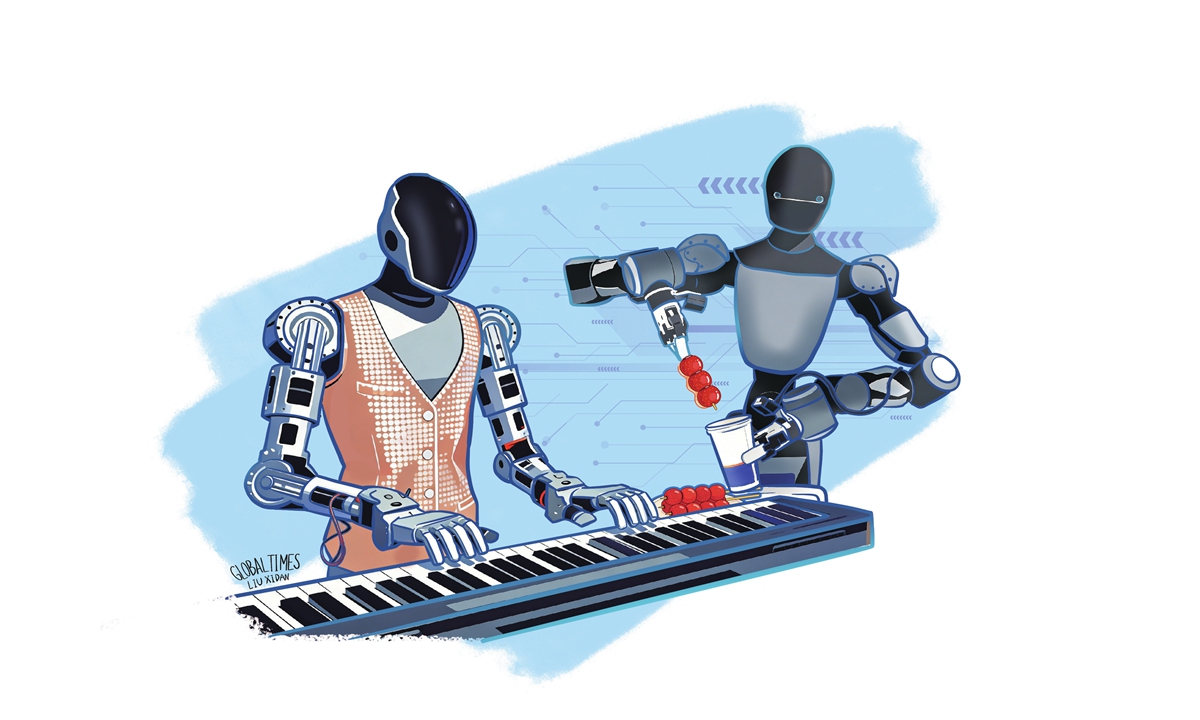
At the 2026 Zhongguancun Forum (ZGC Forum), held from Wednesday to Sunday in Beijing, embodied intelligence once again took the spotlight among other advanced technologies. Beyond eye-catching scenarios of robots in action - from preparing desserts to threading needles - the improved coordination and finesse of the upgraded robots signal a promising shift toward real-world deployment and faster integration into everyday life.As China emphasizes embodied intelligence as one of the key future and emerging industries to receive more investment and opportunities in this year's Government Work Report, the accelerating pace of the embodied intelligence and robotics industries - from research labs to production lines - is expected to help more start-ups scale into global tech leaders and establish an industrial competitive edge in the world.
What is driving this new rapid progress in the embodied intelligence industry in China lies not only in technological breakthroughs, but also in the convergence of multiple advantages: advances in large-language artificial intelligence (AI) models, declining hardware costs, and increasingly rich application scenarios. This combination is helping Chinese high-tech products move rapidly from research prototypes to real-world deployment.
Zhongguancun is actively building an embodied intelligence industry cluster, exemplifying this overall trend in China's robot and embodied intelligence industry. The Zhongguancun (Haidian) Embodied Intelligence Innovation Industrial Park has already attracted 14 embodied intelligence companies and seven AI firms, rapidly creating a full industrial ecosystem that links upstream and downstream enterprises across floors - enabling zero-distance technological coordination and collaborative innovation.
Some Chinese robotics start-ups are already leading the global embodied intelligence field. LINKERBOT, a maker of robotic hands, showcased its advanced models, which now hold a significant share of the worldwide advanced robotic hand market, playing piano and threading needles at the forum. According to a co-founder Zhang Yanbai, high-end robotic manufacturing is no longer limited to traditional hubs in East and South China - Beijing is increasingly becoming both a production base and a center for algorithm development. Here, robotic hands learn specialized skills modeled on human occupations.
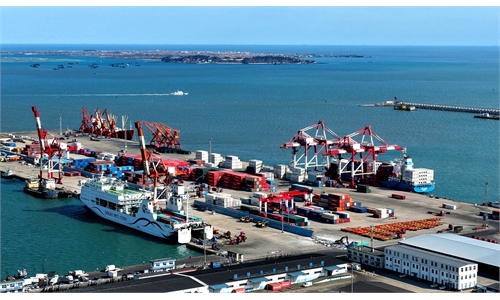
On the ground at the ZGC Forum, many foreign investors said that they plan to bring Chinese made robots back to their home markets - a sign that real demand is emerging beyond the exhibition hall. That optimism is supported by customs data showing China's industrial robot exports surged last year: 2025 saw exports up nearly 49 percent and, for the first time, industrial robot exports exceeded imports, making China a net exporter in this segment.
This remarkable export performance reflects not only growing international confidence in Chinese robotics technology, but also China's ascending position in the global value chain, as locally produced robots gain traction in countries from Southeast Asia to Latin America, helping to diversify markets and expand China's role in global industrial automation.
The Development Research Center of the State Council noted in its China Development Report 2025 that the embodied intelligence market could exceed 1 trillion yuan ($145 billion) by 2035. Such projections point not only to market potential, but to the emergence of a new growth engine - one that could reshape manufacturing and services.
The co-founder of LINKERBOT said that his company's products - dexterous hands paired with mechanical arms - are set to enter industrial applications in the coming year, performing tasks that are hazardous, repetitive, or otherwise undesirable for human workers. The company also plans to use robotic hands to produce more precise items, such as robots, in the near future.
The confidence of Chinese entrepreneurs and investors and a wide variety of versatile embodied intelligence robots at the forum offered a glimpse of future work and lifestyles. No longer a distant vision, this technology is poised to drive productivity, reduce costs, and transform China's rapidly evolving manufacturing landscape. As robots take on increasingly complex and high-risk tasks, embodied intelligence is becoming an important force shaping the future of industry.
Following China's emergence as a net exporter of industrial robots in 2025, its manufacturing sector is accelerating toward a crucial leap into higher-end, smarter, and more internationalized production. During the 14th Five-Year Plan (2021-25) period, China's manufacturing contributed more than 30 percent of global manufacturing growth, with its manufacturing value-added share approaching 30 percent of the world total, maintaining the largest overall scale globally for 15 consecutive years. The strong development momentum of China's embodied intelligence industry is further strengthening its position as a hub in the global supply chain.
The author is a reporter with the Global Times. bizopinion@globaltimes.com.cn
RELATED ARTICLES