Chinese scientists discover new species of ancient fish in Yunnan, dating back to around 244 million years
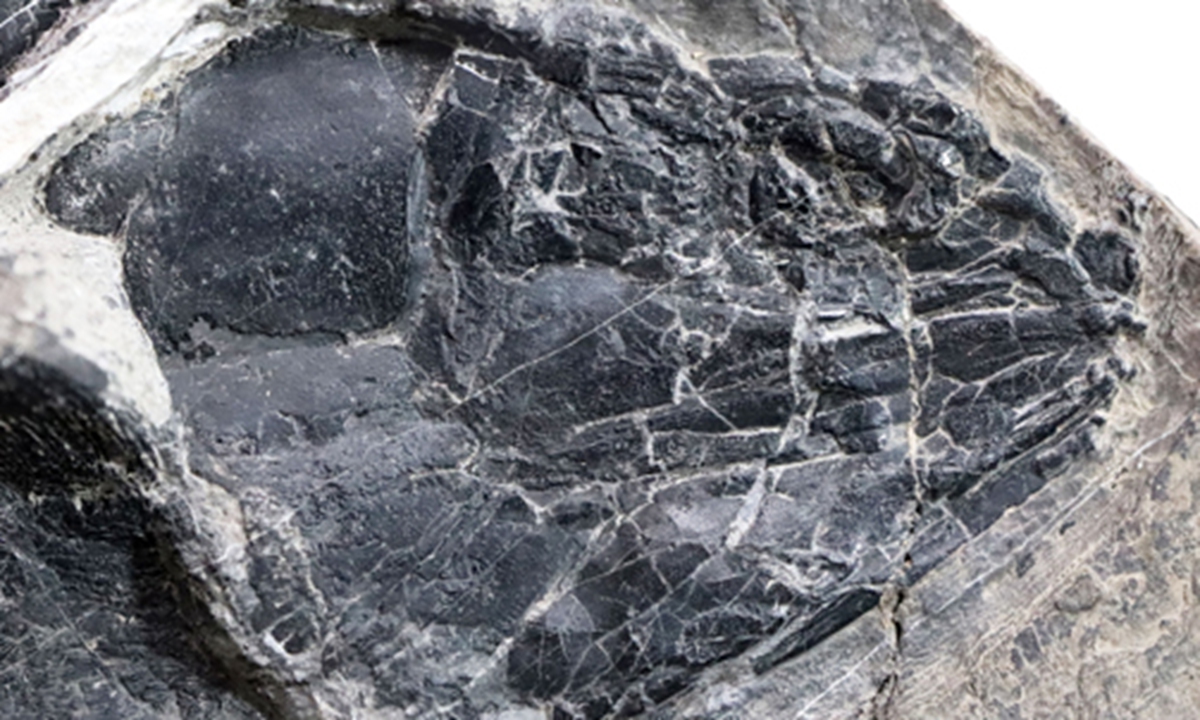
Fossil specimen of Ptycholepis Photo: Screenshot from mapress.com
Chinese scientists have recently discovered fossils of a new species of ancient ray-finned fish that lived about 244 million years ago, which they have named P. huoae. The discovery is the first record of Ptycholepis in China, filling the previous deficiency of marine ptycholepids in Asia, media reported on Monday. The dating of the specimen also makes it the oldest known fossil of this genus in the world.
A total of 27.5 centimeters long, the fish fossil was found by a joint research team in Luxi county, the Honghe Hani and Yi autonomous prefecture, Yunnan Province. The related research paper was published online in the international academic journal Mesozoic on Monday.
According to Xu Guanghui, a fellow researcher from the Institute of Vertebrate Paleontology and Paleoanthropology, who was co-first author and corresponding author of the research paper, the new species belongs to an extinct group of ray-finned fishes whose existence lasted from the Middle Triassic to the Jurassic. Other examples of the genus were previously found in Early Jurassic strata in Germany, the UK and France, while the previous earliest known species of the genus had been found in strata dating back about 242 million years in the Monte San Giorgio area on the border between Italy and Switzerland.
The newly identified species from Yunnan differs from other species in the genus in skull features, gill bones and pectoral fin structure. Researchers say the new finding predates the previously known oldest record from Europe by approximately two million years, demonstrating a longer geological range and wider biogeographical distribution than previously appreciated for the genus. The discovery documents the first record of Ptycholepis in China and fills the previous deficiency of marine ptycholepids in Asia, making it scientifically significant.
According to Xu, since the research team discovered Honghesaurus longicaudalis, a prehistoric species of marine reptile in Luxi, Yunnan in 2022, a series of new marine reptile and fish fossils have been uncovered there, turning the site into one of the key research hotspots for Triassic aquatic vertebrates.
Global Times
RELATED ARTICLES