ARTS / CULTURE & LEISURE
‘Diamond Sutra’ inscription from Tang Dynasty discovered at Longmen Grottoes
By Published: Mar 30, 2026 11:22 PM

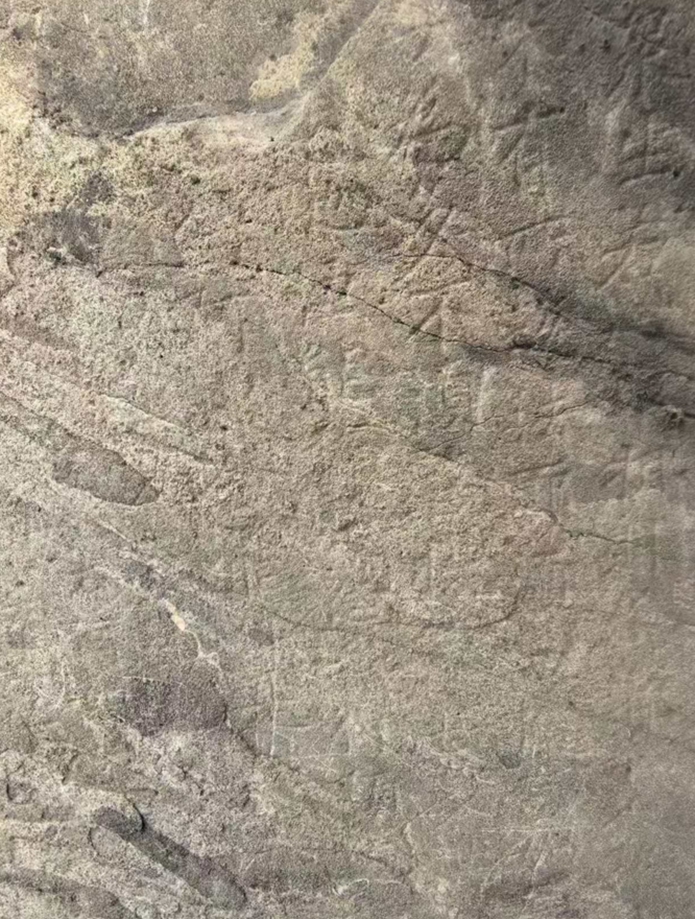
The newly discovered inscription of the Diamond Sutra Photo: Courtesy of the Longmen Grottoes Research Institute
During recent conservation and reinforcement work around the six pagodas on the southern face of the West Hill at the Longmen Grottoes, researchers newly identified a stone inscription of the Diamond Sutra dating back to the Tang Dynasty (618-907). According to information from the Longmen Grottoes Research Institute sent to the Global Times on Monday, this is regarded as a major discovery in the field of Buddhist scripture carvings in recent years.Buddhist texts engraved on cliff faces, pagodas, and steles are known as carved scriptures, which are an essential part of China's Buddhist cultural heritage.
This newly found Diamond Sutra inscription was carved on a sheer vertical cliff beneath the six pagodas, about 30 meters above the ground. Because of the dangerous and high location, it had remained hidden and unnoticed for a long time. On-site investigation found it was neatly and elegantly written in the regular script. The carving has been fairly well preserved, leaving most of the more than 1,000 characters clearly legible. The core content of the scripture can be completely identified, providing an accurate and reliable basis for future research.
Based on features of the script and nearby Tang Dynasty statue niches, experts from the Longmen Grottoes Research Institute concluded that the inscription was carved during the Tang Dynasty.
The Diamond Sutra was a widely circulated Buddhist classic during the Tang Dynasty and played an important role in Buddhist teaching and popular belief at the time. The rediscovery of a carved Diamond Sutra at the Longmen Grottoes is further physical evidence of how widespread this scripture was in the Tang Dynasty. This finding also enriches the collection of scripture carvings from the Tang period at Longmen and is valuable for understanding Buddhist beliefs, calligraphy, and stone carving techniques in Luoyang, Central China's Henan Province, during that era, according to the institute.
One especially noteworthy aspect of this discovery is that the inscription is located high on a steep cliff in a prominent position, and was found together with three burial niches containing the ashes of Buddhist followers. This unique combination has not been found before and provides new material for research into the functions and meanings of Buddhist scripture carvings.
Initial comparison indicates that this could be the earliest known Chinese translation of the Diamond Sutra, which holds great significance for the study and verification of ancient Buddhist scriptures, Ma Chaolong, deputy director at the center for grotto protection and heritage monitoring of the Longmen Grottoes Research Institute, told the Global Times on Monday.
In recent years, the Longmen Grottoes has strengthened its systematic conservation efforts, launching projects for protection, preservation, and research. Management at the site has carried out reinforcement work on unstable rock masses, addressed water leakage issues, and conducted field surveys and archaeological studies. These projects have led to several important archaeological discoveries. For example, in 2022, while reinforcing the Fengxian Temple's cliff face, experts found evidence of glass eyeballs and gold leaf on the statues, which attracted wide public attention and enhanced public understanding of the grottoes.
Currently, the Longmen Grottoes Research Institute has launched a dedicated project for the protection and study of this newly discovered Diamond Sutra inscription. Scientific and effective conservation measures will be adopted to preserve its original appearance. Specialists will record detailed information about the artifact and conduct in-depth research on the content, dating, and artistic value of the inscription. The research findings will be shared with the public in due course, according to the institute.
RELATED ARTICLES