ARTS / CULTURE & LEISURE
Millennia-old grave markers unearthed, offering clues to origins of tombstones
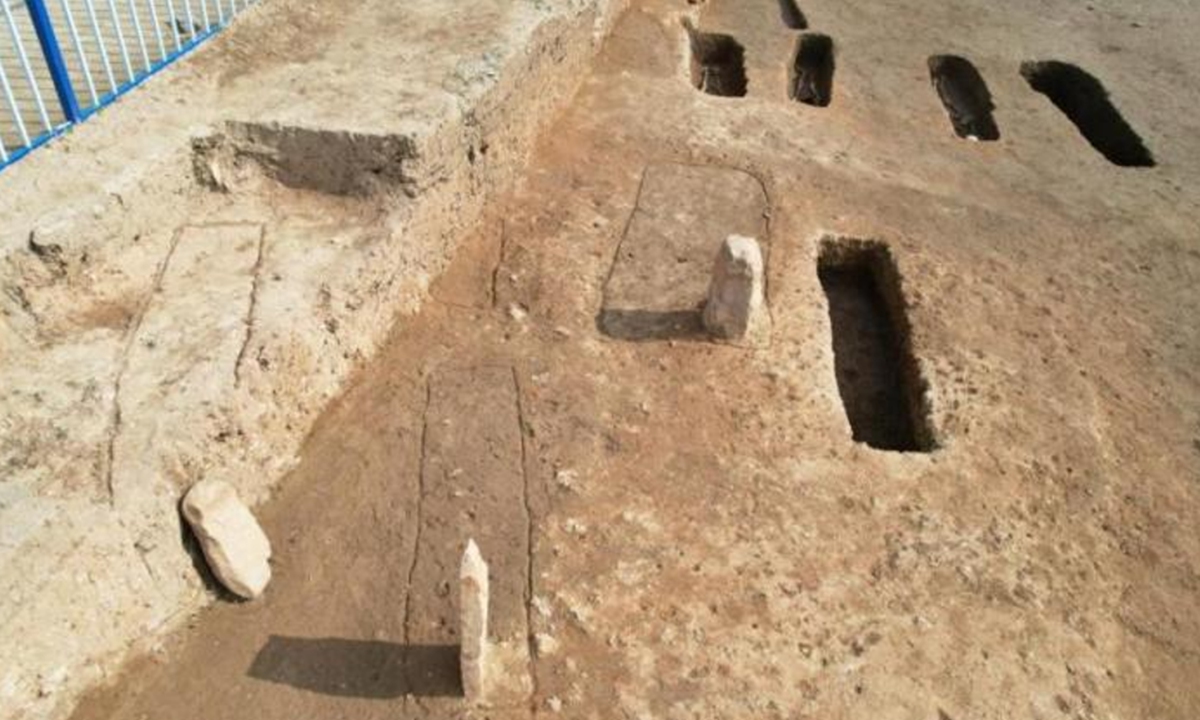
Grave markers unearthed from the Potou site in North China's Shanxi Province Photo: Courtesy of the Shanxi Provincial Institute of Archaeology
Archaeologists in North China have discovered what they say are the earliest known grave markers in the country, offering new insight into the origins of tombstones and challenging long-held assumptions about burial customs in ancient China, according to the Shanxi Provincial Institute of Archaeology.During the pre-Qin Dynasty (221BC-206BC) period, burials were typically low-profile, with no raised mounds or visible markers to indicate the grave's location. Stones or other markers were not planted above the tomb, making the burial site inconspicuous. As a result, early graves were often difficult to locate, and over time, even the occupants' descendants or locals might not know their exact location. This partly explains why many royal tombs from the Western Zhou Dynasty (1046BC-771BC) have yet to be discovered, Liu Zheng, a member of the Chinese Society of Cultural Relics, told the Global Times on Sunday.
The discovery was made at the Potou Site in Ruicheng county, North China's Shanxi Province, where archaeologists identified multiple burials dating to around 2000 BC that feature upright stones intentionally planted above graves.
"These grave-top standing stones are the earliest indigenous markers discovered so far in China," Zhang Guanghui, an associate research fellow at the institute, said while introducing the findings on Saturday. "They provide a prototype for the later appearance of tombstones and challenge the traditional understanding that pre-Qin burials had neither mounds nor markers."
The recent archaeological discovery in Shanxi indicates that the concept of tombstones had already begun to emerge in Neolithic China. It suggests that people at the time felt the need to erect markers to honor and commemorate their ancestors, noted Liu.
The newly discovered cemetery lies southwest of Potou village and was identified in March 2025. It dates to roughly 2200BC to 1800BC. More than 120 tombs have been cleared in the burial ground.
The Potou site is one of the largest and most continuously occupied prehistoric settlements in Shanxi. Located on a slope along the southern foothills of Zhongtiao Mountain, the site covers about 4 million square meters and contains remains from multiple stages of the Neolithic period.
Archaeologists have identified layers from several cultural phases, including the Yangshao culture, the Miaodigou Phase II and the Longshan culture.
Leveraging its strategic location along key transportation routes and abundant local resources, the site gave rise to multiple regional center settlements over time. Archaeologists have now mapped the layout and scale of settlements from the early, middle, and late Yangshao periods, as well as the Longshan period. The early Yangshao settlement covered about 50,000 square meters, the middle Yangshao settlement 150,000 square meters, the late Yangshao settlement 700,000 square meters, and the Longshan-period enclosure roughly 2 million square meters.
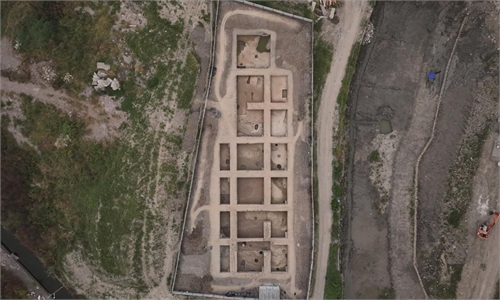
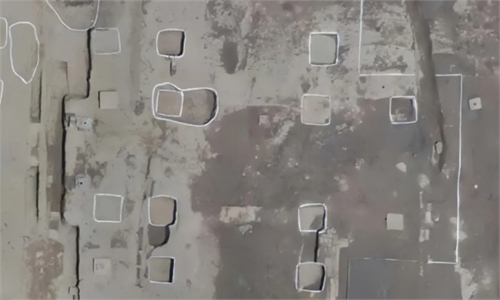
The 2025 excavations revealed that the tombs are clustered, with each cluster following a consistent burial pattern, generally arranged from west to east in rows running north to south. In the central area of the cemetery, archaeologists identified square open spaces on the west, north, and east sides, bordered by upright stones or rows of graves, which are believed to have served as ceremonial or ritual areas.
RELATED ARTICLES