Story of Third Sister: A Yangtze fisherwoman’s journey ashore
‘The people protect the Yangtze, and the Yangtze rewards the people’
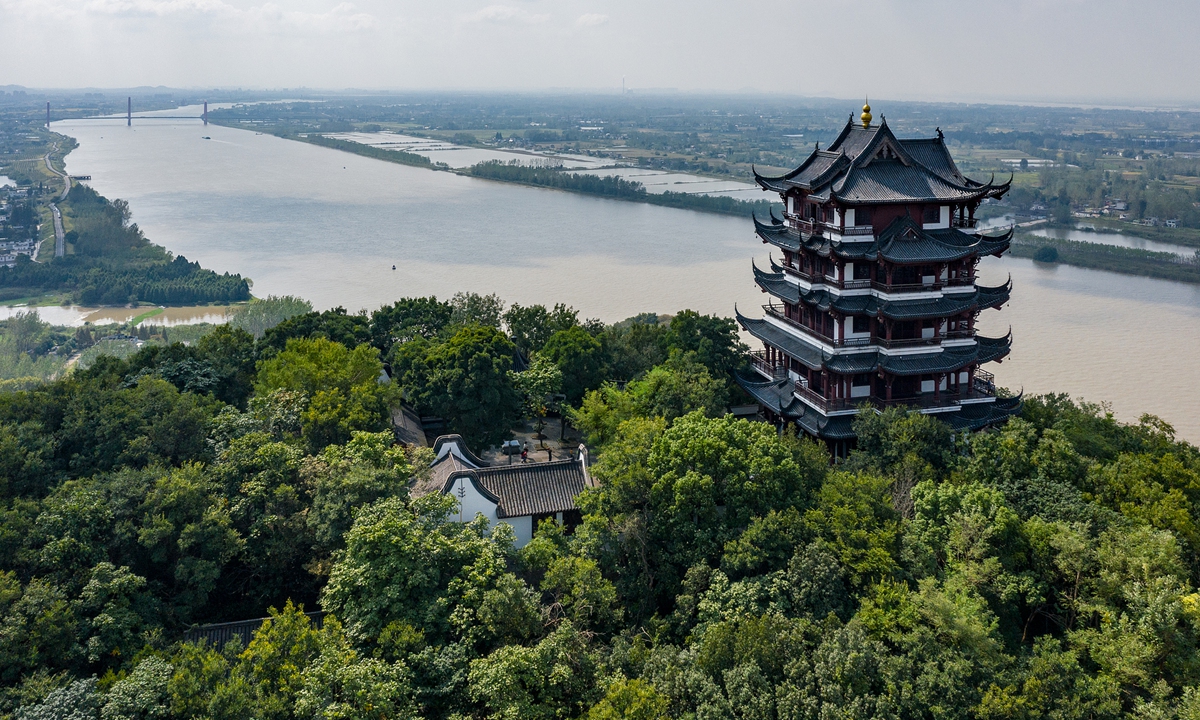
Aerial view of the Caishiji Scenic Area in Ma'anshan, East China's Anhui Province Photo: VCG
"Third Sister, I was totally talked into coming ashore by you back then!"
The dark, tanned man chuckled, took a thick stack of new banknotes, and counted them one by one with his fingers.
"Boss Chen, that's so ungrateful of him!" a woman nearby cut in. "Helping us find jobs and giving us dividends - since when is that fooling people?"
Inside the conference room of Third Sister Labor Service Co in Ma'anshan, East China's Anhui Province, 22 neat stacks of brand-new banknotes lay on the table. Nine fisherman-shareholders received their dividends and bantered with one another.
Formerly known as Third Sister and now general manager, Chen Lanxiang pushed open the window and gazed into the distance.
Xuejiawa by the Yangtze River was once Third Sister's home. She drifted on the water for more than 20 years. At that time, the river grew increasingly murky, and the fish caught kept getting smaller.
A turning point came in early 2016.
Chinese President Xi Jinping, also general secretary of the Communist Party of China Central Committee and chairman of the Central Military Commission, called for promoting well-coordinated environmental conservation and avoiding excessive development at a symposium on advancing the development of the Yangtze River Economic Belt in early 2016.
In May 2019, Third Sister and over 50 other fishing households in Xuejiawa gave up fishing and settled on land. In just a few years, she gained a new name, moved into a new apartment, founded a company, joined the Communist Party of China, was elected a city-level people's congress deputy, and attended the National Women's Congress.
On August 19, 2020, General Secretary Xi inspected Xuejiawa in Ma'anshan, urging enhanced awareness of protecting and cherishing the Yangtze River to achieve a positive cycle in which the people protect the Yangtze, and the Yangtze rewards the people, and to strive to restore the river's magnificent scenery as soon as possible.
On January 1, 2021, the 10-year fishing ban on the Yangtze River was fully implemented. Nationwide, 231,000 fishermen came ashore one after another, integrating into the new vision of ecological conservation first and green development.
Over the past five years, 351 fish species have been recorded in the Yangtze River basin, 43 more than before the fishing ban. The population of Yangtze finless porpoises has recovered to over 1,400, becoming a key ecological symbol of the Yangtze River conservation initiative.
Today's Xuejiawa boasts clear waters, green banks, and harmony between people and nature. The giant inscription along the riverside ecological park — "The people protect the Yangtze, and the Yangtze rewards the people" — is deeply engraved in people's hearts.
Coming ashore
Xuejiawa, a harbor on the east bank of the Ma'anshan section of the Yangtze River, once housed more than 50 fishing households and more than 200 fishing boats at its peak.
At 21, Third Sister married into Xuejiawa. Her husband, Zhang Zhouhua, came from a family of fishermen. Braving wind and waves, they initially caught more than 100 jin of fish a day. Gradually, the catch dwindled to dozens, then just a few jin. "We all felt we could no longer make a living on the water, yet had no idea where else to go..."
The Yangtze River was sick - and seriously so.
Starting in 2017, Ma'anshan underwent successive central ecological and environmental protection inspections and follow-up reviews, and was cited in the ecological and environmental warning film for the Yangtze River Economic Belt.
In March 2019, senior officials of Anhui Provincial Party Committee, during an unannounced visit, pointed out that the ecological problems in the Xuejiawa area "must be addressed without delay."
Ma'anshan took the lead in launching the fisherman's resettlement program in May 2019.
Resistance was only to be expected. When Wu Jifei, then director of the Yushan district responsible for the bureau of agriculture, rural affairs and water resources, tried to mobilize the fishermen, they would not even let him board their boats.
"All we know is fishing. If we come ashore, are we just going to wait to die?" To his surprise, Third Sister shot back at him immediately.
After many visits, he learned the hidden difficulties: Third Sister had undergone major surgery for a serious illness, and Zhang also suffered from heart disease. In accordance with policy, the district provided them with urban-rural critical illness medical assistance, easing their urgent crisis first.
Time and again, he spoke sincerely and from the heart. When she calmed down and began to think about the long term, Third Sister took it to heart and took the lead in signing the agreement.
On May 20, 2019, Third Sister and more than 50 fisherman households in Xuejiawa resettled ashore.
On October 28, 2020, Third Sister received her new ID card with her formal name - Chen Lanxiang.
And what about her nickname? It turned out to be invaluable. On that very day, Ma'anshan Third Sister Labor Service Co was registered, and "Third Sister" became her brand.
When the Yangtze receded, fish and shrimp were trapped in ponds near Xuejiawa and needed urgent relocation back to the river. The authorities approached Chen, and without hesitation, she organized the resettled fishermen overnight. They did an excellent job and earned their pay honestly.
They took on cleaning, landscaping, and housekeeping work, unafraid of dirt or hardship, working with purpose and dedication. The "Third Sister" name grew into a trusted brand. By 2025, the company's revenue had reached more than 3 million yuan ($434,037), creating jobs for more than 70 people.
With more than 10,000 fishermen resettled ashore, Ma'anshan took the national lead in implementing the Yangtze fishing ban and the withdrawal of fishermen from fishing.
Moving into apartments
Across the community, in Yanghu Park, people gather in small groups to do morning exercises and dance. As the music starts, Chen steps to the rhythm.
"Moving into a new apartment - with all kinds of subsidies, we basically paid nothing ourselves." Her new home is a 100-square-meter, two-bedroom, one-living-room apartment, worlds apart from her past life.
"Back then, the whole family squeezed onto one boat. To bathe, we just hung up a cloth for privacy." Chen flips through old photos. Her houseboat was little more than a floating concrete hut. Sweltering in summer, she would dip her feet in the water to cool off - only to be swarmed by mosquitoes.
Near Xuejiawa stood a cement factory that spewed dust daily, warning residents with a gong beforehand. The sound of the gong filled her with dread; she would rush to bring in her laundry at once.
Night brought no peace. The rumble of factories and chaos of the docks made sleep impossible.
The fishing boats were gone, and they now lived in an apartment. With air conditioning in every room, she fell asleep as soon as her head hit the pillow. "We don't fear wind, rain, thunder, or lightning anymore." Chen smiled happily.
Her son Zhang Chengwei was born on a boat. "Before he turned 6, we tied him to the oar post with a rope; we'd panic if we lost sight of him for a moment…" After moving ashore, Chengwei joined the company, and began driving a sprinkler truck. He got married and had a child of his own.
The grandson runs around as soon as he can walk. When visiting the park, he buys a boat ticket by himself. The stories his grandparents tell about life on the water feel utterly new to him.
Is such a life too ordinary?
"A stable life and peaceful work are true happiness." That is how Chen's family understands joy.

Residents exercise at Yushanhu Park in Ma'anshan, East China's Anhui Province on January 15, 2026. Photo: VCG
Taking it to heart
At 6 am, Zhang reports for duty. By the Yangtze River, a former fisherman had become a river protector.
Once, Xuejiawa was home to seven scattered, polluting and unregulated enterprises and three illegal docks, with eroded shorelines and sewage flowing everywhere.
In May 2019, as fishermen stepped ashore and gave up fishing, the campaign to remediate Xuejiawa officially began.
Using Xuejiawa's remediation as a starting point, Ma'anshan launched a comprehensive management plan for the east bank of the Yangtze, systematically restoring 23 kilometers of shoreline. It rectified 895 scattered, polluting and unregulated enterprises, demolished 153 illegal docks, and closed or relocated 497 livestock and poultry farms.
A privately contracted poplar grove, with trees as thick as bowls and reaching high into the sky, was to be cut down for timber by its owner. Yushan district bought back the forest, turning its paths into leisure greenways.
Below Wangfu Hill, polluting and unregulated facilities were shut down, freeing up 340 mu of vacant land. The city turned away real estate developers and built the Caishiji grassland. One music festival there drew tens of thousands of people.
In December 2023, Ma'anshan took the national lead in establishing a Yangtze River Protection Day, set for August 19 every year.
Today, water quality in the main stream of the Yangtze at Ma'anshan remains at Grade II. Fish population and resource density have increased by 1.5 times and twice, respectively, compared with before the fishing ban. Yangtze Finless porpoises, gone for many years, have returned. The Ranxin Pavilion at Caishiji has become a popular porpoise‑watching spot for tourists.
Chen and her husband may not know these exact figures.
But illegal docks have given way to clear waters and green banks; they can gaze at the river, listen to the waves and watch fish every day. "Somehow, now that we're ashore, we feel closer to the Yangtze than ever before…"
Striving for progress
In September 2022, Yushan district organized literacy classes for fishermen who had moved ashore, using the conference room of Chen's company as the classroom. Being close by, Chen led her employees to sign up immediately, learning to read and write and understand government policies.
In February 2023, Chen was elected as a deputy to the Ma'anshan People's Congress; on November 22 of the same year, she joined the Communist Party of China. The company established a Party branch and also set up a "Fishermen's Home," setting aside reserve funds to help resettled fishermen solve their problems.
The most unforgettable was October 23, 2023. For the first time, she went to Beijing, walked into the Great Hall of the People, and joined the delegation at the 13th National Women's Congress.
As the congress opened, General Secretary Xi smiled and waved to everyone. Thinking of his earnest instructions at Xuejiawa and the completely new chapter in her life after moving ashore, tears welled up in her eyes instantly.
This January, the Ma'anshan People's Congress was held. As a deputy to the Ma'anshan People's Congress, Chen's greatest concern remained the protection of the Yangtze River. During delegate discussions, "ecological priority and green development" was also a key topic.
She heard much news both during and after the sessions.
The city invested 3.5 billion yuan to implement rain-sewage diversion, and all 2,770 sewage outfalls into the main and tributaries of the Yangtze River were rectified;
Ma'anshan Iron & Steel Co, once a major polluter, was awarded one of the first "Green Factories" by the Ministry of Industry and Information Technology after ultra-low emission transformation;;
The open-pit Oushan Mining Site was transformed into a geological and cultural park, becoming a national 3A-level tourist attraction;
In November 2025, Ma'anshan authorities appeared at a United Nations forum, delivering a keynote speech at the first thematic side event "Ecological Civilization and the Practice of a Beautiful China" during the 30th Conference of the Parties to the United Nations Framework Convention on Climate Change.
As the 15th Five-Year Plan (2026-30) begins, accelerating the comprehensive green transformation of economic and social development remains a mandatory task and a tough challenge.
In the display cabinet of Chen's company is an embroidery piece: clear waters and blue skies, reeds swaying, finless porpoises chasing the waves.
A single reed cannot withstand wind and rain, but integrated into a sea of reeds, the scenery is boundless. "We are living in good times!"
This was compiled from an article originally published on the fourth page of People's Daily on March 30, 2026.
RELATED ARTICLES