US seeks Arab countries’ funding while Iran advances Hormuz Strait toll plan; US’ mixed statements act as a ‘smoke screen’: Chinese expert
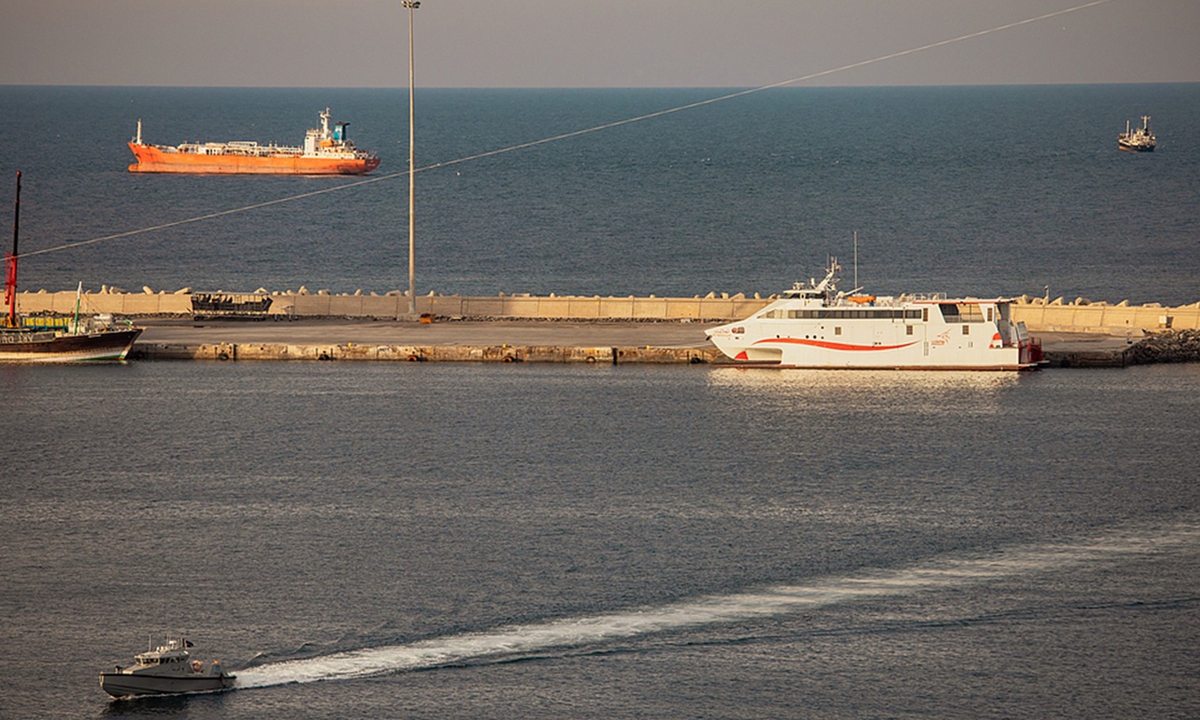
A police speed boat patrols the port as oil tankers and high speed crafts sit anchored at Muscat Anchorage near the Strait of Hormuz on March 30, 2026 in Muscat, Oman. Photo: VCG
Amid the escalating tensions in the Middle East, US President Donald Trump has made a series of statements, on one hand claiming that he is willing to end the US military campaign against Iran even if the Strait of Hormuz remains closed, while on the other hand calling on the Arab countries to pay for the costs of the Iran war. A Chinese expert said that these statements often act as a "smoke screen" to mislead both Iran and regional states, while the US administration faces genuine budgetary constraints for the ongoing war.
On Monday, Trump told aides he's willing to end the US military campaign against Iran even if the Strait of Hormuz remains largely closed, the Wall Street Journal reported citing administration officials.
White House Press Secretary Karoline Leavitt later alleged that Trump was seeking a deal with Iran before an April 6 deadline and that private discussions with Tehran were ongoing, even if public statements diverged from private communications, per Reuters.
While claiming to pursue an end to military strikes in practice, the US president was also reportedly interested in calling on Arab countries to pay for the costs related to the ongoing Iran war, Leavitt said on Monday, Xinhua reported. Global Times reporters have not seen Arab countries made relevant responses over the matter as of press time.
The Defense Department has requested $200 billion in funding to support Operation Epic Fury against Iran, but the Pentagon has yet to provide Congress much clarity on how it plans to spend that money, National Defense Magazine reported on March 25, citing Sen. Joni Ernst, R-Iowa.
The US statements often act as a "smoke screen" to mislead both Iran and regional states, while the US administration faces genuine budgetary constraints for the ongoing war, Li Haidong, a professor at China Foreign Affairs University, told the Global Times on Tuesday.
Regarding the intention to ask Arab countries to share the burden of the war, Li noted that "If these countries contribute financially, the funds would serve US objectives rather than their own security, potentially leaving the Gulf states disadvantaged. This is a clear example of the US leveraging regional allies at their expense," Li said.
Iran's National Security Committee on Monday approved a plan to impose fees on vessels passing through the Strait of Hormuz, according to Iran's semi-official Fars News Agency. Vessels associated with the US, Israel and countries that sanctioned Iran wouldn't be able to pass under the new plan, WSJ reported citing Iranian state media.
Iran reported that it had received US peace proposals through intermediaries following talks on Sunday between the foreign ministers of Pakistan, Egypt, Saudi Arabia, and Turkey. Iranian Foreign Ministry spokesperson Esmaeil Baghaei dismissed the proposals as "unrealistic, illogical, and excessive," stressing that Tehran's position remained one of self-defense amid ongoing military aggression, according to Reuters.
Meanwhile, Iran's military strikes have continued, with the Islamic Revolutionary Guard Corps (IRGC) conducted the 87th wave of the "True Promise-4" operation on March 30, Tasnim reported, citing the IRGC press service.
Li noted that Iran is demonstrating firm determination, and the plan of imposing transit fees by Iran underscores failure in US policy. "The US has been forcing Iran to open the Strait of Hormuz, yet the conflict has instead pushed Iran to impose fees," Li said.
Beyond the battlefield, the economic impact is mounting. The International Monetary Fund warned on Monday that war in the Middle East has caused serious disruption to the economies of frontline countries, and is dimming the outlook for many economies that had just started to recover from previous crises. G7 finance leaders echoed these concerns, pledging to take "all necessary measures" to stabilize energy markets and limit broader economic spillovers.
In a move that shows the UK firmly refuses to be drawn into the Iran war, prioritizing its own principles and domestic interests, British Prime Minister Keir Starmer remarked on March 30 over Iran war that "this is not our war" and UK "are not going to be dragged into it." "That's my value, that's my principles, and that what we've applied to our decisions, whatever the pressure, and whoever it is coming from," he said during a local election campaign in the UK.
UK's attitude embodies US' predicament in the war. Li noted that whether Arab states will risk being used to fund someone else's strategic objectives remain unknown, and global energy markets remain on edge. The region faces uncertainty, economic disruption, and heightened risk while US strategic goals remain unclear.
RELATED ARTICLES