ARTS / ART
NCHA launches nationwide action to strengthen security management of collections in state-owned museums
NCHA launches action for state-owned museums


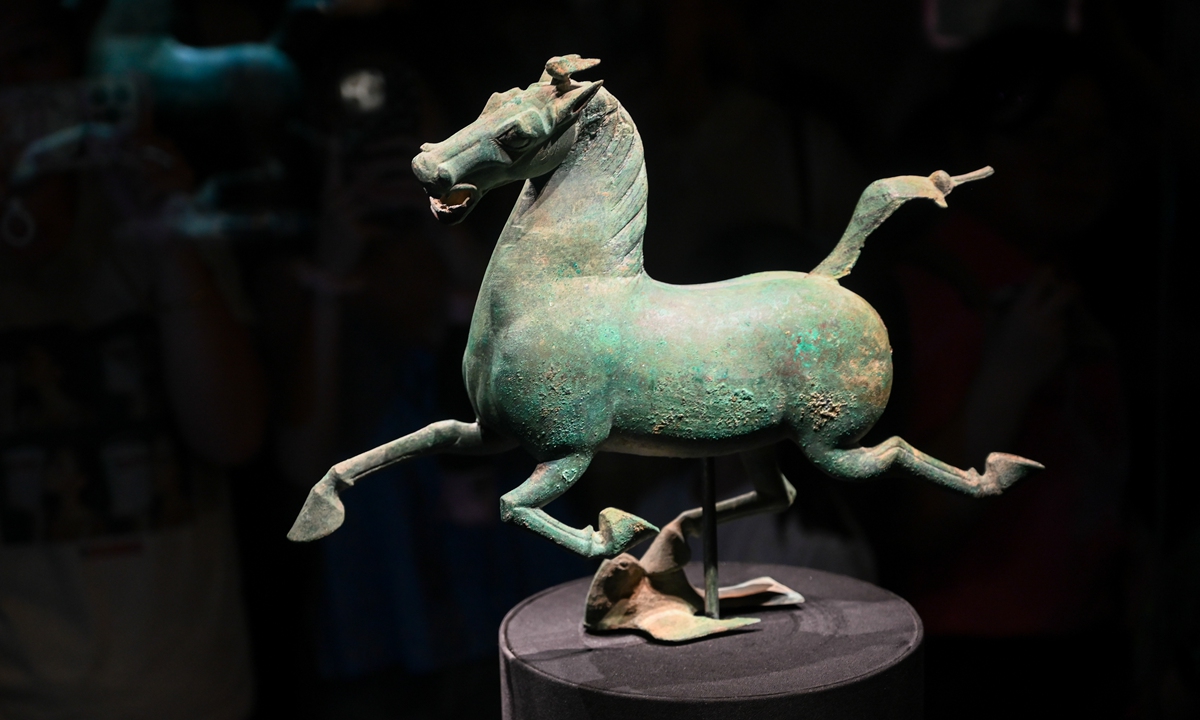
An ancient bronze horse statue at Gansu Provincial Museum in Lanzhou, Northwest China's Gansu Province Photo: VCG
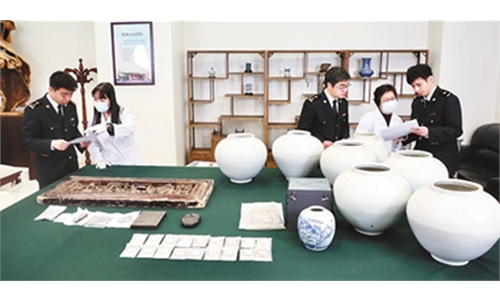
China's National Cultural Heritage Administration (NCHA) has recently issued a notice that it is launching a special nationwide campaign aimed at strengthening the safety management of cultural relics in state-owned museums. The initiative involves a comprehensive inventory check and risk inspection of all relics held by public museums across China. The campaign will see museums conduct item-by-item checks, thoroughly verifying the consistency between records and actual holdings, with the goal of establishing a standardized and regularized system for managing and auditing museum collections, according to an article published Wednesday on the NCHA's official WeChat account.
The campaign will focus on identifying and addressing potential safety hazards concerning cultural relics in museum collections, further enhancing preventive measures and improving emergency response capabilities to ensure their security. The NCHA calls on all local authorities and museums to take this campaign as an opportunity to improve collection management systems, strengthen security defenses, and raise the overall level of security management for cultural relics. At the same time, pilot work for the second national census on movable cultural relics will also be launched.
Since December 2025, the administration has thoroughly investigated management issues associated with museum collections that have attracted public concern. It has issued notices on strengthening museum security work and standardizing the management of donated collections in state-owned museums, urging all levels of cultural heritage authorities and museums to reinforce basic management practices by regulating the categorization, registration, cataloging and storage procedures of collections; and by strictly implementing protocols for the acceptance and preservation of donated items, thereby ensuring their proper protection and usage.
In December 2025, the NCHA formed a dedicated working group to investigate issues related to museum collection management at the Nanjing Museum, after concerns arose regarding the whereabouts of certain items in its holdings.
According to the Xinhua News Agency, descendants of the late renowned collector Pang Laichen discovered that five out of 137 ancient paintings and calligraphy works that their family had donated to the Nanjing Museum in 1959 could not be located. The Paper, a Shanghai-based outlet, reported that one of the "missing" pieces, Spring in Jiangnan by Ming Dynasty (1368-1644) artist Qiu Ying, appeared in a preview exhibition at a Beijing auction house in May 2025, with an estimated value of 88 million yuan ($12.5 million). The incident drew widespread public attention.
"The incident at the Nanjing Museum has not only exposed management loopholes at a single museum, but also revealed common problems in collection management at many renowned institutions," Qin Dashu, a professor at the School of Archaeology and Museology of Peking University, told the Global Times on Wednesday.
Against this backdrop, the NCHA's launch of a one-year inventory campaign is not only clearly problem-oriented and serves as an industry warning, but also to a certain extent responds to current public concerns, he added.
Qin noted that as long as it is earnestly promoted, it will inevitably promote the inventory, understanding and management of collected cultural relics.
Speaking at a press conference held by the NCHA on March 25, Chen Peijun, director of the administration's Department of Supervision, said that the administration launched a three-year campaign for tackling the root causes of work safety in the cultural relics industry nationwide in 2024 in accordance with the deployment requirements of the State Council.
Over the past two years, cultural relics administrative departments at all levels and cultural relics and museums across the country have identified more than 127,000 potential accidents, of which more than 123,000 have been rectified. In addition, the rectification rate has continued to rise to 97 percent, Chen said.
"A number of prominent hidden dangers have been eradicated, and work safety in the national cultural relics industry has maintained a stable and positive trend," Chen noted.
Looking ahead, NCHA will focus on carrying out the following three key tasks, including issuing the Standards for Determining Major Hidden Dangers in Cultural Relics and Museums (Trial) to further improve the quality and efficiency of hidden danger investigation, said Chen.
RELATED ARTICLES