IN-DEPTH / IN-DEPTH
How the evolving ‘New India’ faces China anew
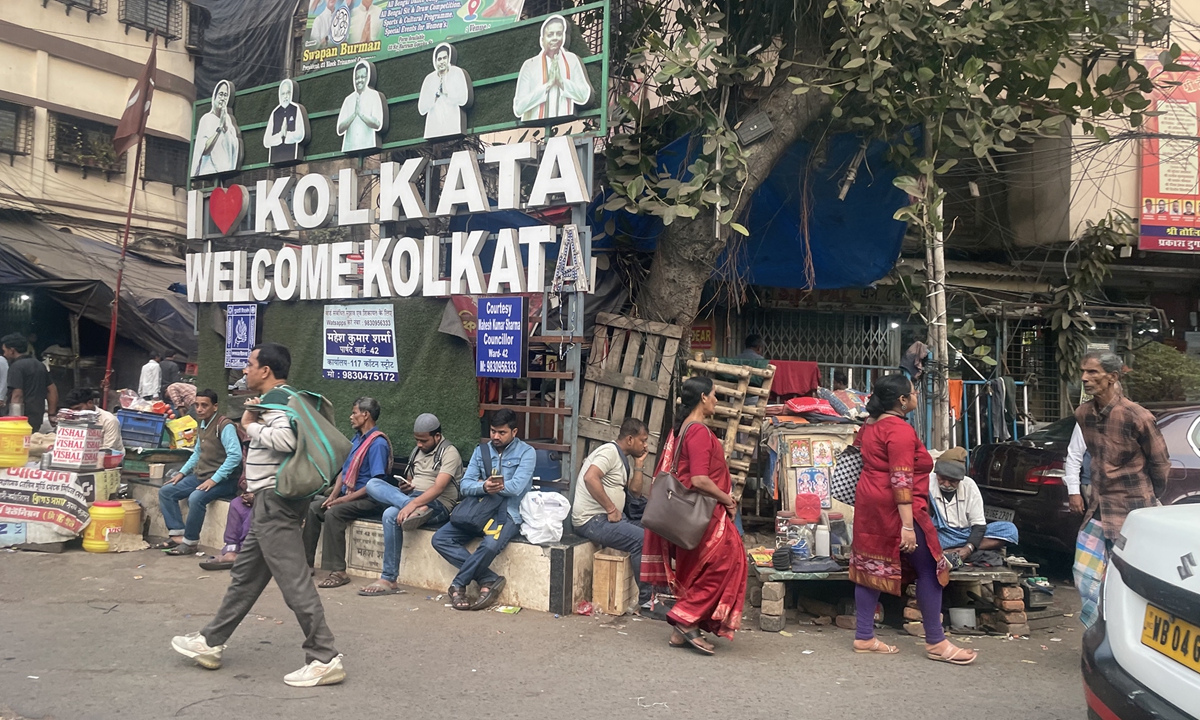
Publicity billboards of the Bharatiya Janata Party and the All India Trinamool Congress stand in Burrabazar Market in Kolkata, the capital of India's West Bengal, on January 21, 2026. Photo: Courtesy of Chen Jinying
In January, as a delegation member from Shanghai International Studies University visiting India, I extensively traveled to places including the capital, New Delhi, Bolpur and Kolkata in West Bengal, and Bengaluru in Karnataka. We paid visits to universities, think tanks, local government offices, and enterprises, and held talks with scholars, young students, Indian officials, business owners, and ordinary citizens. Over the week-long field research, I gained fresh insights into India's current development and its mindset toward China.An awkward mindset
On the China Eastern Airlines flight from Shanghai to New Delhi in mid-January, roughly two-thirds of the passengers were Indian nationals. Nearly half a year had passed since India resumed tourist visas to Chinese citizens in July 2025, yet there was no sign of a tourism boom for Chinese visitors. Even with positive signals from improved China-India ties, opportunities for Chinese people to travel to India remain scarce.
India has set numerous intentional barriers in tourism visa applications. Chinese applicants must submit round-trip flight itineraries, detailed travel plans, bank deposit certificates, notarized no-criminal-record certificates, employment certificates, copies of company business licenses, and other documents. In addition, India once specified exact city names on Chinese tourist visas. This means Chinese travelers cannot take spontaneous trips in India and must follow their pre-planned routes strictly. Chinese scholars generally agree that it is still quite difficult to visit India.
This mixed attitude is also reflected in India's economic and trade policies toward China. After June 2020, India almost fully blocked Chinese investment and sought to "decouple" economically from China. Six years on, the "decoupling" attempt has failed and hurt India's own economic growth. Since July 2024, voices calling for attracting Chinese investment have grown louder in India. The government first eased visa restrictions for Chinese skilled workers in sectors hardest hit by the "decoupling" policies, such as electronics manufacturing. Subsequent moves have remained cautious overall but have moved forward steadily.
During my visit, India further simplified and sped up the approval process for Chinese business visas in order to get skilled Chinese workers back to India. In March, it made minor adjustments to its Chinese investment restrictions, allowing up to 10% non-controlling beneficial ownership from China via the automatic route. In practice, this rule focuses not on how much an investor puts into India, but on how much the investor itself is controlled by Chinese entities. If the Chinese equity stake in the investing entity's capital structure exceeds 10 percent, even if its investment in India constitutes only 1 percent of the invested entity's equity, it still requires Indian government approval. It shows India's "awkward position": it distrusts China yet cannot cut ties with China.
Huge development potential
Indian economic performance has stood out over the past decade. Its GDP doubled from 2.1 trillion US dollars in 2014 to 4 trillion US dollars in 2024. According to the World Bank, the share of the Indian population living in extreme poverty dropped from 16.2 percent in 2011-2012 to 2.3 percent in 2022-2023.
My field research confirmed clear improvements in the Indian economy and rapid urban development. Compared with my visit in 2016, begging has decreased noticeably in New Delhi and Kolkata, and is rarely seen in southern cities such as Bengaluru. A decade ago, cycle rickshaws were a main means of transport on New Delhi's streets, alongside motorbikes, auto-rickshaws, and cars. Today, cycle rickshaws are no more. In New Delhi's aerotropolis area, high-end office buildings, shopping malls, and five-star hotels cluster together, and construction sites can be seen everywhere around the capital.
Manufacturing has long been a weak point for the Indian economy. Prime Minister Narendra Modi launched the "Make in India" initiative in 2014, aiming to raise manufacturing's share of GDP to 25 percent by 2025. Instead, the proportion fell to 14 percent by 2025. Even so, the government remains determined to boost manufacturing. Take the auto industry as an example: India is now the world's third-largest auto market, yet new energy vehicles are still rarely seen on its roads. To change this, the government has rolled out local manufacturing plans for new energy vehicles, using industrial policies to channel resources into key sectors and drive manufacturing growth. This approach has achieved results in some industries: India has become the world's second-largest mobile phone exporter, after China.
The growing consensus around developing manufacturing is also reshaping the identity of some cities. Bengaluru, once hailed as "India's Silicon Valley," is now also trying to transform itself into a "hub for cutting-edge manufacturing," with strong efforts to develop industries such as aerospace, electronics manufacturing, and biotechnology.
However, compared with China's development model, which started by absorbing large numbers of agricultural laborers through labor-intensive industries such as textiles, garments, and toys, the Indian government seems more interested in advanced manufacturing or capital-intensive sectors such as chips and semiconductors. This means its employment pressure is unlikely to ease in the short term. Even so, India is still viewed favorably by many multinational companies.
Digital infrastructure is an area where India has developed very rapidly. I found during this research trip that India's national ID card, the Aadhaar card, is now widely used and linked to public policies such as mobile phone registration, banking services, voter registration, and access to public services and welfare. Electronic payment, which was quite rare a decade ago, has also now become mainstream in India.
Promoting national integration
After the Modi government took office in 2014, the rule of the Bharatiya Janata Party (BJP) has continued to consolidate, cementing its position as the dominant party.
Under Modi, the "New India" vision and Hindu nationalism have become the new political narrative. The BJP has not only strengthened national integration through ideology and security measures, but also promoted the integration of peripheral regions into mainstream society through economic development.
During the trip, I found that many employees in the hotel industry in New Delhi and Bengaluru come from the northeastern region, showing that Indian internal economic integration is accelerating.
It is worth noting that tensions also lie beneath the surface of society under BJP rule. The party's ideology is Hindu nationalism, which advocates unifying India through Hindu culture. In recent years, the government has made progress in this regard, but it has also invisibly changed relations among religious communities.
Some Indian friends said that precisely because Hindu society has placed strong emphasis on its own cultural beliefs and identities, followers of other religions have also started to highlight their own religious identities. What impact this phenomenon will have on Indian social development in the future deserves continued attention.
'Admiration and unease'
Although the Indian government has an ambivalent mindset in its engagement with China, the overwhelming majority of ordinary Indians - including scholars, university students, businesspeople, and local officials - still hope to strengthen people-to-people exchanges between the two sides.
In our exchanges with Indian think tanks, cooperation has become the tone of dialogue, and Indian scholars are no longer focused solely on border disputes. Indian businesses are eager to gain access to Chinese technology, while local government officials hope to learn more from China's successful experience.
In Bengaluru, one local official in charge of skills training in the Karnataka government specifically mentioned Shanghai's experience of school-enterprise cooperation and the integration of industry and education in vocational training, expressing hope that it could be adopted and promoted locally.
In recent years, hard-liners in the Indian strategic community have viewed China as an "enemy," while moderates have seen China as a "competitor." This mentality has hindered the mutual trust between the two sides.
In October 2024, the leaders of China and India held a meeting in Kazan, Russia, helping thaw bilateral relations. Regarding the meeting, a statement released by the Foreign Ministry of China stressed that China and India should be "cooperation partners rather than competitors." While the Ministry of External Affairs of India refused to acknowledge the partnership, the statement just said that the "stable, predictable, and amicable bilateral relations between India and China … will have a positive impact on regional and global peace and prosperity."
The Indian government's perception of China and its policies have also invisibly shaped ordinary Indians' attitudes toward China. On the one hand, Indian young people admire Chinese development achievements. On the other, they feel uneasy about the development gap between the two countries.
An Indian PhD student studying Chinese politics told me, "We like China very much, but we also have to say that China is a 'threat' to India." This "somewhat helpless" remark reflects the trust deficit caused by the disruption of personnel exchanges and people-to-people interactions between the two countries in recent years.
In 2025, the Chinese government issued more than 200,000 visas to Indian citizens, allowing them to travel and do business in China. China also resumed pilgrimages for Indian devotees to sacred mountains and holy lakes in China's Xizang Autonomous Region.
These gestures of goodwill show that China has consistently regarded India as a cooperation partner, and reflect China's efforts to improve bilateral ties and help each other succeed in development.
If India also adheres to the understanding that the two countries are "development opportunities for each other rather than threats," the Indian public's sense of insecurity would be greatly reduced.
The author is director of the Center for Indian Studies at Shanghai International Studies University
RELATED ARTICLES