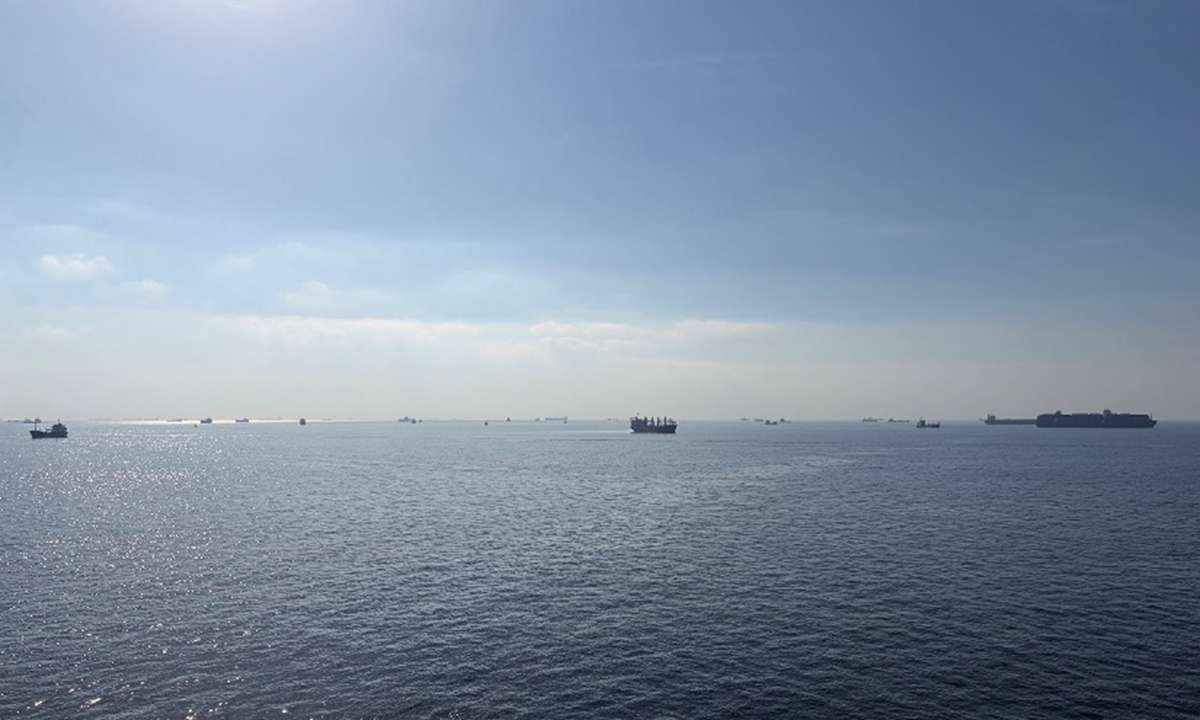
Numerous vessels are seen anchored at the inner anchorage of Port of Khor Fakkan in the UAE, around 8 am local time on April 3, 2026. Photo: Liu Yiwen
At night, the anchorage off Port of Khor Fakkan in UAE is sparsely lit, yet the sea is crowded. Hundreds of merchant vessels lie motionless, as if time hads been paused.
"Almost no ships can pass through the Strait of Hormuz into the Persian Gulf at the moment.," Chinese sailor Liu Yiwen told athe Global Times' reporter. LiuHe and his colleagues are currently anchored off Khor Fakkan, awaiting further instructions. Their vessel is a liquefied petroleum gas (LPG) carrier owned by a Southeast Asian shipowner. The original voyage plan was clear: sail empty into the Gulf, load LPG, and transport it back to Asia. But everything changed in late February, just as they approached the Strait of Hormuz.
On February 28, Iran's Revolutionary Guards issued a ban via VHF transmission, prohibiting all vessels from entering the Persian Gulf. Since that day, Liu and the vessel he serves on have been stuck offat the Khor Fakkan - once a key resupply point for the Strait of Hormuz, now turned into a massive "waiting zone."
"The shipowner gave just one instruction: stay put," Liu said. "Wait until the situation eases before entering to load cargo. But no one knows how long that will take - not them, and certainly not us."
According to Liu, the waters near Khor Fakkan are now packed with various types of vessels. "Tankers, cargo ships, container ships - everyone is waiting," he said, but no one has even a vague time table.
In Liu's view, the conflict has brought three major challenges: disrupted navigation, security threats, and daily hardships. Recalling February 28, he said the first issue was the ship's GPS signal. "It was heavily jammed at first, then completely failed, leaving us disoriented." Soon after, VHF radio signals began pouring in, reporting fires and emergencies on nearby vessels. The constant alerts kept Liu and his colleagues on edge, fearing their own ship could be next.
The area where they have anchored is far from safe. Liu noted that there is a naval base near Khor Fakkan, with frequent missile launches occasionally visible. Helicopters and fighter jets circle overhead all day, while naval vessels patrol continuously.
Conditions are even more severe near Fujairah Port, not far from Khor Fakkan. Liu observed that the port has been frequently attacked, with infrastructure and oil storage facilities repeatedly targeted. Ships in nearby waters have also been hit.
Beyond the constant threat of attack, stranded sailors face another pressing issue: supplies.
"The food on the ship is almost gone - vegetables and fruits are already gone," Liu said. Since the outbreak of the conflict, prices of nearby supplies have surged nearly tenfold. "500 gramsHalf of kilogram of mangoes costs $34, a box of bottled water has jumped from just over $1 to $14, and pork is $20 per kilogram…" He added that such prices are hard to bear, forcing everyone to ration thriftilycarefully.
Amid the hardship, there have also been moments of humanity. At the beginning of the conflict, many ships lost communication, leaving sailors completely cut off from their families. Because Liu's ship is relatively close to shore and can still maintain a relatively stable network connection, he took the initiative to call out in Chinese over maritime public channels four times a day, helping other sailors send messages via WeChat to reassure their families back home. His efforts eased the anxiety of many both at sea and on land.
"When we're away from home, we're all Chinese. We feel really close to each other, just like family. If we can help someone out, we just do it," he told the Global Times reporters.
According to Liu, the situation shows no signs of de-escalation. A few days ago, a Kuwaiti oil tanker was attacked near Dubai's anchorage. On April 1, another tanker was hit in Qatari waters.
Under such circumstances, Liu and his 25 crewmates from China, Indonesia, and Pakistan continue to wait at anchor off Khor Fakkan for further instructions. They pass the time fishing, playing chess, and singing - trying to cope with anxiety and maintain morale amid the tense situation.
Their prolonged wait reflects the plight of countless seafarers caught in the turmoil. According to UN News, as the conflict in the Middle East continues, around 20,000 seafarers are stranded on vessels stuck in the Strait of Hormuz — "unprecedented in the post-Second World War era." The seafarers are working on some 2,000 ships including oil and gas tankers, bulk carriers, cargo ships as well as six tourist cruise liners.
Meanwhile, the London-based International Maritime Organization reports that 21 commercial ships have been attacked in the strait over the past month since the conflict erupted. The organization has called on all parties to de-escalate, allowing seafarers to evacuate to safer areas.
"I just hope the war ends soon so I can go home," Liu told Global TimesT. "That's my biggest wish right now."