US, Iran escalate threats as Trump’s new ultimatum looms
Talking while threatening’ approach functions more as maximum pressure to test concessions: expert
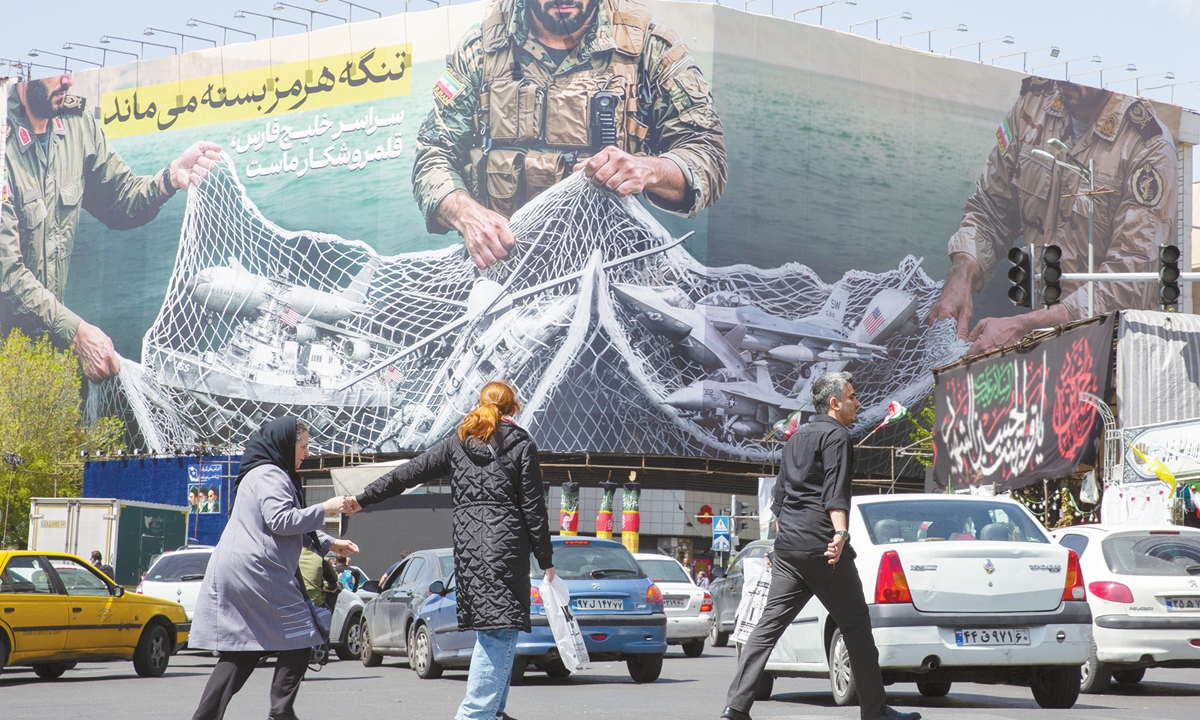
On April 5, 2026, a new billboard in Enghelab square in Tehran, Iran, shows Iranian military commanders capturing US aircrafts in a net with a message saying "The Strait of Hormuz will stay closed." Photo: VCG
The conflict triggered by the US-Israeli military attacks against Iran grounded into its 37th day on Monday, caught between fragile hopes for a 45-day ceasefire and the reality of escalating tensions. As regional mediators relayed Tehran's positions and demands, Iranian officials warned that diplomacy could not survive "ultimatums and threats to commit war crimes." The rebuke followed another expletive-laced warning from President Donald Trump, who threatened Tuesday would be "Power Plant Day and Bridge Day" in Iran if the Strait of Hormuz isn't opened.
This delicate diplomatic maneuvering is unfolding against a backdrop of intensifying military and economic peril. A senior Islamic Revolutionary Guards Corps intelligence chief was confirmed killed in a joint US-Israeli strike, as Tehran vowed to choke off a second critical artery for global trade - the Bab el-Mandeb Strait - sending fresh tremors through international energy markets.
A Chinese expert warned that these compounding crises - volatile oil price, energy crisis, and growing humanitarian toll - could force both sides to act in the short term. While a temporary ceasefire remains possible, it would likely be a stopgap rather than a path to a permanent resolution.
Stopgap de-escalation window
Axios reported Monday that the US, Iran and a group of regional mediators are discussing the terms for a potential 45-day ceasefire that could lead to a permanent end to the war, according to four US, Israeli and regional sources with knowledge of the talks.
The sources said the chances for reaching a partial deal over the next 48 hours are slim. But this last-ditch effort is the only chance to prevent a dramatic escalation in the war that will include massive strikes on Iranian civilian infrastructure and a retaliation against energy and water facilities in the Gulf states.
Iran has conveyed its response to the US proposal for ending the war, rejecting a ceasefire and emphasizing the necessity of a permanent end to the war, the official IRNA news agency said on Monday.
Iran's response consists of 10 clauses, including an end to conflicts in the region, a protocol for safe passage through the Strait of Hormuz, lifting of sanctions, and reconstruction, the agency added.
At a press conference on Monday, spokesman for the Iranian Foreign Ministry Esmaeil Baghaei addressed various proposals, including a 15-point American one.
The spokesperson said Tehran's response to intermediaries had been prepared, adding, "Whenever necessary, we will communicate it explicitly," Iranian media Press TV reported.
He asserted that Tehran resolutely withstands any American "ultimatum," while noting how Washington's supposed pursuit of diplomatic engagement with Tehran runs counter to continuing its crimes against the Iranian nation and threatening the nation with even more war crimes.
Earlier on Easter Sunday, President Donald Trump posted a message on Truth Social in which he warned Iran that Tuesday would be "Power Plant Day and Bridge Day, all wrapped up in one, in Iran" if the Strait of Hormuz, crucial for global trade, isn't opened.
IRGC Navy vowed Sunday night local time that the Strait of Hormuz has undergone irreversible strategic changes and will never revert to its former status, particularly for the US and the Israeli regime, as Iranian forces finalize operational preparations for a new security order in the Persian Gulf, Press TV reported.
According to AP News, Trump has issued such deadlines before but extended them when mediators have claimed progress toward ending the war.
After Trump's threat, oil prices rose on Sunday with US crude topping $114 per barrel, CNBC News reported. Rapidan Energy said it was expecting a total net loss of 630 million barrels of oil and products by the end of June, when accounting for redirected flows through pipelines, emergency stockpile releases and inventory drawdowns.
Eight key members of the OPEC+ alliance agreed Sunday to an increase in oil production next month while warning that war-related disruptions and attacks on energy infrastructure are escalating price swings in global markets, Yahoo finance reported Monday.
Saudi Arabia, Russia, Iraq, the United Arab Emirates, Kuwait, Kazakhstan, Algeria and Oman said they would raise output by a combined 206,000 barrels per day starting in May.
The reported downing of a US warplane has also sparked a war of words between Iran and the US. Earlier, Press TV reported that Iran had shot down a US F-15E Strike Eagle fighter jet on Friday, leaving the two pilots missing. On Sunday, Trump claimed the US recovered a second crew member of an F-15E that went down over Iran on Friday in what he called a "daring" search and rescue operation.
However, Iran's foreign ministry said the US operation to rescue a downed airman may have been a cover to "steal enriched uranium" from the country, Al Jazeera reported. "The area where the American pilot was claimed to be present in Kohgiluyeh and Boyer-Ahmad Province is a long way from the area where they attempted to land or wanted to land their forces in central Iran," Baqaei said.
"Achieving a temporary US-Iran ceasefire faces multiple practical obstacles, as the core demands of both sides are difficult to reconcile," Zhu Yongbiao, director of the Center for Afghanistan Studies at Lanzhou University, told the Global Times.
He noted that control of shipping lanes and nuclear issues are the main structural points of contention. Iran's conditions, including compensation, are unacceptable to the US, while Washington's demands are equivalent to asking Tehran to make unilateral concessions that affect its sovereignty and security.
The expert added that trust between the parties is extremely weak: Iran acknowledges exchanging information via friendly states but denies direct talks, while the US signals willingness to negotiate but continues issuing military ultimatums. "This 'talking while threatening' approach functions more as maximum pressure to test concessions than genuine reconciliation," he said.
Avoiding force, seeking diplomacy
Xinhua News Agency, citing a statement from Russia's Foreign Ministry on Sunday, reported that Russian Foreign Minister Sergei Lavrov held a phone call with his Iranian counterpart Abbas Araghchi, with both sides urging relevant parties not to undermine opportunities to resolve the crisis through political and diplomatic means.
Following Russia's communication with Iran, Chinese Foreign Minister Wang Yi spoke by phone with Lavrov on Sunday to exchange views on the current situation in the Middle East.
China is willing to continue working with Russia within the framework of the United Nations (UN) Security Council, maintain timely communication on major issues, and make joint efforts to help de-escalate the situation in the Middle East, safeguard regional peace and stability, and uphold common security for the world, Wang said, according to Xinhua.
Russia stands ready to maintain close communication and coordination with China and continue to make efforts and speak out in support of a ceasefire and the end of the war, Lavrov said.
The phone call between the Russian and Iranian foreign ministers, followed by swift communication between the Chinese and Russian foreign ministers, shows that regional countries and major powers are highly sensitive to the conflict, according to the expert.
It also indicates that there is a broad expectation for mediation and diplomatic solutions, and that China and Russia are coordinating their positions on the issue, Zhu said.
RELATED ARTICLES