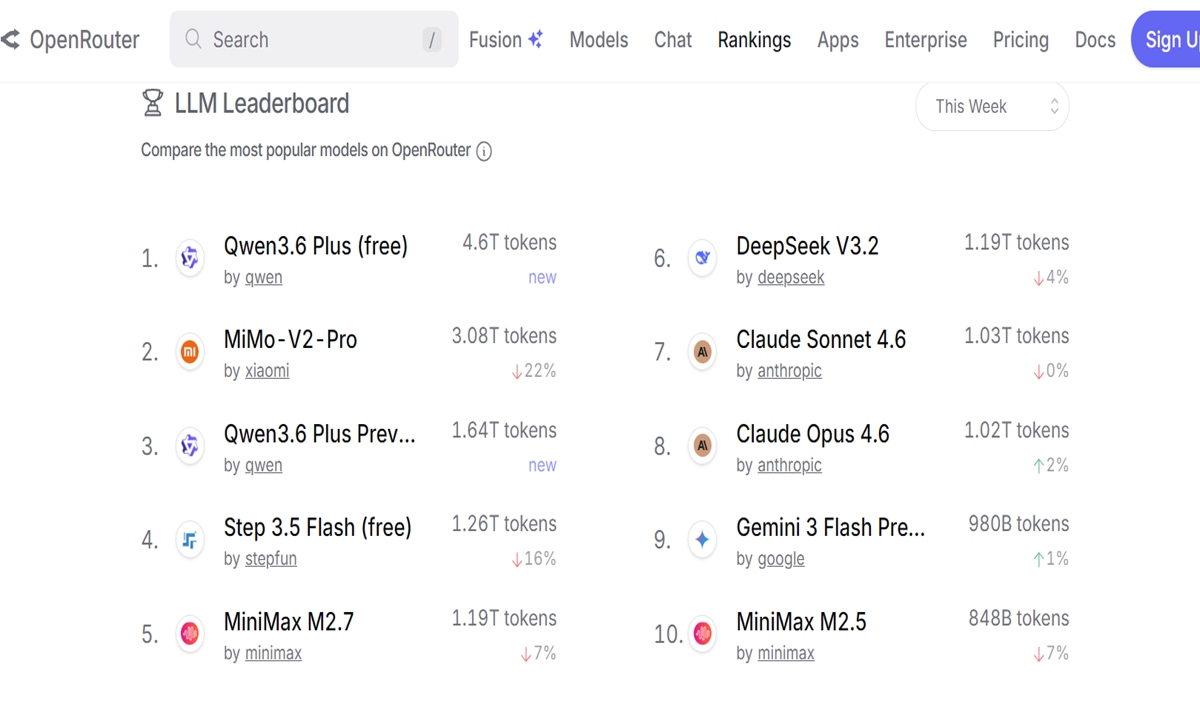
Screenshot shows the ranking of weekly model usage on OpenRouter on April 6, 2026. Photo: OpenRouter website
Chinese large-language models dominated global usage rankings during the week from March 30 to April 5, with all of the top six models by token consumption coming from China, according to OpenRouter, a global large-language model (LLM) aggregation platform.
Two Alibaba Qwen 3.6 series models ranked among the top three. Qwen3.6 Plus (free) topped the list with 4.6 trillion weekly tokens, while Qwen3.6 Plus Preview ranked third with 1.64 trillion tokens, according to OpenRouter.
The trend was also reflected at the model level. Qwen3.6-Plus, launched on Thursday, topped OpenRouter's daily rankings on Saturday, with more than 1.4 trillion tokens in single-day usage, setting a platform record, according to OpenRouter data and media reports.
According to media calculations based on OpenRouter data, global artificial intelligence (AI) LLM usage reached 27 trillion tokens during the same period, up 18.9 percent week-on-week.
Chinese models accounted for 12.96 trillion tokens, rising 31.48 percent, while US models totaled 3.03 trillion tokens, up 0.76 percent. China has surpassed the US in weekly usage for five consecutive weeks, the National Business Daily reported.
Data from the National Data Administration showed China's average daily token calls surged from 100 billion in early 2024 to 140 trillion last month.
"In China, large models are quickly embedded into high-frequency platforms such as e-commerce, social media and public services, while aggressive pricing strategies, including free-tier access, have significantly lowered adoption barriers and expanded the user base," Wang Peng, an associate research fellow at the Beijing Academy of Social Sciences, told the Global Times on Monday.
"Token consumption is structurally higher due to the rapid expansion of AI agents and multi-step workflows," Wang noted. "These systems rely on iterative reasoning, long-context processing and chained calls, meaning a single task can consume multiple times the tokens of traditional interactions."
"More fundamentally, China benefits from coordinated advantages in computing power, energy supply and cost-efficient deployment," Wang said.
Large-scale data center clusters, integration of computing and electricity infrastructure, and the continued optimization of inference efficiency enable higher throughput at lower cost. More importantly, China has one of the world's richest internet application ecosystems, where large-language models are deeply embedded into real-economy scenarios, translating directly into sustained and hard demand for tokens, according to Wang.
To underpin AI growth, China's government work report this year unveiled plans to launch new infrastructure projects focused on hyperscale intelligent computing clusters, alongside the coordinated development of computing capacity and power supply, according to the Xinhua News Agency.
RELATED ARTICLES