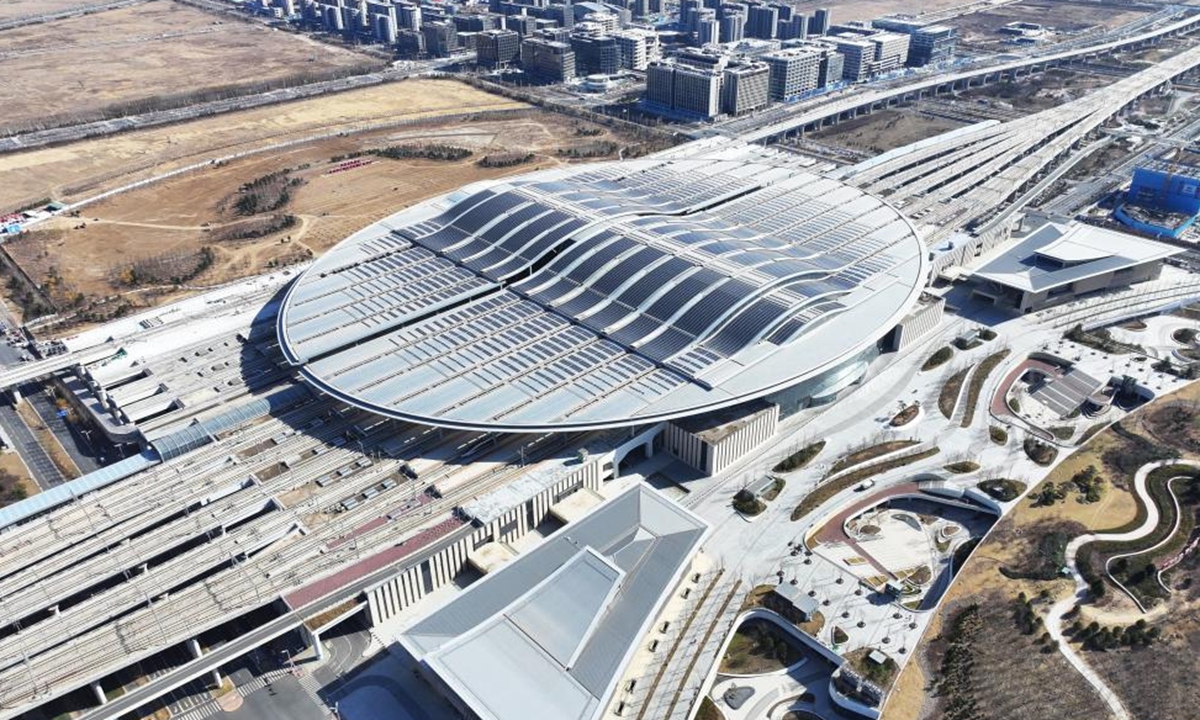
This aerial drone photo taken on March 18, 2026 shows the Xiong'an Railway Station in Xiong'an New Area, north China's Hebei Province. Photo: Xinhua
As a member of a Silicon Valley-based AI startup, I once viewed Xiong'an New Area as a distant, largely conceptual national strategy. That perception shifted dramatically on March 28 when I joined peers from Beijing's technology sector at the Xiong'an "Artificial Intelligence+" Industry Ecosystem Integration Development Forum. What I witnessed was no longer just a grand plan on paper, but a rapidly emerging innovation hub that is actively shaping China's - and potentially the world's - digital future.The forum showcased deep coordination between Beijing and Xiong'an in advancing the AI industry. A series of significant initiatives were unveiled, including the release of AI application scenarios, announcements of "open bidding for selecting the best candidates" projects, the signing of contracts for national science and technology programs, and Xiong'an Fund investment projects.
Compared with my experience in Silicon Valley, the most striking impression was how distinctly China and the US are pursuing AI development paths. While the US focuses heavily on frontier model innovation and AI infrastructure, China emphasizes large-scale deployment and deep scenario-based integration. Xiong'an exemplifies this alternative approach. Rather than treating AI as an add-on tool layered onto an existing city, it is embedding AI into every aspect of urban planning, public services, and industrial ecosystems from the ground up.
This realization left me with a profound sense: We are living through a massive shift in the global narrative. In the AI era, almost every industry is about to be rebuilt from the inside out. Xiong'an may well be emerging as one of the world's first true "AI-native" city samples - a city designed with AI as its foundational DNA rather than as a later upgrade.
This "AI-native" feeling became especially vivid during conversations with leading enterprises. From Mech-Mind Robotics that officially began operations here in September 2024 and is actively advising to build a comprehensive digital industrial ecosystem in Xiong'an while offering competitive compensation packages to attract young talent, to Xiong'an Xingyuan Technology Co, Ltd, which focuses on metaverse and AI research and development, and Xiong'an Group Digital City Technology Co, Ltd, which has established a public R&D platform for intelligent agents, these companies are turning abstract AI capabilities into tangible tools for urban governance and daily operations.
Exchanges with international participants further deepened my perspective. A German professor from the Eurasian innovation delegation, who began research and industrial cooperation with local institutions after his visit last year, spoke highly of Xiong'an's forward-looking planning and rapid development. He noted that the new area is not only building a modern city but also cultivating a next-generation innovation hub connecting Europe and Asia. He particularly praised its large-scale platform for testing and applying advanced technologies such as edge computing and intelligent systems, which generates rich real-world data to support both urban governance and scientific research.
He also highlighted Xiong'an's progress in green and smart city development, thus advancing energy conservation, promoting green technologies, and seamlessly integrating digital systems into urban planning. In his view, the area's systematic industrial layout, talent support policies, and long-term development model offer valuable lessons for global urban innovation and international cooperation.
Conversations with representatives from more than a dozen domestic and international technology companies reinforced my conviction: Xiong'an's appeal is growing steadily. Strong policy support, sustained capital investment, improving public services, and clear long-term planning are helping digital industrial clusters take shape and a smart city framework gradually solidify.
As I left the forum, one thought kept echoing in my mind: in this AI-driven age, traditional models of urban and industrial development are no longer sufficient. Silicon Valley represented the peak of technology-driven innovation for the past two decades. Xiong'an, by contrast, may foreshadow the paradigm shift for the next 20 years and beyond - a city born with AI as its core architecture, where industries are being reimagined and rebuilt around intelligent systems from day one.
China is working hard to build Xiong'an into an innovation hub for the new era and a model of high-quality development. It is no longer merely a blueprint; it is evolving into a dynamic, forward-looking city with tangible industrial progress and expanding opportunities for cooperation. For global technology innovators, Xiong'an is emerging as a promising frontier for digital transformation and international collaboration.
The author is a co-founder of CrowdCore AI, a Silicon Valley-based startup delivering agentic AI solutions for the marketing industry. opinion@globaltimes.com.cn
RELATED ARTICLES