KMT chairperson’s scheduled mainland visit garners island media attention
‘Rain after a long drought’ visit expected to be second icebreaking journey for cross-Straits relations: island media
By Published: Apr 07, 2026 12:03 AM


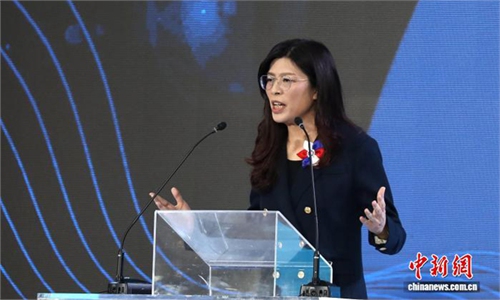
Cheng Li-wun, chairperson of the Chinese Kuomintang (KMT) party, held a press conference at 11 am. on Monday at Sun Yat-sen Hall at the Kuomintang's central headquarters to address her visit to the mainland. Photo: Screenshot from website
Cheng Li-wun, chairperson of the Chinese Kuomintang (KMT) party, is scheduled to visit the Chinese mainland from April 7 to 12. This visit has garnered wide attention from the island of Taiwan, with local media also calling it an icebreaking journey.
The Communist Party of China (CPC) Central Committee and Xi Jinping, general secretary of the CPC Central Committee, have invited Cheng to visit the Chinese mainland from April 7 to 12, a CPC official announced on March 30, per the Xinhua News Agency.
Cheng said that Taiwan's industries and Taiwan-funded businesses have been neglected for too long, and described her visit to the mainland as "rain after a long drought," expressing hope that the trip could usher in a springtime for cross-Straits relations and offer new light and hope amid the current gloomy international landscape, Taiwan's United Daily News reported on Sunday.
According to the itinerary released by the KMT quoted by United Daily News, Cheng will arrive in Shanghai on the afternoon of April 7 and head directly to Nanjing. On the morning of April 8, she will pay tribute at the Sun Yat-sen Mausoleum before returning to Shanghai for follow-up visits and activities. She is scheduled to travel to Beijing on the afternoon of April 9.
Cheng's visit has garnered wide attention from the island of Taiwan. Taiwan's China Times quoted Herman Shuai, a retired Taiwan lieutenant general, as saying that Cheng's visit to the mainland is of great significance. Former KMT chairmen Lien Chan's previous trip to the mainland in 2005 marked the first icebreaking journey, while Cheng's visit is seen as a second icebreaking journey.
The mainland choosing this time to invite Cheng to visit not only demonstrates Beijing's confidence in remaining undisrupted by external interference, but also creates strategic space for peace across the Taiwan Straits, according to Taiwan's CTi News.
By inviting Cheng to visit, the mainland sends a consistent policy signal: the mainland welcomes party leaders or political figures in the island of Taiwan that uphold that the mainland and Taiwan belong to one China and accept the 1992 Consensus to visit the mainland, Xin Qiang, director of the Taiwan Studies Center at Fudan University, told the Global Times.
Speaking about Cheng's visit, KMT vice-chairman Sean Lien, the son of Lien Chan, said that compared with his father's visit in 2005, cross-Straits situation has become increasingly tense, and many positive interactions between mainland and the island of Taiwan risk being distorted, or interpreted out of context by pro-independence supporters. Thus, Cheng's visit also requires great caution in this regard, he warned.
In order to smear Cheng's visit, Hsu Chih-chieh, a Taiwan regional legislator from DPP, said that for personal interests, Cheng would rather block arms procurement and prioritize a visit to the mainland, Taiwan's TVBS reported.
A special defense budget, which includes Taiwan's military purchases from the US, has recently completed its preliminary review and a caucus consultation had originally been scheduled for April 9, but the KMT legislative caucus suddenly sent a letter on April 2 requesting that the talks be postponed to April 15 or 16, reported by Liberty Times, which is widely regarded as a pro- DPP outlet.
The pro- DPP outlet hyped speculation that the delay was intended to coincide with Cheng's mainland visit.
Responding to the speculation, Cheng said she respects the caucus' decision and criticized the DPP for what she described as deliberate smears, false accusations, and attempts to shape public opinion.
The DPP's narrative of Cheng's scheduled visit is deliberately constructed to mislead the Taiwan public and offset the positive influence of the visit, Zheng Jian, a professor of Taiwan studies at Xiamen University, told the Global Times.
He said that the greatest common denominator for compatriots on both sides of the Taiwan Straits is peace. The KMT and Cheng's visit to the Chinese mainland is in line with the mainstream public opinion on the island, and they come with the aspiration to promote the peaceful development of cross-Straits relations. Once this kind of interaction based on peace and development resonates widely, it will inevitably exert pressure on the "Taiwan independence" and "anti-mainland" line that the DPP has long promoted.
Tse-hsun Niu, professor at the Chinese Culture University in Taiwan, said on his social media account that as long as Cheng can hold firm to the position while bringing back concrete benefits and resources for the island, this will not only ease cross-straits relations but also allow the KMT to regain its confidence and competence in handling cross-straits affairs. It will reawaken the public's impression that the KMT is better able than the DPP to maintain and stabilize relations across the straits.
RELATED ARTICLES