Trump’s ultimatum meets resistance from Iran as conflict risks protraction; Chinese special envoy meets with French ambassador
By Published: Apr 07, 2026 12:48 PM

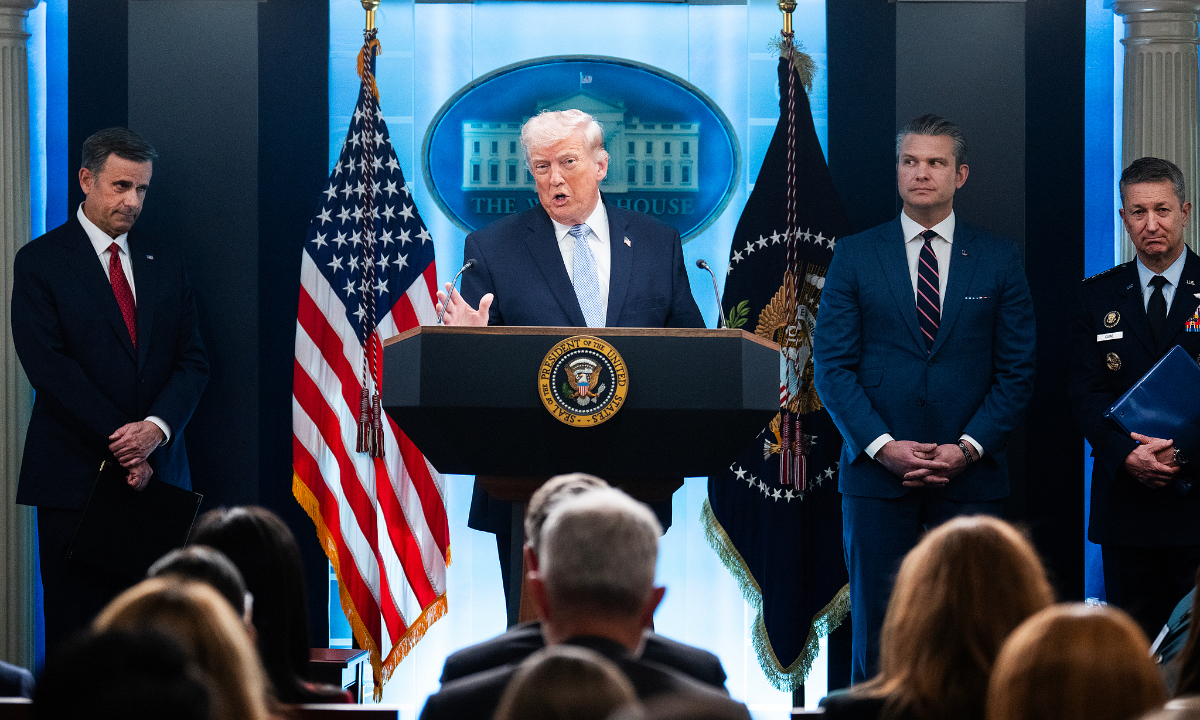
President Donald Trump, CIA Director John Ratcliffe, left, Defense Secretary Pete Hegseth, and Chairman of the Joint Chiefs of Staff Dan Caine, conduct a news conference in the White House briefing room about the war in Iran on Monday, April 6, 2026. Photo: VCG
When asked to comment on US President Donald Trump's claim regarding his Tuesday deadline of 8 pm to reach a deal, Chinese Foreign Ministry spokesperson Mao Ning said on Tuesday that the ongoing conflict has caused heavy casualties and damage. It is hitting the security and stability of regional countries and impacting the world economy and energy security.
"China is deeply concerned over this. To prolong or escalate the conflict does not serve any party's interest. All sides should play a constructive role in de-escalating the situation and facilitating peace talks," said Mao.
With the US' ultimatum on Iran approaching on Tuesday, Trump renewed his threat to Iran during an 83-minute press conference on Monday, warning that Iran could be "taken out" if it did not meet his newly updated deadline to reach a deal, but also cited effort to negotiate, media reported. Yet there has been little indication that Iran is ready to agree to the US' ultimatum.
"The entire country can be taken out in one night, and that night might be tomorrow night," Trump said, referring to the 8 pm EDT Tuesday (Wednesday 8am Beijing time) deadline he set for Iran to meet US demands or face the destruction of its national infrastructure, Reuters reported.
In a post on his Truth Social platform on Tuesday morning, Trump has warned a "whole civilization will die tonight" as a deadline he has set Iran of 8 pm ET to reopen the Strait of Hormuz grows closer. "I don't want that to happen, but it probably will," he wrote.
Several explosions were heard in Iran's Kharg Island on Tuesday, following multiple attacks by the US and Israel, according to Iran's semi-official Mehr news agency, the Xinhua News Agency reported.
Yet as the final hours tick down, there has been little indication that Iran is ready to agree to Trump's ultimatum. "We only accept an end of the war with guarantees that we won't be attacked again," Mojtaba Ferdousi Pour, head of Iran's diplomatic mission in Cairo, told The Associated Press. He said Iran no longer trusts the Trump administration after the US bombed the Islamic Republic twice during previous rounds of talks.
Iran's paramilitary Revolutionary Guard warned Tuesday it would "deprive the US and its allies of the region's oil and gas for years" if Trump carries out his threat to attack power plants and bridges if the Strait of Hormuz doesn't open, AP News reported, noting that multiple Iranian media outlets carried the statement.
It also issued a new threat to the Gulf Arab states. "We have exercised great restraint and had considerations in choosing retaliatory targets, but from now on all these considerations have been removed," AP News reported, citing the warning.
In a latest X post on Tuesday, Iran's President Masoud Pezeshkian said that "more than 14 million brave Iranians have so far registered to sacrifice their lives to defend Iran. I too have been, am, and will remain devoted to giving my life for Iran."
According Press TV on Tuesday, the Islamic Revolution Guards Corps has pounded US-owned petrochemical sites in the Wave 99 of its sweeping retaliatory strikes, warning that any further attacks on Iranian infrastructure will be met with zero restraint. Iranian forces targeted US bases and interests in the Persian Gulf and the Strait of Hormuz, as well as military gathering centers and command-and-control hubs in the occupied Palestinian territories, per the report.
Based on past patterns, when confronted with mounting pressure, the US has at times escalated tensions, while at other moments abruptly shifted course with tactical adjustments. This makes Washington's next move highly unpredictable if a deal fails again, Li Haidong, a professor at China Foreign Affairs University, told the Global Times.
However, current dynamics suggest that Tehran is unlikely to make meaningful concessions, while Washington also faces significant constraints in altering its own position. Coupled with Israel's role in shaping the conflict, this latest "ultimatum" is likely to unfold in a more dramatic and uncertain manner, said Li.
Li noted that the conflict is unlikely to end on Washington's terms simply because of Trump's ultimatum, but is more likely to become protracted. Such a scenario would be politically disastrous for the US, as a prolonged conflict would amplify pressure and deepen divisions at home.
The BBC also noted that Iran is unlikely to agree to Trump's ultimatum. They've rejected a temporary ceasefire and issued their own list of demands, which a US official described as "maximalist".
This places the American president in a delicate position. If there is no agreement, Trump could extend the deadline - for the fourth time in the past three weeks, according to the BBC.
At the same press conference, when asked about China's view on the current situation in the Middle East, Mao Ning said on Tuesday that the situation in the Middle East continues to worsen and the military conflict is still escalating, hitting the world economy and energy security and drawing deep concerns from the international community.
Since the conflict began, China has held an objective, just and balanced position and has been working to help bring about a ceasefire and end to the conflict. Foreign Minister Wang Yi made 26 phone calls with parties including Iran, Israel, Russia and the Gulf states. The Special Envoy of the Chinese Government on the Middle East Issue traveled to the region in a mediation effort.
Last week, China and Pakistan issued the five-point initiative, which embodies the international consensus for ceasefire and peace. The use of force does not bring peace. Political settlement is the right way forward, the spokesperson said.
On Tuesday, Zhai Jun, special envoy of the Chinese government on the Middle East issue, met with French Ambassador to China Bertrand Lortholary at the latter's request.
Lortholary said that France is deeply concerned about the escalation of the situation in the Middle East and the negative impact of the conflict on the global economy. He noted that the five-point initiative proposed by China and Pakistan to restore peace and stability in the Gulf and the broader Middle East largely aligns with France's position. France is willing to maintain coordination with China to help promote peace and stability in the region.
Zhai said that the ongoing escalation and spillover of the conflict are endangering regional peace and stability, while also impacting global economic and energy security. As permanent members of the United Nations Security Council, China and France should uphold fairness and justice, work together to promote ceasefire and de-escalation, and support the parties concerned in returning to the right track of dialogue and negotiation.
RELATED ARTICLES