Illustration: Liu Xidan/GT
The military conflict between the US, Israel and Iran has lasted for more than a month, and the situation in the Strait of Hormuz has directly disrupted the global oil and gas supplies. As a region highly dependent on imported fossil fuels, how severely will Europe be affected by the strained energy supply chains caused by issues in the Strait of Hormuz? How will the EU address these practical challenges? These questions have become a key focus of European media.
EU officials revealed that in just one month, since the outbreak of the conflict, Europe's additional spending on fossil fuel imports has reached 14 billion euros ($16.2 billion) - almost a replay of the energy crisis triggered by the Russia-Ukraine conflict in 2022.
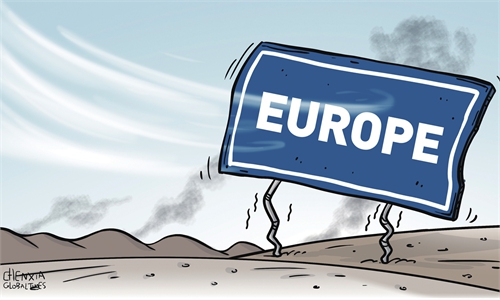
This issue of the strait serves as a stress test for Europe's energy system. With member states adopting fragmented and uncoordinated relief measures, structural changes to EU energy policy are unlikely in the short term, leaving the bloc trapped in a vicious cycle of short-term emergency responses and long-term absence.
First, the EU's "de-Russification" of energy has resulted in deeper dependence. To reduce reliance on Russian energy, the EU has sharply cut its imports of Russian oil since the outbreak of the Russia-Ukraine conflict, reducing them to just 2 percent, and plans to completely halt the imports of Russian natural gas next year. The EU has strengthened internal demand coordination and actively engaged with international gas suppliers. Meanwhile, it has also introduced gas storage regulations requiring member states to maintain storage levels of no less than 90 percent annually.
However, these measures have not fundamentally enhanced the EU's energy independence. Instead, they have merely shifted dependence from Russia to heavy reliance on liquefied natural gas (LNG) from the US. This simple substitution has not reduced the vulnerability of the EU's energy system; rather, it has made the bloc more susceptible to global market fluctuations and US political factors, leaving energy security risks still prominent.
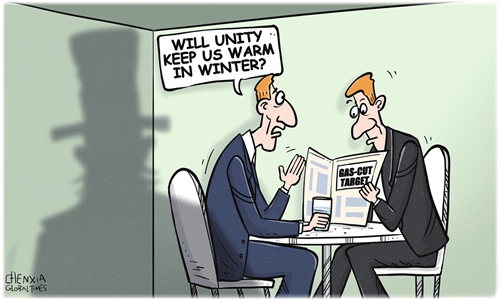
Second, the Middle East conflict has triggered a new round of energy crisis. However, EU member states have gone their own separate ways in responding to the crisis, leaving the energy dilemma difficult to resolve.
Spain has launched a 5-billion-euro relief package, implementing nearly 80 measures such as tax cuts, price caps, subsidies and the release of strategic reserves to ease the burden on businesses and households. Germany has focused on regulating fuel station prices. Italy has warned of further taxation on profiteering companies with four other EU countries. Due to varying degrees of impact and the lack of unified EU coordination, these scattered measures fail to create synergy. Short-term "emergency-style" responses cannot resolve the deep structural issues in Europe's energy sector.
Third, the EU has been ineffective in its response, and energy coordination has been fraught with difficulties. Faced with a new wave of energy shocks, the EU has responded slowly and cautiously, failing to introduce a unified and effective strategy. Significant differences in fiscal capacity, energy structure and domestic political pressures among member states are reflected in their varying levels of support and policy tools, exposing the EU's shortcomings in coordination efficiency and collective action during major crises.
In conclusion, the EU's response to this round of energy shocks remains slow and inefficient, largely confined to the reactive, short-term measures without addressing structural reform.
At the core of the issue lies the constraint imposed by political cycles. Over the next year and a half, Spain, France and Italy, among other countries, will hold elections. In pursuit of public support, governments tend to avoid difficult reforms and instead favor short-term relief measures such as subsidies, price caps and tax cuts. While these measures may temporarily ease public pressure, they weaken market price signals, crowd out long-term energy investment and further exacerbate the EU's policy short-sightedness and fragmentation.
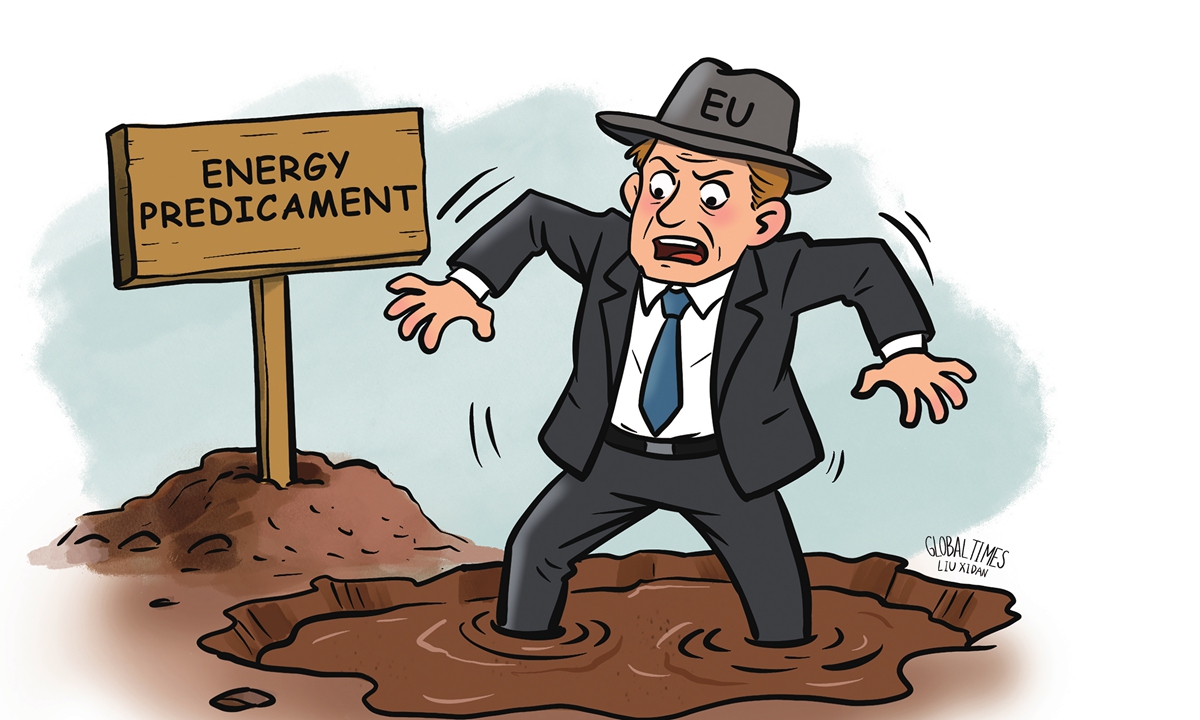
Looking ahead, if the EU is to truly overcome its energy predicament, it should accelerate the transformation of its energy structure. At the same time, electrification in heating and transport sectors should be promoted. The EU should also address infrastructure shortcomings by upgrading power grids and enhancing interconnectivity of energy networks, while leveraging initiatives such as the Net-Zero Industry Act to streamline regulation and mobilize market forces.
Only by moving beyond a short-term "firefighting mind-set" and adopting a long-term strategic approach to building a resilient and autonomous energy system can Europe fundamentally escape the recurring cycle of energy crises.
The author is a researcher at the Research Center for European Union Studies of Sichuan University. opinion@globaltimes.com.cn
RELATED ARTICLES