ARTS / CULTURE & LEISURE
Unearthing 100,000-year-old giant panda remains, Wang Deyuan safeguards ‘underground maze’ Shuanghe Cave
The riddle of nature
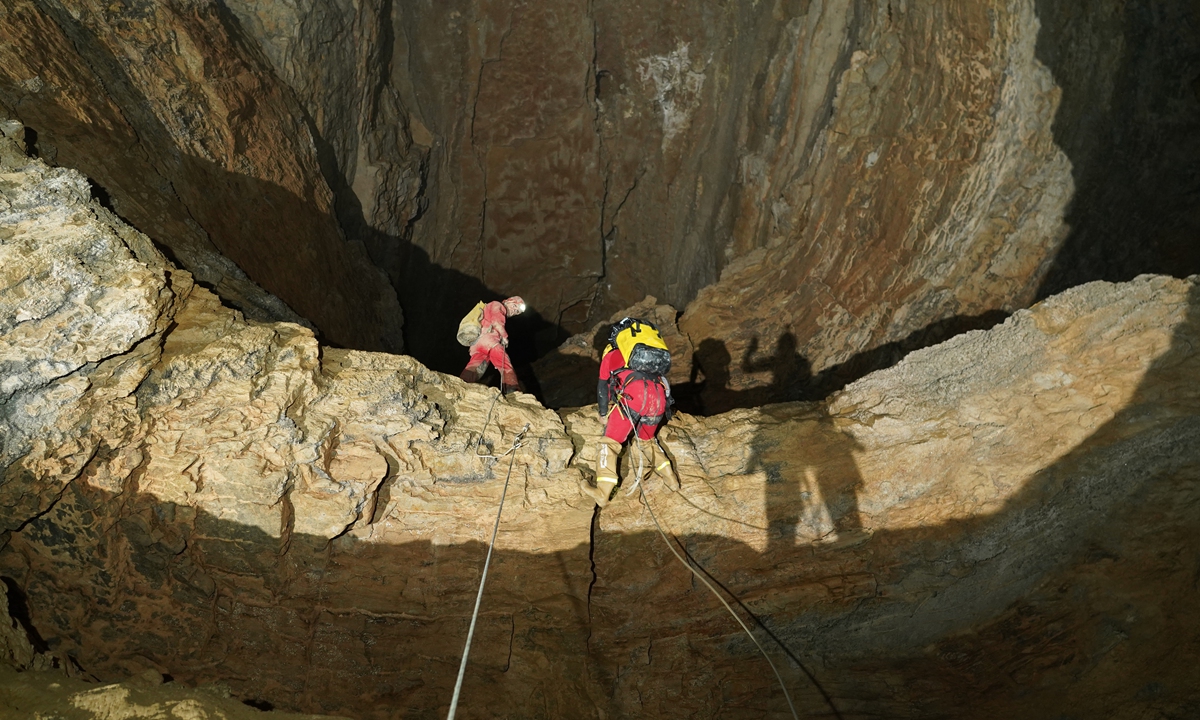
Experts investigate the Shuanghe Cave in Suiyang county, Southwest China's Guizhou Province, in October 2025. Photos: Courtesy of Wang Deyuan
Beneath the soil, shrouded in silence, lies the Shuanghe Cave, a natural riddle buried under the land of Suiyang county, Southwest China's Guizhou Province. For millions of years, it has evolved into one of the world's largest and most structurally intricate cave systems ever discovered in dolomite strata.
So far, 440 kilometers of the Shuanghe Cave's secrets have been explored, yet the length still fails to capture its full measure.
Without a map or a compass, eight years of dedication to the site allows spelunking expert Wang Deyuan to easily locate the cave entrance buried deep beneath fallen leaves.
Armed with nothing but a rope and a headlamp, he has gazed upon the wonders of this cave, where karst rock walls cradle the flowing river. And with his own hands, he has unearthed from a lost world multiple treasures, giant panda skulls among them.
"Too many secrets are hidden here. Our exploration has no end," Wang, who works at the Guizhou Institute of Mountain Resources, told the Global Times.
Explorer's instinct
Just a few days ago, Wang unveiled a recent discovery made by his team in the cave: the most complete takin fossil ever unearthed in China.
Wang revealed to the Global Times that several takin fossils have now been discovered following the first one.
The stellar takin fossil was first spotted in May 2025 during a field survey by Wang's research partner, French explorer Jean Bottazzi.
When found, only half of the skull and one horn of the large mammal skeleton were visible.
"When Jean sent me the photos, we both found it very strange. At first glance, we thought it might be a serow, which we had found before," Wang noted. "But after a closer look at the horns, we became certain it was not."
Driven by a researcher's instinct, Wang headed to the site and soon sensed that there likely was more than one fossil hidden nearby. As he ventured deeper, his foot kicked something that made a hollow sound. "A stone wouldn't make such noise," he recalled.
Looking down, he saw a second fossil was laying at his feet.
"That was a more complete fossil. I could clearly identify that its distinctive twisting horns belonged to no else but a takin," he said.
Both fossils date to the late Late Pleistocene, roughly 15,000 and 11,000 years ago. They accidentally fell into the narrow, rugged cave and were "trapped there, never to leave," Bottazzi told the Global Times.
Including these two, Wang and his team have now discovered a total of five takin fossils, providing biological puzzle pieces for future research on the evolution and migration of this species.
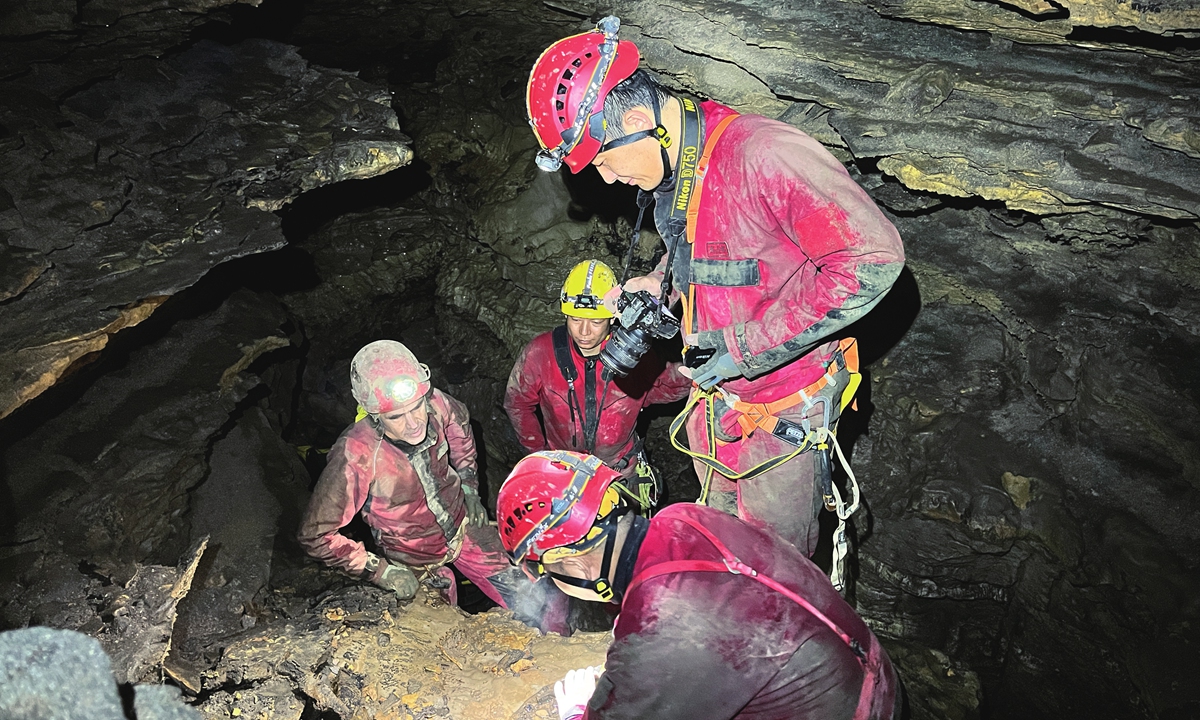
Experts inspect fossil remains in the Shuanghe Cave in 2022.
Giant panda secrets
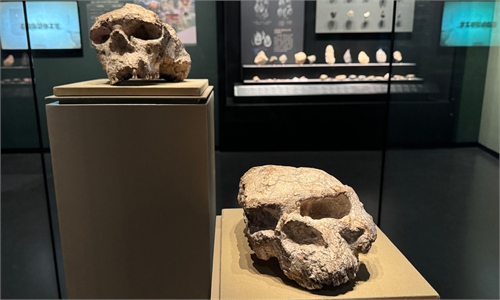
Besides the takins, the Shuanghe Cave is like an underground zoo, having the remains of various creatures such as extinct stegodons, Sumatran rhinos, and precious giant pandas.
A total of 52 giant panda fossils have been discovered in the cave one after another since 2011, the largest number of such fossils anywhere in the world.
In 2021, the team discovered a unique "pseudo-thumb" bone fossil among the giant panda remains. It resembles the extra "thumb" on a giant panda's paw that is used together with the other five fingers to grasp bamboo. Although this fossil was small, it confirmed a special evolutionary adaptation: That as far back as over 100,000 years ago, giant pandas had already developed the physiological conditions to flexibly use their front paws to grasp bamboo.
In 2025, six more giant panda fossils were unearthed, including skulls, teeth, and other remains. The latest among them lived only 800 to 900 years ago. Through ancient DNA research, experts have discovered that ancient giant pandas were half the size of modern giant pandas.
"It is like an endless treasure trove. It helps us to explore the ancient environment and ecology of Southwest China," Wang noted.
More than local heritage
Including the latest generation of researchers like Wang, several generations of experts, particularly overseas specialists, have been fascinated by the Shuanghe Cave site since it was discovered in the late 1980s.
Taking the pair of Wang and Bottazzi as an example, the local area has organized 24 joint Chinese-foreign scientific expeditions, involving experts from France, Italy, Portugal, and other countries. Chinese and foreign experts have worked together, extending the indefinable possibilities of the cave.
"Both Bottazzi and I know that there are at least 200 more kilometers of the cave still waiting to be discovered," said Wang.
He also added that the "regularized" cooperation has enabled him and the foreign experts to go from struggling with language barriers and relying on translation tools at the beginning to now understanding each other effortlessly and building a strong rapport.
This "regularized" cooperation has propelled the Shuanghe Cave to become an internationally recognized topic. In 2025, it was officially inscribed on UNESCO's Tentative List for World Natural Heritage.
"Among China's numerous World Heritage sites, if the Shuanghe Cave successfully makes it onto the list, it will be a flagship one, as it would fill the gap of the 'dolomite cave system' category that is currently a blank space on the World Heritage List," Tian Ai'ming, a heritage management expert, told the Global Times.
Adding his efforts toward attaining this title, Wang said that he wants to do as much as he can. "We are not gravediggers of fossils, but translators of time and and space."
RELATED ARTICLES