China to accelerate space computing ecosystem: MIIT
Country's first space computing professional committee established
By Published: Apr 07, 2026 09:54 PM

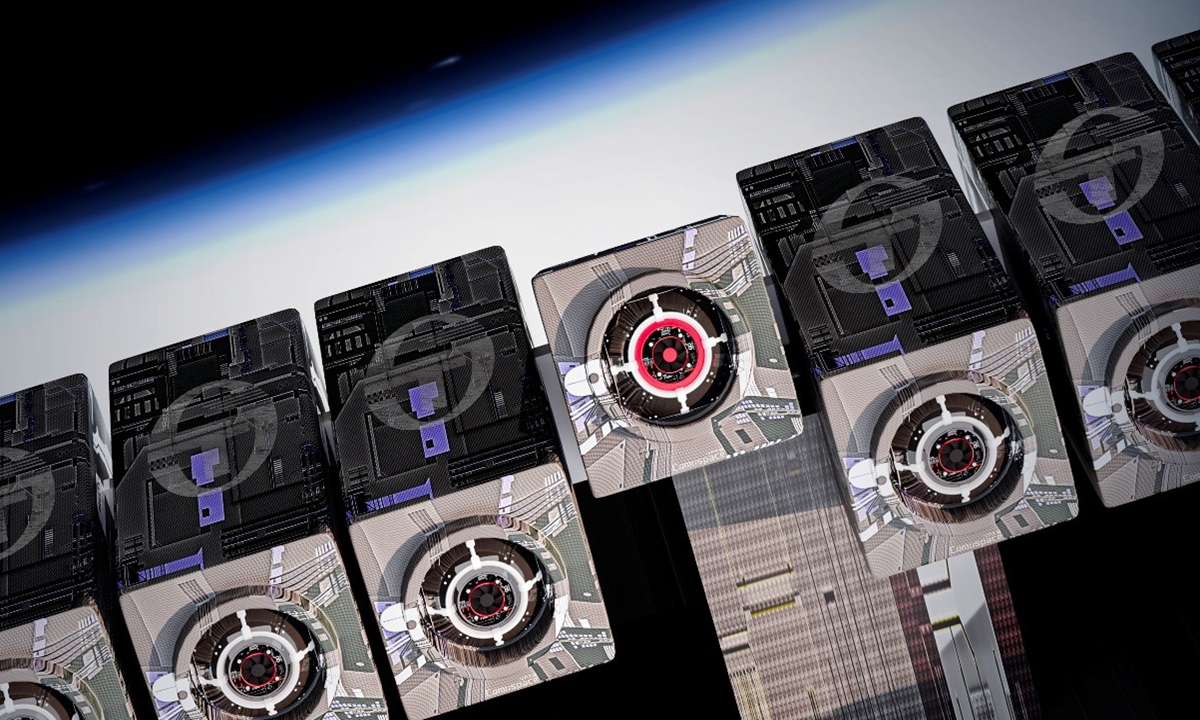
Laser Communication Array for Space-Based Supercomputing Center Illustration: Courtesy of the Institute of Computing Technology, Chinese Academy of Sciences
China will accelerate the development of the space computing industry ecosystem, and China is currently the first country to realize the in-orbit networking and operation of a space computing satellite constellation, according to a WeChat post published by China's Ministry of Industry and Information Technology (MIIT) on Tuesday, citing a report from China Central Television.
The country is already at the forefront globally in terms of engineering implementation and commercial deployment speed, and ranks among the world's top tier in the space computing sector, the report said.
Computing satellites can be networked via laser communications to achieve seamless global coverage and process data directly in orbit, reducing the latency for applications such as disaster warning and resource monitoring from several hours to seconds - something that ground-based computing cannot achieve, Xie Lina, deputy director of the Cloud Computing and Big Data Research Institute under the China Academy of Information and Communication Technology (CAICT), was quoted as saying in the report.
The CAICT is a scientific research institute directly under the MIIT, according to its website.
"The future of the human information industry will inevitably be an integrated space-air-ground system. A large volume of data will be processed in space, where abundant solar energy can be harnessed to provide greater power and higher efficiency," Xiang Ligang, director-general of the Zhongguancun Modern Information Consumer Application Industry Technology Alliance, told the Global Times on Tuesday.
By deploying computing capabilities in orbit, satellites can be managed directly from space, and many computational tasks can be completed there, Xiang said.
This approach can significantly improve efficiency and reduce costs. It also offers a certain degree of security, as it minimizes the need for large-scale data transmission, he noted.
Some MIIT officials and veteran experts focusing on this field have been emphasizing the importance of developing the space computing industry.
Zhao Ce, an official from the MIIT's information and communications development department, explained at a conference on space computing industry on Friday in Beijing that space computing presents new opportunities, but also faces a number of pressing challenges that need to be addressed, domestic news site Securities Times reported on Tuesday.
Zhao emphasized the need to strengthen systematic planning, make forward-looking arrangements, deepen industrial development, enhance coordinated efforts, and steadily and orderly advance the growth of the space computing industry, according to the media report.
Also, during the conference, China's first industry-wide collaborative platform for space computing - a space computing professional committee - has been officially established, marking a new stage of coordinated development for the country's space computing industry, the Xinhua News Agency reported.
The committee is committed to systematically building a technological framework and industrial ecosystem for space computing, which will focus on areas such as onboard AI chips, inter-satellite laser communications, efficient thermal control and space-based photovoltaics, and will carry out coordinated, forward-looking research on key technologies, per Xinhua.
It will also accelerate the pre-research and development of standards systems, and promote the solicitation of innovative solutions and pilot demonstrations for application scenarios including satellite-based intelligent agents, disaster emergency response, low-Earth-orbit satellite internet and deep-space exploration, Xinhua said.
Renowned Chinese cloud computing and AI scholar Wang Jian put forward a point of view during a public speech delivered in September 2025: only by sending AI and computing power into space can humanity truly have the possibility of leaving Earth, according to media reports.
In an exclusive interview with the Global Times recently, Wang explained that when satellites are tens of thousands of kilometers from Earth, data transmission already becomes quite difficult. If humans are to venture further into space in the future - when satellites may be 100,000 kilometers away or even farther - data will be almost impossible to transmit back to Earth. Therefore, "computing power must be built in space, and data must be processed in space," he said.
Zhejiang Lab, where Wang works, together with global partners, is building a space-based AI infrastructure known as the "Three-Body Computing Constellation," while exploring the concept of "sending AI into space."
On May 14, 2025, the first batch of 12 computing satellites for the constellation was successfully launched into orbit. So far, the team has completed the in-orbit deployment and verification of 10 AI models and applications, according to media reports.
In 2026, Zhejiang Lab will collaborate with satellite companies to deploy more than 50 computing satellites, further advancing the application and development of artificial intelligence in space, Wang told the Global Times.
Besides China, other countries have also been working on the space computing industry.
US tech leaders like SpaceX CEO Elon Musk, Amazon founder Jeff Bezos and Google CEO Sundar Pichai are framing data centers in space as a cost-effective solution to AI's insatiable appetite for resources, such as land and power, Business Insider reported on Friday.
After building computing capabilities in space, what can we do? Wang explained that weather forecasting, for example, could be carried out directly in space.
At present, meteorological satellites transmit data back to Earth, but in the future, weather data could be processed directly in orbit, making forecasts more accurate. Just as the invention of electricity gave rise to a wide range of electrical appliances, the "Three-Body Computing Constellation," as a space-based AI infrastructure, will also enable countless innovative applications that are beyond our current imagination, Wang added.
RELATED ARTICLES