Stay alert to Tokyo’s arms exports ambition to build security dependence on Japan in the Asia-Pacific
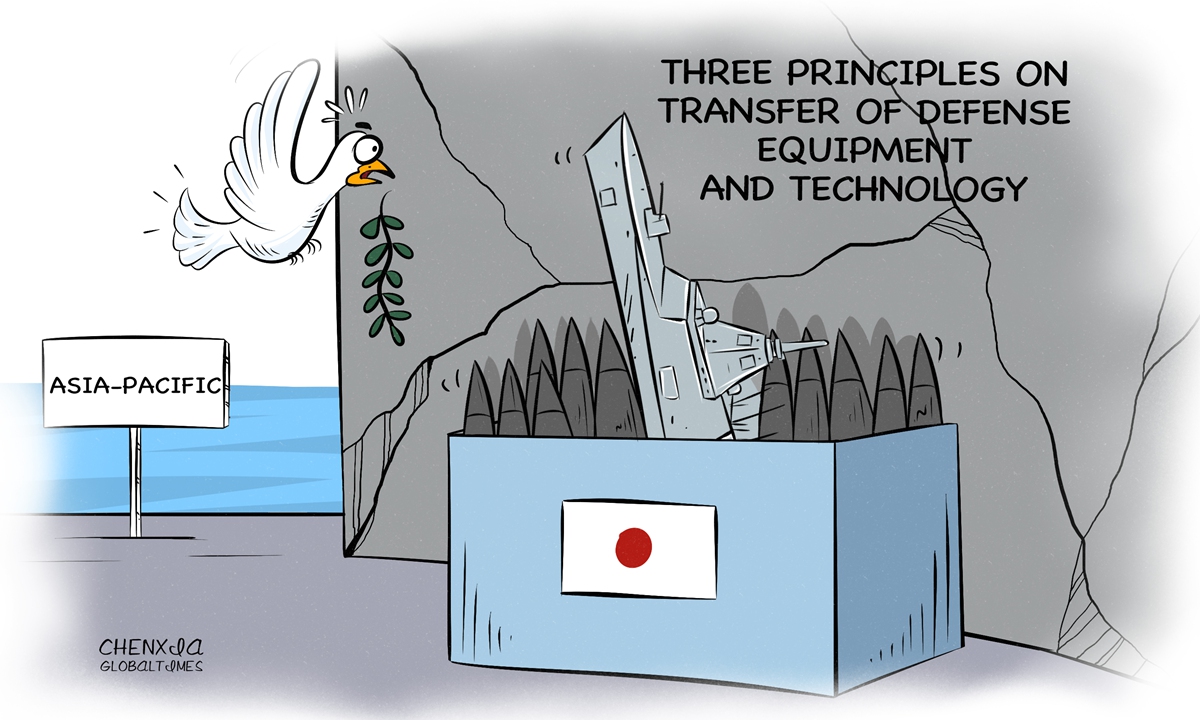
Illustration: Chen Xia/GT
This month, the Japanese government plans to formally revise the implementation guidelines for the "three principles on transfer of defense equipment and technology," local media reported. Echoing its attempt to accelerate arms sales across the Asia-Pacific, these actions reflect a further resurgence of militarist thinking in Japan and add new uncertainties to regional security.
According to media reports, Japan's Defense Minister Shinjiro Koizumi plans to visit the Philippines in early May, where Tokyo is considering providing used Abukuma-class frigates as well as Type 03 medium-range surface-to-air missile systems. Prior to that, he is also anticipated to visit Indonesia, which has likewise expressed interest in purchasing decommissioned destroyers and submarines.
"Through arms sales and a frequent push for arms cooperation in the Asia-Pacific, Japan is not only building up its military-industrial chain and seeking new drivers of economic growth, but also expanding its influence in the regional security landscape and gradually shaping a security dependence centered on itself," Lü Chao, a research fellow at the Liaoning Academy of Social Sciences, told the Global Times.
"If Japan's weapons exports become a long-term norm, countries — especially those engaged in transactions involving offensive weapons with Japan — may develop a dependence on it. This could even trigger an arms race and pose threats to regional security," Lü said.
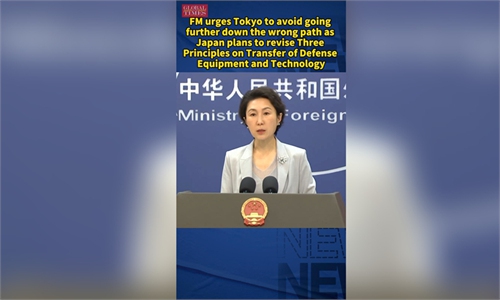
To enable its defense products to go global more openly, the Japanese government has been actively seeking legal and policy grounds to expand arms exports. The planned revision of the "three principles on transfer of defense equipment and technology" will pave the way for overseas sales, including lethal weapons. In response, China's Foreign Ministry stated on Tuesday that ''Japan's remilitarization is gathering pace. This is already a reality with an actual roadmap and concrete steps, and this is posing a threat to regional peace and stability.''
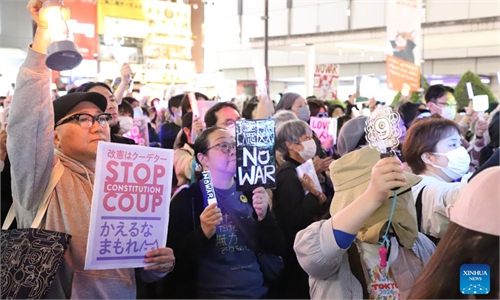
Such concerns are not limited to China; they have also resonated within Japan and the broader international community. On Sunday, senior figures from several Japanese opposition parties joined thousands of citizens in Tokyo to protest the government's dangerous push to ease restrictions on arms exports and advance sweeping military expansion, voicing concern about the country's future path. In the comment section of related foreign media reports, some netizens noted that China's concern lies in "Sanae Takaichi shifting Japan away from their pacifist constitution restraint toward a neo-colonial imperialism," especially given Japan's bloody history of aggression against China, arguing that Japan should not be framed as "one of the ordinary Asian countries."
It's true that the loosening of Japan's arms export policy should not be viewed as a routine adjustment of an "ordinary Asian country." The risks of Japan's arms push in the Asia-Pacific lie in the fact that Japan has yet to fundamentally reflect on its historical crimes. This is not about a handful of right-wing figures, but a broader political establishment — represented by figures such as Takaichi — that has failed to properly reckon with wartime atrocities. Historically, there was a clear trajectory linking Japan's pre-World War II military-industrial expansion with its external aggression. Today, Japan's rapidly expanding defense industry, the normalization of arms exports, and deepening military ties with other countries echo, to some extent, that troubling path.
In essence, what Japan is advancing is not merely a policy adjustment, but a reshaping of its security philosophy — from a postwar posture centered on defensive peace to a more offensive and expansionist security practice. When such a shift intersects with regional flashpoints, alliance politics and unresolved historical issues — particularly against the backdrop of growing rightward drift and historical revisionism in Japanese politics — its spillover effects cannot be underestimated.
History offers clear warnings. Once the gears of the military-industrial complex begin turning in service of revived militarism, the war machine that once brought profound suffering to Asia could again be set in motion. The international community must stay on high alert and firmly reject the reckless moves of Japanese neo-militarism.
RELATED ARTICLES