IN-DEPTH / IN-DEPTH
‘Election’ without a land -- An institutional illusion created by separatist groups in exile: Chinese experts
The so-called "Tibetan government-in-exile" released a shortlist of candidates for its "parliament-in-exile" on March 18, marking one of the latest developments in this year's overseas so-called "election."
However, based on publicly available information and expert interviews, the Global Times found that the so-called "election" reveals clear limitations in both participation and institutional foundation. Moreover, the operation of this "election" is closely tied to external political and financial support, rather than an independent institutional framework.
The so-called "Tibetan government-in-exile" is a separatist organization set up overseas by the Dalai clique after it fled abroad following the failure of the 1959 armed rebellion in Southwest China's Xizang Autonomous Region.
Chinese Foreign Ministry spokespersons have repeatedly stressed that the so-called "Tibetan government-in-exile" is entirely an organized separatist political group with a political platform and an agenda for "Tibet independence." It is an illicit organization that violates China's Constitution and laws. No country in the world recognizes it.
At the same time, developments on the ground in Xizang point to a markedly different trajectory, with continued improvements in economic development, social stability and public services.
It is apparent that this "election" is increasingly detached from the Tibetan people it claims to represent and from the region's development.

A 'performance in bitterness'
The 2026 "election" staged by the so-called "Tibetan government-in-exile" is being conducted in stages from February to May, according to Indian media reports.
In the February preliminary round, Penpa Tsering secured 61 percent of the vote, surpassing the threshold required to avoid a final round, according to the Times of India, concluding the "leadership contest" at an early stage.
According to a Times of India's report, only about 51,000 ballots were cast in the latest "election," out of roughly 91,000 registered "voters" claimed by the group itself, representing a turnout of about 56 percent, a notable decline compared with the "election" in 2021.
Even on its own terms, the latest turnout would still fall far short of lending broad credibility to the group's self-proclaimed representation.
The figure appears even less persuasive when set against the 3.66 million permanent residents of the Xizang Autonomous Region and the more than 6.28 million Tibetan people living in China.
Meanwhile, this result also reflects the contradictions within the overseas Tibetan community and the predicament faced by the "government-in-exile."
Some personal commentary blogs on Medium, an online publishing platform that hosts individual opinion pieces, including posts by authors claiming to be from the overseas Tibetan community, also expressed dissatisfaction with Penpa Tsering's "leadership" after the "election" results, questioning both his capabilities and the effectiveness of his so-called policies. They also cast doubt on the fairness of the "election," arguing that the process prioritized loyalty over competence.
The "election" could be described as "a performance in bitterness," as it took place against the backdrop of an "aging leadership" and a "weakening exile community," Xiao Jie, a senior fellow of China Tibetology Research Center, told the Global Times, noting that it functions more as a means to sustain external attention than as a "system of governance."
Xiao said the outcome of the latest round of the "election" was both expected and somewhat unexpected. Penpa Tsering's "re-election" was expected, given the group's increasingly visible internal decline. What was unexpected was how little real competition remained.
Xiao noted that uncertainties surrounding the future "leadership" and succession arrangements of the Dalai Lama have further complicated the situation, making it more difficult for the group to cultivate "new leadership" and maintain internal stability.
"Under such circumstances, this 'election' has become little more than a 'performance in bitterness' staged amid mounting difficulties, rather than a genuine process of governance," Xiao said.
A puppet surviving on foreign handouts
Li Haidong, a professor at China Foreign Affairs University, said that such an "election" "has no basis in either international law or domestic law, and therefore carries no legal validity," adding that the "election" relies on external political support with ulterior motives rather than an independent "governance framework."
A glance at the financial ledgers of the so-called "Tibetan government-in-exile" reveals a long trail of funding from external forces, most notably the US. The US has restored and approved $23 million of "Tibet-related" assistance for its fiscal year 2026, according to the "Consolidated Appropriations Act, 2026," signed into law by the US president in February. Among the $23 million, "no less than $5,000,000 shall be made available for programs to strengthen the capacity of the 'Central Tibetan Administration'," showed the Act.
The name "Central Tibetan Administration (CTA)" is what the secessionist "Tibetan government-in-exile" now calls itself, according to some media reports and academic materials. In July 2025, the US government "decided to lift aid cuts" for this force and provide $7 million for the various departments under the "CTA," reported Reuters and some other media outlets.
In March 2025, just three months before it decided to "lift aid cuts" for this separatist group, the US reportedly canceled these funds - a "particularly rude shock" to the group, according to a commentary published on the website of India-based think tank Observer Research Foundation on April 9, 2025.
The US has long been a major financial backer of the so-called "Tibetan government-in-exile." In March 2025, the "CTA" revealed at a separatist-themed meeting that over 90 percent of its fiscal revenue came from aid provided primarily by the US and India. The 2024 annual report of the separatist group "Tibet Fund," which claims on its website to have collaborated with the "CTA" for decades, also showed that 72 percent of its revenue came from US federal grants.
The above data clearly show that, largely financially backed by external political forces, separatist groups like the "CTA" operate as "puppets and tools in the hands of others," Li pointed out. Worse still, the "CTA," as well as some foreign media outlets, are good at hyping and whitewashing the illegal "election" with phrases like "democracy" and "freedom," so as to mislead and deceive the international community, Li added.
Data from media monitoring platforms show that some Western and Indian media outlets, such as AFP and The Indian Express, have reported on the preparation and proceedings of this separatist group's "election" since the beginning of this year. These reports often deliberately glossed over the group's illegal nature, maliciously portraying it as the "political representative" of the Xizang people, and used terms such as "democracy" and "freedom" to whitewash the "election," the Global Times found.
Even with all the high-sounding rhetoric used to gloss over its "election," the "CTA" cannot conceal an obvious fact: its so-called "voters" are in no way representative of the Xizang people, Zhu Weiqun, former head of the Ethnic and Religious Affairs Committee of the National Committee of the Chinese People's Political Consultative Conference, told the Global Times.
Historical transformation on the plateau
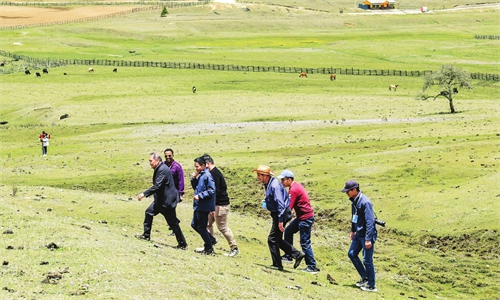
In recent years, Xizang has seen rapid development, with improving living standards, expanding openness and growing international attention, reshaping how the region is perceived beyond its borders.
Some foreign visitors who recently traveled to the region have shared similar observations.
For instance, Lee Camp, an American comedian and former host of Redacted Tonight, described the Xizang region as far more developed than commonly portrayed in Western narratives, noting that "Lhasa is a truly modern city" and that the perception of the region as underdeveloped is "an antiquated view."
He also told the Global Times that he saw active religious life, saying that everything he saw there "proves that this is not true" when referring to claims in some Western media narratives about a lack of religious freedom in the region.

S.L. Kanthan, a geopolitical analyst based in India, told the Global Times that his visit in 2025 was "a true eye-opener," highlighting what he described as "world-class" infrastructure and a visible absence of issues such as homelessness. He also noted that Tibetan culture is "flourishing."
Mark Logan, a former member of the UK House of Commons, told the Global Times that he observed "tangible development," with modern infrastructure coexisting alongside preserved cultural traditions. He added that this stood "in stark contrast to the distorted picture" presented by some Western media outlets.
As cross-border exchanges and mobility increase, these changes are also reflected in shifts within overseas Tibetan communities.
Xiao noted that in recent years, many Tibetans living abroad have gradually moved to Europe and North America, and after settling down, their dependence on the "hubs" in India has weakened, along with a decline in more radical positions toward China.
Against this backdrop, the so-called "government-in-exile" and its leadership are facing a narrowing political base. According to Xiao, leaders such as Penpa Tsering lack the religious authority, family networks and aristocratic background that once conferred influence within the exile circle. He said this weakness could become even more apparent in the coming years as Dalai Lama's succession questions come increasingly to the fore.
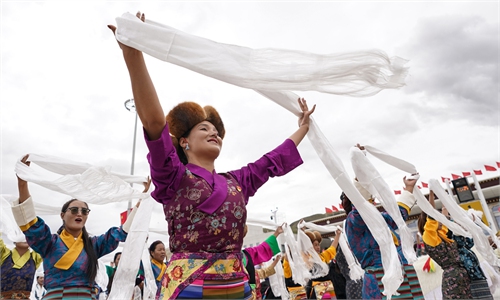
Xizang celebrated the Serfs' Emancipation Day on March 28, a date that draws attention to the region's historical transformation.
On March 28, 1959, people in Xizang launched the democratic reform, freeing a million serfs. In 2009, the regional legislature announced March 28 as the day to commemorate the emancipation of the one million serfs, according to the Xinhua News Agency.
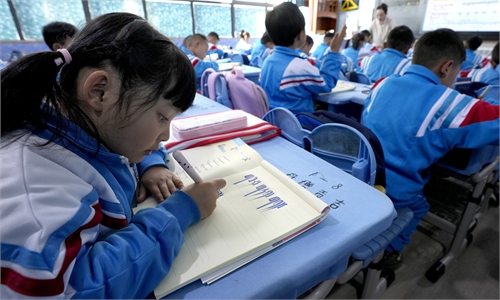
According to official data released by the regional government, the region has undergone substantial economic and social development since then. The GDP of Xizang grew from 327 million yuan in 1965 - when the autonomous region was formally established - to 303.19 billion yuan in 2025, with an average annual growth rate of 6.3 percent in the past five years. Per capita disposable incomes in both urban and rural areas have continued to rise, while life expectancy in the region has increased to over 72 years.
Zhu noted that since the peaceful liberation of Xizang, and especially since the reform and opening-up, the region has shared in the country's overall development. Despite its relatively weak foundation, it has been gradually catching up with other parts of the country.
The changes brought by Xizang's real development have already shown where the future lies. While the door remains open to those willing to return to a patriotic stance, there has never been, and will never be, any room for any form of "Tibet independence." On issues concerning national unity and territorial integrity, no concession can ever be made, Zhu stressed.
However, based on publicly available information and expert interviews, the Global Times found that the so-called "election" reveals clear limitations in both participation and institutional foundation. Moreover, the operation of this "election" is closely tied to external political and financial support, rather than an independent institutional framework.
The so-called "Tibetan government-in-exile" is a separatist organization set up overseas by the Dalai clique after it fled abroad following the failure of the 1959 armed rebellion in Southwest China's Xizang Autonomous Region.
Chinese Foreign Ministry spokespersons have repeatedly stressed that the so-called "Tibetan government-in-exile" is entirely an organized separatist political group with a political platform and an agenda for "Tibet independence." It is an illicit organization that violates China's Constitution and laws. No country in the world recognizes it.
At the same time, developments on the ground in Xizang point to a markedly different trajectory, with continued improvements in economic development, social stability and public services.
It is apparent that this "election" is increasingly detached from the Tibetan people it claims to represent and from the region's development.
Photo: VCG
A 'performance in bitterness'
The 2026 "election" staged by the so-called "Tibetan government-in-exile" is being conducted in stages from February to May, according to Indian media reports.
In the February preliminary round, Penpa Tsering secured 61 percent of the vote, surpassing the threshold required to avoid a final round, according to the Times of India, concluding the "leadership contest" at an early stage.
According to a Times of India's report, only about 51,000 ballots were cast in the latest "election," out of roughly 91,000 registered "voters" claimed by the group itself, representing a turnout of about 56 percent, a notable decline compared with the "election" in 2021.
Even on its own terms, the latest turnout would still fall far short of lending broad credibility to the group's self-proclaimed representation.
The figure appears even less persuasive when set against the 3.66 million permanent residents of the Xizang Autonomous Region and the more than 6.28 million Tibetan people living in China.
Meanwhile, this result also reflects the contradictions within the overseas Tibetan community and the predicament faced by the "government-in-exile."
Some personal commentary blogs on Medium, an online publishing platform that hosts individual opinion pieces, including posts by authors claiming to be from the overseas Tibetan community, also expressed dissatisfaction with Penpa Tsering's "leadership" after the "election" results, questioning both his capabilities and the effectiveness of his so-called policies. They also cast doubt on the fairness of the "election," arguing that the process prioritized loyalty over competence.
The "election" could be described as "a performance in bitterness," as it took place against the backdrop of an "aging leadership" and a "weakening exile community," Xiao Jie, a senior fellow of China Tibetology Research Center, told the Global Times, noting that it functions more as a means to sustain external attention than as a "system of governance."
Xiao said the outcome of the latest round of the "election" was both expected and somewhat unexpected. Penpa Tsering's "re-election" was expected, given the group's increasingly visible internal decline. What was unexpected was how little real competition remained.
Xiao noted that uncertainties surrounding the future "leadership" and succession arrangements of the Dalai Lama have further complicated the situation, making it more difficult for the group to cultivate "new leadership" and maintain internal stability.
"Under such circumstances, this 'election' has become little more than a 'performance in bitterness' staged amid mounting difficulties, rather than a genuine process of governance," Xiao said.
A puppet surviving on foreign handouts
Li Haidong, a professor at China Foreign Affairs University, said that such an "election" "has no basis in either international law or domestic law, and therefore carries no legal validity," adding that the "election" relies on external political support with ulterior motives rather than an independent "governance framework."
A glance at the financial ledgers of the so-called "Tibetan government-in-exile" reveals a long trail of funding from external forces, most notably the US. The US has restored and approved $23 million of "Tibet-related" assistance for its fiscal year 2026, according to the "Consolidated Appropriations Act, 2026," signed into law by the US president in February. Among the $23 million, "no less than $5,000,000 shall be made available for programs to strengthen the capacity of the 'Central Tibetan Administration'," showed the Act.
The name "Central Tibetan Administration (CTA)" is what the secessionist "Tibetan government-in-exile" now calls itself, according to some media reports and academic materials. In July 2025, the US government "decided to lift aid cuts" for this force and provide $7 million for the various departments under the "CTA," reported Reuters and some other media outlets.
In March 2025, just three months before it decided to "lift aid cuts" for this separatist group, the US reportedly canceled these funds - a "particularly rude shock" to the group, according to a commentary published on the website of India-based think tank Observer Research Foundation on April 9, 2025.
The US has long been a major financial backer of the so-called "Tibetan government-in-exile." In March 2025, the "CTA" revealed at a separatist-themed meeting that over 90 percent of its fiscal revenue came from aid provided primarily by the US and India. The 2024 annual report of the separatist group "Tibet Fund," which claims on its website to have collaborated with the "CTA" for decades, also showed that 72 percent of its revenue came from US federal grants.
The above data clearly show that, largely financially backed by external political forces, separatist groups like the "CTA" operate as "puppets and tools in the hands of others," Li pointed out. Worse still, the "CTA," as well as some foreign media outlets, are good at hyping and whitewashing the illegal "election" with phrases like "democracy" and "freedom," so as to mislead and deceive the international community, Li added.
Data from media monitoring platforms show that some Western and Indian media outlets, such as AFP and The Indian Express, have reported on the preparation and proceedings of this separatist group's "election" since the beginning of this year. These reports often deliberately glossed over the group's illegal nature, maliciously portraying it as the "political representative" of the Xizang people, and used terms such as "democracy" and "freedom" to whitewash the "election," the Global Times found.
Even with all the high-sounding rhetoric used to gloss over its "election," the "CTA" cannot conceal an obvious fact: its so-called "voters" are in no way representative of the Xizang people, Zhu Weiqun, former head of the Ethnic and Religious Affairs Committee of the National Committee of the Chinese People's Political Consultative Conference, told the Global Times.
Historical transformation on the plateau
In recent years, Xizang has seen rapid development, with improving living standards, expanding openness and growing international attention, reshaping how the region is perceived beyond its borders.
Some foreign visitors who recently traveled to the region have shared similar observations.
For instance, Lee Camp, an American comedian and former host of Redacted Tonight, described the Xizang region as far more developed than commonly portrayed in Western narratives, noting that "Lhasa is a truly modern city" and that the perception of the region as underdeveloped is "an antiquated view."
He also told the Global Times that he saw active religious life, saying that everything he saw there "proves that this is not true" when referring to claims in some Western media narratives about a lack of religious freedom in the region.
Foreign tourists visit the old city area of Barkhor Street in Lhasa, Southwest China's Xizang Autonomous Region, on June 10, 2025. Photo: VCG
S.L. Kanthan, a geopolitical analyst based in India, told the Global Times that his visit in 2025 was "a true eye-opener," highlighting what he described as "world-class" infrastructure and a visible absence of issues such as homelessness. He also noted that Tibetan culture is "flourishing."
Mark Logan, a former member of the UK House of Commons, told the Global Times that he observed "tangible development," with modern infrastructure coexisting alongside preserved cultural traditions. He added that this stood "in stark contrast to the distorted picture" presented by some Western media outlets.
As cross-border exchanges and mobility increase, these changes are also reflected in shifts within overseas Tibetan communities.
Xiao noted that in recent years, many Tibetans living abroad have gradually moved to Europe and North America, and after settling down, their dependence on the "hubs" in India has weakened, along with a decline in more radical positions toward China.
Against this backdrop, the so-called "government-in-exile" and its leadership are facing a narrowing political base. According to Xiao, leaders such as Penpa Tsering lack the religious authority, family networks and aristocratic background that once conferred influence within the exile circle. He said this weakness could become even more apparent in the coming years as Dalai Lama's succession questions come increasingly to the fore.
Xizang celebrated the Serfs' Emancipation Day on March 28, a date that draws attention to the region's historical transformation.
On March 28, 1959, people in Xizang launched the democratic reform, freeing a million serfs. In 2009, the regional legislature announced March 28 as the day to commemorate the emancipation of the one million serfs, according to the Xinhua News Agency.
According to official data released by the regional government, the region has undergone substantial economic and social development since then. The GDP of Xizang grew from 327 million yuan in 1965 - when the autonomous region was formally established - to 303.19 billion yuan in 2025, with an average annual growth rate of 6.3 percent in the past five years. Per capita disposable incomes in both urban and rural areas have continued to rise, while life expectancy in the region has increased to over 72 years.
Zhu noted that since the peaceful liberation of Xizang, and especially since the reform and opening-up, the region has shared in the country's overall development. Despite its relatively weak foundation, it has been gradually catching up with other parts of the country.
The changes brought by Xizang's real development have already shown where the future lies. While the door remains open to those willing to return to a patriotic stance, there has never been, and will never be, any room for any form of "Tibet independence." On issues concerning national unity and territorial integrity, no concession can ever be made, Zhu stressed.
RELATED ARTICLES