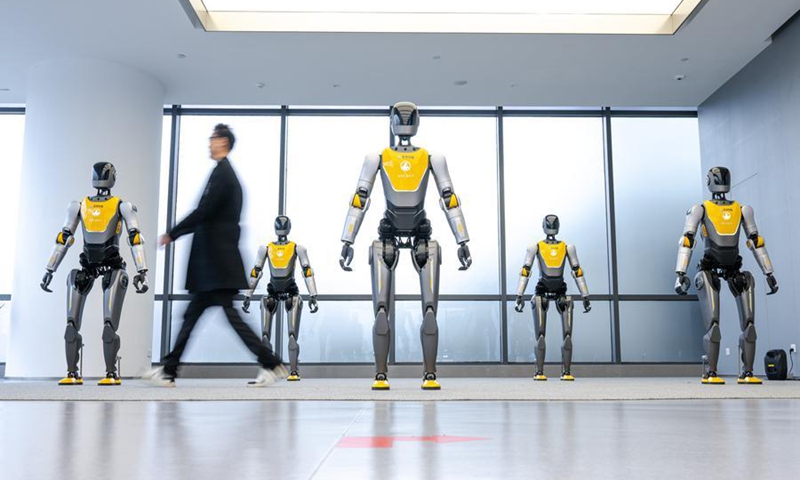
A visitor walks past robots displayed at a humanoid robot innovation center in Wuhan East Lake High-tech Development Zone, also known as the optics valley of China, in Wuhan, central China's Hubei Province, Dec. 4, 2025. (Xinhua/Xiao Yijiu)
Two Chinese embodied intelligence firms announced major funding rounds on Tuesday, as experts said that the sector is gaining momentum from high-profile showcases to accelerating investment, with a stronger foundation for real-world commercial deployment.
Spirit AI announced on Tuesday that it had secured a new round of financing worth 1 billion yuan ($143 million), bringing its total funding to 3 billion yuan within just 30 days after a round of nearly 2 billion yuan in February. Its commercialization efforts are also accelerating, according to Spirit AI's official WeChat account.
Company information shows that Spirit AI, founded in January 2024, is an embodied intelligence company focused on building a "general brain" for robots.
On March 19, the company signed a strategic cooperation agreement with JD.com, with its self-developed Moz robot fully integrated into JD MALL's smart retail scenarios, the company said in its official WeChat account.
In high-precision coffee-making tasks, the Moz robot has not only achieved stable real-world operation, but also established a closed-loop "flywheel" of data collection and model iteration in a live commercial environment. according to Spirit AI's official WeChat account.
On the same day, AheadForm, a company focused on ultra-realistic emotional interaction robots, announced it had secured several hundred million yuan in a Series A1 round. The funding will be used to upgrade its multimodal embodied interaction systems and foundational emotion models, optimize bionic facial components and materials for scaled production, and advance standardized delivery and global expansion.
Investment in embodied AI has remained strong this year, with dozens of companies across the value chain announcing new funding rounds, spanning core hardware and software systems.
According to China National Radio incomplete statistics indicate that as of December 2025, China's embodied AI and robotics sector had recorded 744 investment deals, with total financing reaching 73.543 billion yuan.
According to preliminary statistics published in the National Business Daily, more than 30 financing deals had been disclosed by China's embodied intelligence firms from January 1 to March 23, with a total value of about 20 billion yuan. The number of companies with valuations exceeding 10 billion yuan has risen to 13, as a number of relatively young start-ups are rapidly entering the "unicorn" club.
"The sector remains at a very early stage, but financing is accelerating and valuations are rising, making it a blue-ocean market where capital is rushing to secure early positions," Ma Jihua, a veteran industry analyst, told the Global Times. "The influx of capital is a typical feature of venture markets, but it plays a critical role in the early stages of industry development, helping kick-start the growth cycle of embodied AI."
"Supportive government policies and the integration of AI with real-world applications are also reinforcing investor confidence," Ma noted. "For capital, entering the embodied AI sector aligns with policy direction and offers strong return potential, especially as the industry moves from research and development toward commercialization."
"The commercialization of embodied AI depends on three key factors: strong demand, technological maturity and affordable pricing," Ma said. "China is currently in a leading position globally, supported by a complete industrial and supply chain system, strong manufacturing capabilities and a large user base, all of which help accelerate product iteration, lower costs and support large-scale adoption."
Industry insiders said that the push toward commercialization is becoming more concrete at the company level, with clearer application pathways emerging.
"Large-scale deployment of humanoid robots will likely begin in industrial settings, where standardized environments allow for scalable replication once key tasks are solved," Chen Jianyu, founder of RobotEra, told the Global Times previously.
RELATED ARTICLES